
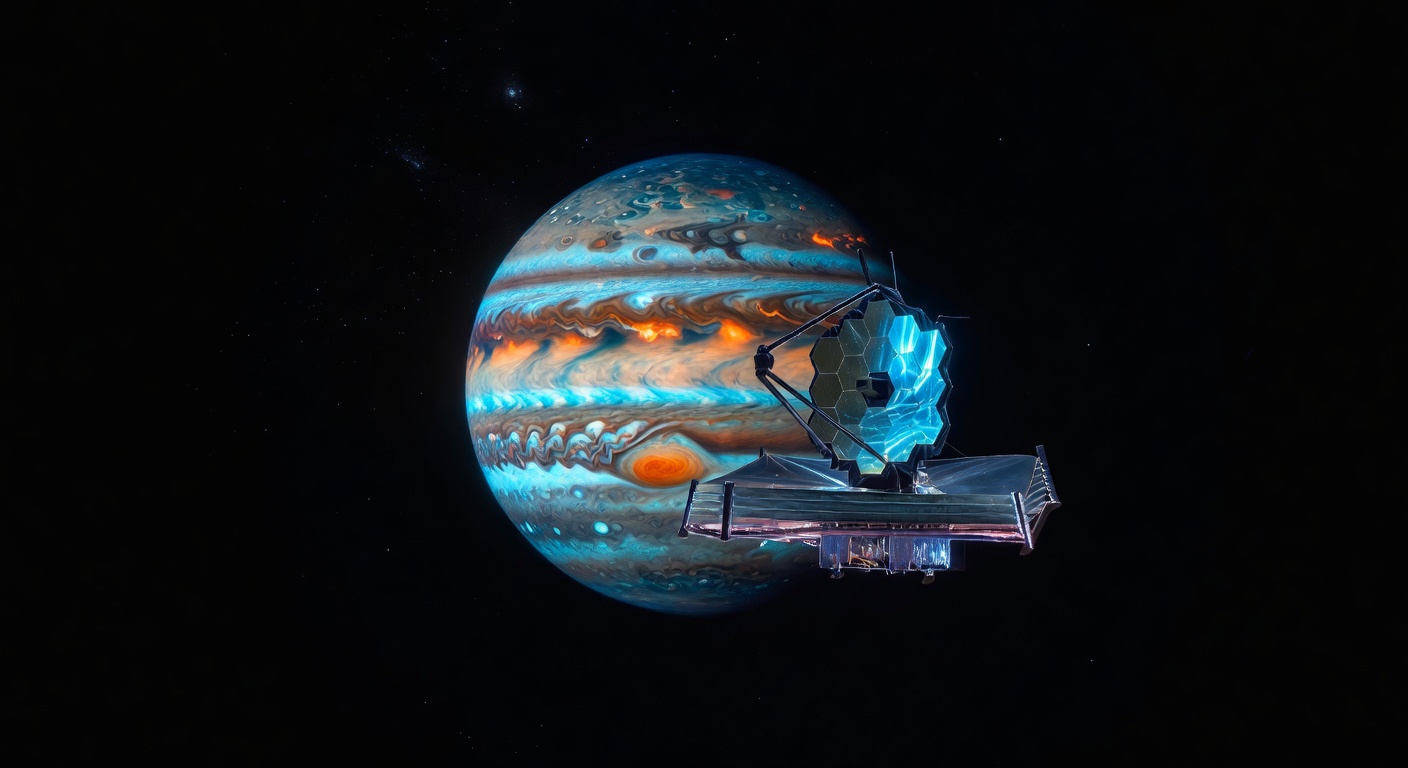
When a Planet Decides to Be Weird
Imagine finding a teenager who's somehow smarter than both their parents combined. That's basically what astronomers just found orbiting a distant red dwarf star, and it's got scientists scratching their heads in the best possible way.
The planet, called TOI-5205 b, is about the same size as Jupiter but it orbits a star that's way smaller and dimmer than our Sun. We're talking about a star that's only 40% as massive as the Sun but somehow managed to host this enormous gas giant right in its backyard. If our solar system worked this way, it would be like finding Jupiter orbiting Mercury.
The Detective Work Gets Interesting
Here's where it gets really cool. When the planet passes in front of its star—what astronomers call a "transit"—it blocks a tiny sliver of light. Using the James Webb Space Telescope, scientists can break that starlight into its component colors, kind of like how a prism splits white light into a rainbow. But instead of just pretty colors, they're looking at the chemical fingerprints of the planet's atmosphere.
This is where things got really strange.
The Backward Atmosphere Mystery
Think about how the universe usually works. Planets form in disks of gas and dust around young stars. Over time, as a planet grows massive enough, it sucks in more and more heavy elements like metals. Generally, the bigger the planet, the heavier its atmosphere tends to be.
TOI-5205 b says "thanks, but no thanks" to this rule.
When researchers looked at its atmosphere, they found it has way fewer heavy elements than Jupiter does. But here's the kicker—it has even fewer heavy elements than its own host star! This is like discovering a child who's less intelligent than their parents but somehow much bigger and stronger. It breaks literally everything we thought we understood about how giant planets should work.
The team even detected methane and hydrogen sulfide in the atmosphere, which added another layer of weirdness to this cosmic puzzle.
So Where Did All the Heavy Stuff Go?
This is where it gets clever. Researchers at the University of Zurich ran computer models of what the planet's interior might look like, and they came up with a wild answer: the heavy elements are probably there—they're just buried deep, deep inside the planet.
Imagine a giant cosmic onion where all the metal-rich layers sank to the core during the planet's formation, while the lighter outer layers stayed on top. The heavy stuff and the lighter atmosphere aren't mixing anymore, which means what we're seeing on the surface is misleading. The whole planet is actually about 100 times richer in metals than its atmosphere suggests.
This is like looking at a rich person's mansion from the outside during a blackout and thinking they're broke because all the lights are off. The wealth is there—you just can't see it.
Why This Matters
This discovery is part of something called the GEMS Survey—that stands for Giant Exoplanets around M dwarf stars. Scientists are basically hunting for these weird outlier planets specifically because they challenge our understanding of planetary birth.
For decades, scientists thought planets formed following pretty predictable patterns. But the universe loves to surprise us. Every planet like TOI-5205 b that we find is like finding evidence that someone else's rule book exists for how nature works in different situations.
The Starspot Problem (Yes, It's a Real Thing)
One more nerdy detail that I actually think is pretty cool: the researchers had to account for starspots on the host star. These are like dark freckles on the star's surface, and they can trick our instruments by messing with the light that passes through the planet's atmosphere.
Think of it like trying to read someone's facial expression through a kaleidoscope—the extra patterns get in the way. The team figured out how to correct for this interference, which makes their measurements way more reliable. This technique could help other astronomers studying planets around active stars get better results too.
What's Next?
This is honestly one of my favorite parts of astronomy as it exists right now. We're not at the stage where we have all the answers anymore. We're finding planets that make us go "wait, that's impossible... but it's right there." That means the next generation of models about how planets form is going to be way more interesting and complex than what we have now.
TOI-5205 b is proof that the universe is still full of surprises, even when we've got billion-dollar space telescopes pointing at it.