
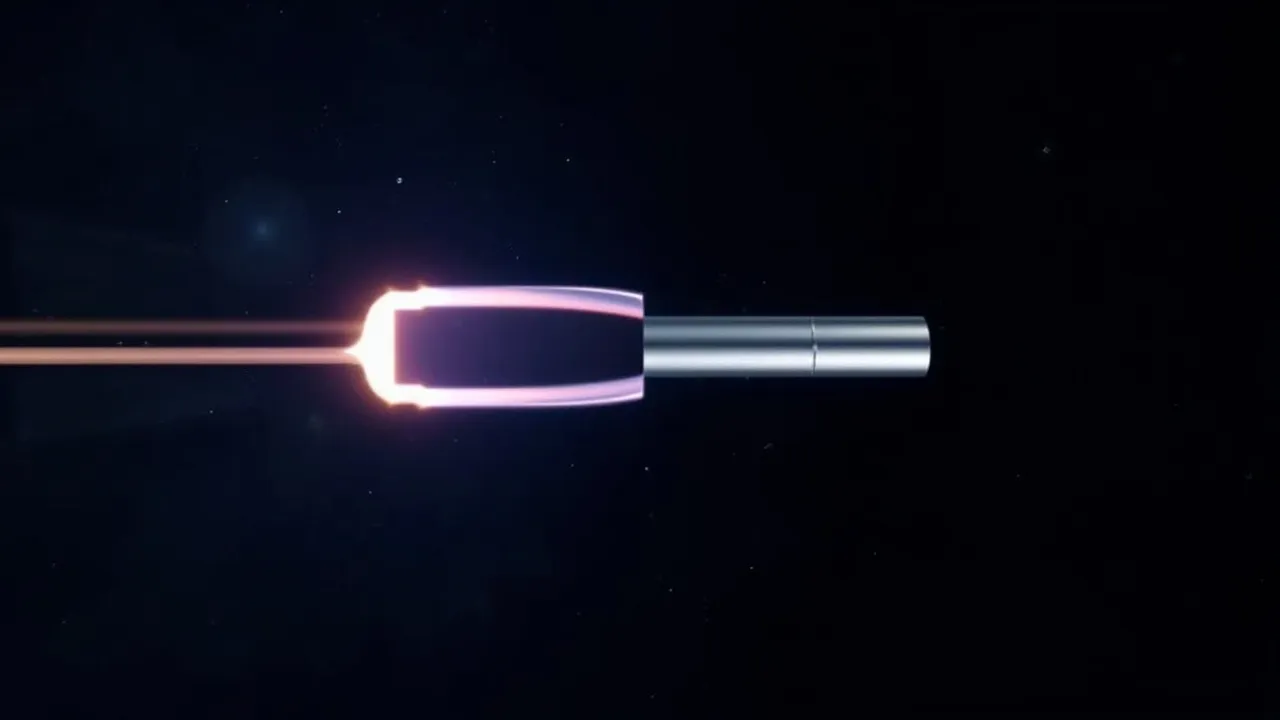
The Dream That Just Won't Die
Okay, I have to admit — I get a little excited every time I hear about someone claiming they've built a reactionless drive. You know, one of those mythical engines that just... pushes itself forward without throwing anything backward. It's the stuff of science fiction posters and late-night "what if" conversations with friends who've had one too many cups of coffee.
But here's the thing about these dreams: physics has a way of being a buzzkill.
A Quick Trip Down Memory Lane
Back in 2001, British engineer Roger Shawyer introduced something called the EmDrive. He claimed it could produce thrust without any propellant at all. Just microwaves bouncing around inside a cone-shaped chamber. No exhaust, no flames, just... thrust?
If that sounds too good to be true, well, that's because it probably was.
Scientists rightfully raised their eyebrows. The whole idea seemed to thumb its nose at the conservation of momentum — one of those fundamental rules that keeps the universe from falling apart into chaos. Shawyer called it the "impossible drive," and the nickname stuck.
For years, though, interesting little signals kept showing up. Even NASA's Eagleworks team reported a potential thrust measurement in 2016. Hope flickered!
Then 2021 happened. Researchers at Dresden University of Technology ran cleaner tests and found... nothing. No thrust. Just experimental noise and wishful thinking. The EmDrive became a cautionary tale about how easy it is to fool yourself when you're looking for something amazing.
But The Dream Lives On
Here's where it gets interesting again.
A company called Exodus Propulsion Technologies has stepped into the spotlight, and they've got a guy named Charles Buhler leading the charge. What's his pedigree? He helped establish the Electrostatics and Surface Physics Laboratory at Kennedy Space Center — you know, the lab that makes sure rockets don't blow up on the launchpad.
Buhler's team claims they've found a "New Force" driven by electric fields. According to their interviews, this force can generate enough thrust to actually counter Earth's gravity. Let me repeat that: counter Earth's gravity.
That's a big deal. That's the kind of claim that makes physicists spit out their coffee.
What's Their Secret Sauce?
Buhler explains it like this: they've discovered that systems with asymmetry in electrostatic pressure or divergent electrostatic fields can generate a non-zero force on an object. Put simply, they're saying electric fields alone might be able to push things around without shooting mass out the back end.
His team — which includes people who've worked at NASA, Blue Origin, and the Air Force — spent decades chasing propellantless drives. For years, their devices produced measly, negligible thrust. But then something changed. With each new iteration, the thrust supposedly got bigger. By 2023, they claim the device generated enough oomph to overcome gravity itself.
As of mid-2026, Buhler says they've run roughly 2,000 vacuum-chamber experiments. Even weirder, he claims the thrust persisted after power was turned off. That's... not how engines are supposed to work.
Why I (Cautiously) Care Anyway
Now, I know what you're thinking. "Didn't we just learn that the EmDrive was a bust? Why should we believe this?"
Fair point. Absolutely fair point.
The history of propellantless drives is basically a graveyard of exciting claims that couldn't survive rigorous testing. And Exodus doesn't have an independent lab yet that's reproduced their results with their own equipment and uncertainty analysis. That's the gold standard, and it's missing.
But here's why I'm not dismissing this completely:
- Buhler's background is legit. This isn't some guy in a garage with a YouTube channel. NASA hired him specifically because he knows his stuff about electrostatics.
- The claims are specific. They're not speaking in vague mystical terms — they're describing experimental conditions and measurable results.
- They're asking for verification. The Alternative Propulsion Energy Conference (APEC), where much of this discussion has happened, is clear that independent replication is the biggest open question.
The Reality Check
I want to be really clear about something: this is almost certainly nothing. The odds are heavily against any propellantless drive claim being real. Physics has been tested billions of times, and the conservation of momentum isn't some random rule — it's woven into how the universe operates at a fundamental level.
But here's the thing about science: it's supposed to be skeptical, not dismissive. The universe is weird, and sometimes we find things we didn't expect.
So what should you do with this information? Stay curious, but keep your champagne on ice. The "improbable engine" might be improbable, but until independent researchers with clean equipment tell us otherwise, it's worth keeping an eye on.
Just maybe don't sell your car yet.
What do you think? Is this the real deal, or another chapter in the long history of wishful propulsion? Drop a comment below — I genuinely want to hear your take!
Source: Popular Mechanics