
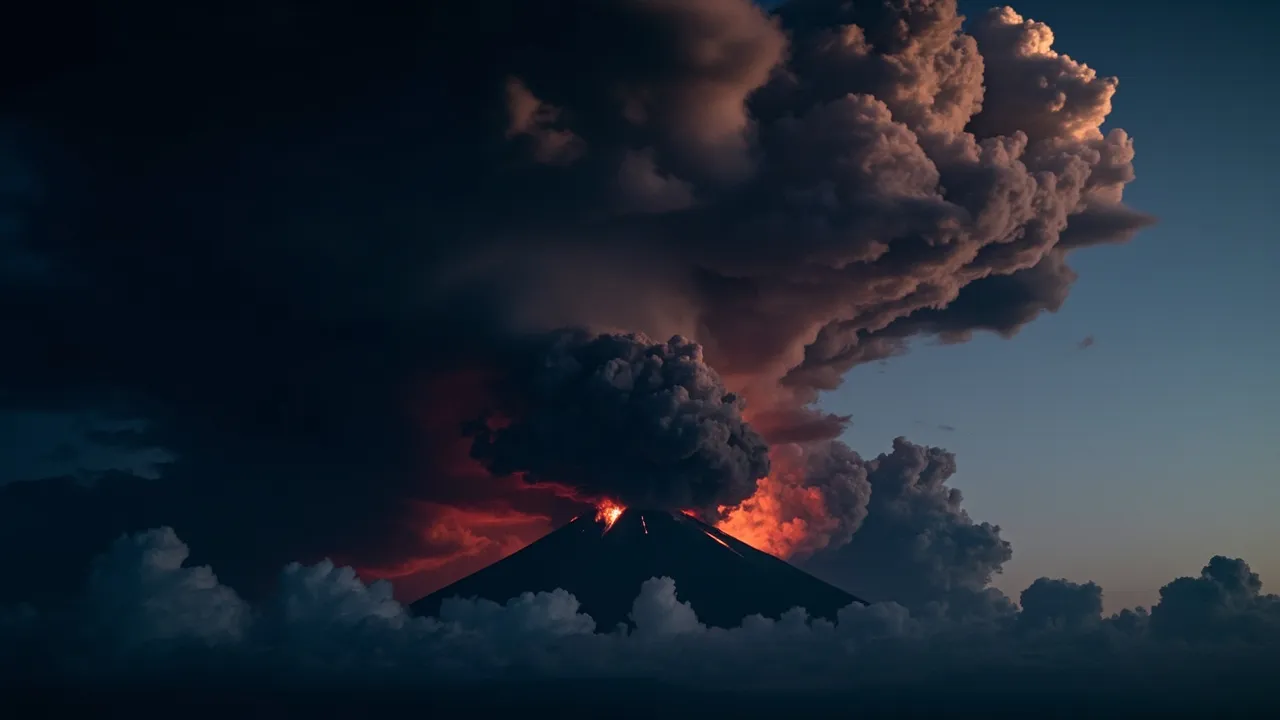
Okay, friends, let's talk about something that happened a couple of weeks ago that honestly made me sit up and pay attention. You know how sometimes you hear about a volcano erupting somewhere far away and it feels like, "Oh cool, nature stuff, not my problem"? Well, this one might make you think twice.
Anak Krakatau — which translates to "Child of Krakatau" and honestly, what a name — is a relatively small volcano sandwiched between the Indonesian islands of Java and Sumatra. And by small, I mean it doesn't look like much. It's not one of those towering, menacing peaks you'd see in a disaster movie. But don't let the size fool you. This little guy has serious firepower.
The Eruption That Wouldn't Quit
So here's what happened. In early September, Anak Krakatau went into what scientists are calling a prolonged explosive phase. We're talking more than 24 hours of continuous activity — not just your typical rumbling and puffing, but full-on explosive bursts shooting gas and ash into the atmosphere.
The really wild part? Satellites captured the whole thing from space. Imagine looking down from orbit and seeing a bright white plume of volcanic gas punching through the clouds, with a darker brown cloud of ash spreading out beneath it. NASA and USGS satellites got some incredible footage of this event.
How High Did It Go?
Let me put this into perspective. The ash reached altitudes of up to 15,000 meters — that's nearly 50,000 feet. Commercial airplanes typically cruise at around 35,000 feet. So this ash cloud was reaching heights where planes actually fly. Yikes.
Different directions got different doses of this stuff. To the east of the volcano, ash climbed to about 20,000 feet. But to the west? A whopping 50,000 feet. That's a seriously tall column of volcanic material punching into the sky.
The Ripple Effects Were Massive
Now, here's where this becomes a story for all of us, not just those living in Indonesia. All that ash floating around in the atmosphere? It forced the temporary closure of eight airports. Eight! We're talking about nearly 3,000 flights disrupted. That's a lot of people whose travel plans got absolutely wrecked.
And the ash didn't just stay up in the sky — it came down. Communities east of the volcano, including Jakarta (you know, that city of over 30 million people), got covered in volcanic ash. The Indonesian Humanitarian Coordination Platform reported that air quality took a serious nosedive in several areas.
A Different Kind of Bad Air
Here's something I found really interesting. Volcanic ash and the smoke from wildfires or peatland fires? They're not the same thing, even though both mess with air quality. Volcanic ash has different particle properties, behaves differently in the atmosphere, and honestly requires different precautions.
So if you were thinking, "Oh, this is just like when there's wildfire smoke," — not quite. The advice for protecting yourself is different. The health impacts can be different too. Volcanic ash can irritate your respiratory system, your eyes, and your skin. Not a fun time.
The Good News (For Now)
By September 6th, the sustained explosive activity started to weaken. The volcano kind of settled back into its more typical pattern — what scientists call Strombolian eruptions. These are the periodic bursts you might see in videos, where the volcano shoots out lava and volcanic material in little bursts rather than one massive continuous explosion.
The airports reopened by September 8th, which was definitely a relief for anyone trying to get somewhere.
But Don't Get Too Comfortable
Here's the thing that sticks with me about this story. Even though things calmed down, Anak Krakatau remained at the second-highest alert level on Indonesia's volcanic warning scale. And it's been there since early July. That's months of elevated concern.
This little volcano is being watched very, very carefully. Because the thing about Anak Krakatau is that it has the potential to produce much more hazardous activity than what we saw in September. This eruption was significant, but it's not the worst this volcano is capable of.
Living near a volcano means living with constant awareness. It's a reminder that these natural wonders don't care about our schedules, our flights, or our plans. They do their thing, and we adapt.
Anyway, I hope this gave you a little glimpse into what happened with Anak Krakatau and why it matters. Sometimes the most unassuming things are the most powerful. Stay curious, friends!