
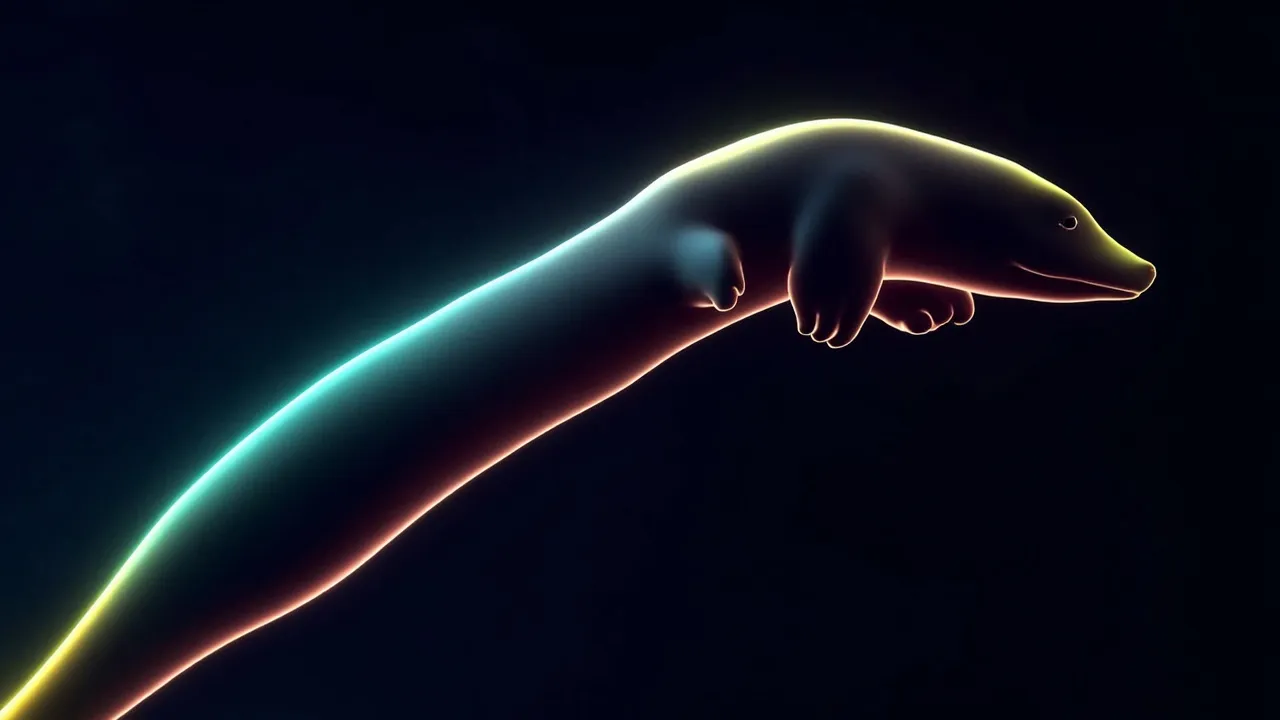
Here's something wild to think about: the next time you're sipping water through a straw (even upside down, because why not), you can thank an ancient, otter-like creature that lived 165 million years ago.
Researchers recently identified a fossil they call Megacauda sungei, and honestly, it's becoming one of my favorite prehistoric animals. This little guy was only about half a meter long—roughly the size of a large house cat—but he (or she) was a heavyweight among early mammal relatives during the age of dinosaurs.
The Soft Palate: A Game-Changer Nobody Talks About
Now, here's where things get really interesting. The researchers weren't just studying Megacauda sungei because it was a cute otter-thing that swam in Jurassic lakes. No, they were studying it because of something far more remarkable: evidence of a soft palate.
What on earth is a soft palate, you ask? Great question. It's that tissue at the back of your mouth that separates your nasal passages from your throat. And trust me, it's kind of a big deal.
Here's why. Many animals—crocodiles, for instance—have to do these awkward head-bobbing, jerking motions to swallow food. They need gravity to help them out. But mammals? We've got this incredible hyoid apparatus (a fancy word for throat bones) that lets us swallow while breathing at the same time.
Think about that for a second. You can drink milk while simultaneously breathing. Human babies can nurse. These aren't just convenient party tricks—they're evolutionary superpowers.
Why This Matters for Brain Development
The connection to brain development might seem like a stretch, but hang with me here.
When mammals developed the ability to swallow efficiently while breathing, something magical happened: we could finally nurse our young properly. No more choking risks. No more liquid going up into the nasal passages. Just efficient, nutritious feeding.
And this is huge because raising helpless, demanding babies who need constant milk is metabolically expensive. It requires parents to stick around, to invest time and energy. That parental investment is what eventually allowed mammals to develop larger brains over generations.
Without this adaptation? Well, you might not be reading this article. The human brain—especially that big prefrontal cortex of yours—might never have happened.
Thomas Martin from the University of Bonn put it bluntly: "The soft palate and the shaping of the oral cavity and pharynx are directly linked to the evolution of mammals."
No pressure, little Megacauda sungei.
Meet the Jurassic Swimmer
So what did this groundbreaking creature actually look like? Based on detailed CT scans of the fossil, scientists reconstructed a short-furred animal with a broad, flattened tail—basically built for paddling through water.
It had some seriously cool teeth, too. Backward-curving cusps for gripping slippery fish, plus these unusual three-rooted canine teeth that surprised the research team. This little predator was built to hunt in water, using its front legs for propulsion while its tail did the undulating work.
The researchers think it could change direction quickly using its hind legs. Basically, it was the Jurassic equivalent of a highly efficient swimming machine.
And here's the really wild part: this is the earliest evidence of an aquatic lifestyle in mammals (or our close relatives, at least).
Small in a World of Giants
It's humbling to put things in perspective. Megacauda sungei was maybe two kilograms of fury, living in a world dominated by enormous dinosaurs. Most of its mammalian relatives were tiny—some weighing just a few grams.
Yet this little creature already showed adaptations that would take millions more years to fully blossom in modern mammals. The soft palate evidence in a 165-million-year-old fossil? That's not supposed to be there yet.
The fossil itself was found in Inner Mongolia and sat in a museum collection for years before three scientists from different continents happened to examine it together and recognized what they had.
My Take
I love stories like this because they remind us that evolution isn't a straight line from "primitive" to "advanced." It's messy, experimental, and full of creatures doing interesting things long before they became the norm.
Megacauda sungei wasn't our direct ancestor, but it was part of the great mammalian experiment happening alongside the dinosaurs. It was trying out solutions to problems, and some of those solutions—swallowing while breathing, growing bigger, nursing young—stuck around because they worked.
So the next time you enjoy that cup of coffee (or breastfeed your baby, or simply breathe while eating a sandwich), give a tiny Jurassic thank-you to our ancient, otter-like relatives. Without them, we quite literally wouldn't be here.
Source: ScienceDaily, "This tiny jurassic predator helped pave the way for the human brain," https://www.sciencedaily.com/releases/2026/10/261012185005.htm