
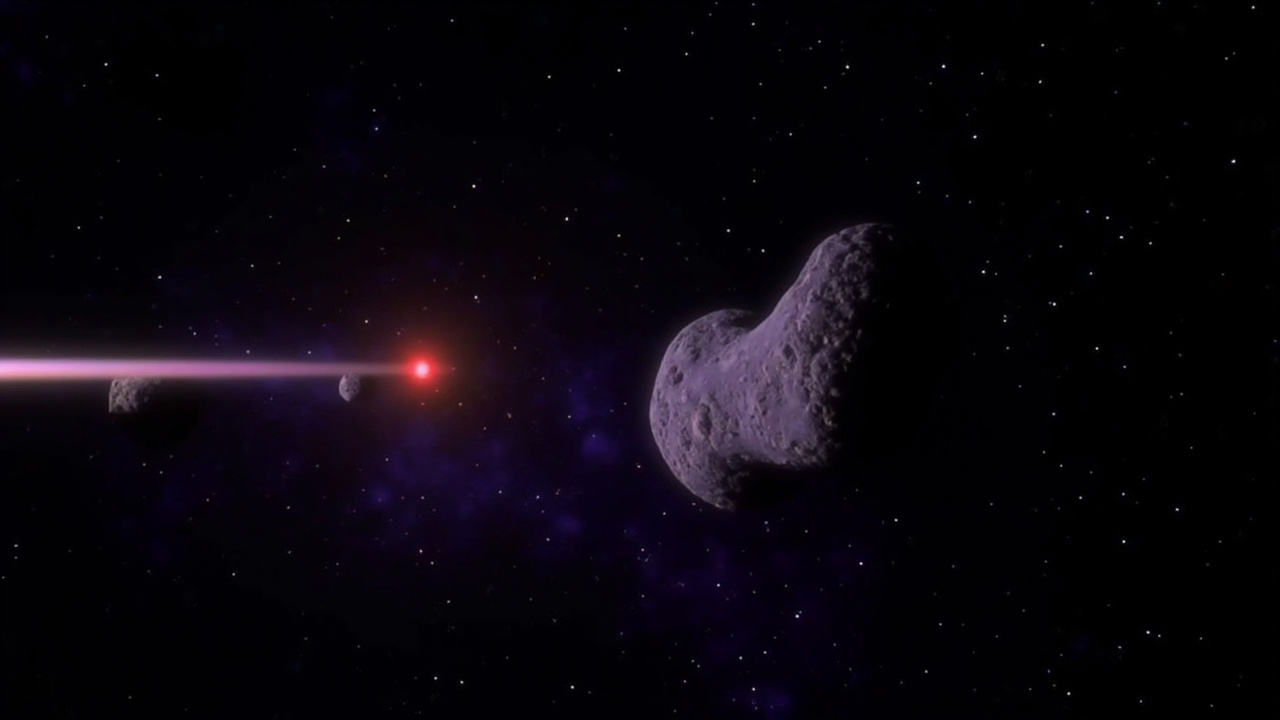
So here's a fun question: what happens when you throw two space rocks together, give them a few hundred million years to chill, and then send a spacecraft zooming past at 30,000 miles per hour to snap some photos?
You get Donaldjohanson, apparently. And let me tell you, this little guy is weird.
Meet the Space Peanut
The Lucy spacecraft (yes, named after the famous fossil — because NASA scientists apparently have a sense of humor about their naming conventions) recently completed a flyby of an asteroid that's officially designated as something long and boring, but unofficially looks like... well, a peanut. Two lumpy lobes stuck together with a narrow neck in between, just drifting through the main asteroid belt like it has somewhere to be.
The wild part? It wasn't always this shape. Scientists now think Donaldjohanson formed when two fragments from an ancient collision drifted together and merged under their own gravity somewhere around 155 million years ago. That's relatively recent in cosmic terms — dinosaurs were still roaming Earth when this thing was first putting itself together.
A Wobbling Top in Space
Here's where things get really interesting. Most objects in space spin in a pretty straightforward way — they rotate around a single axis, like a spinning basketball on someone's finger. Donaldjohanson said "nah, I'm different" and decided to wobble instead.
Instead of just spinning nicely on one axis, this asteroid does something called "wobbling" — it tumbles end-over-end every 10.5 days while simultaneously rocking back and forth around its long axis on a 26.5-day cycle. Imagine if you tried to spin a peanut and it decided to act like a tipsy top instead. That's basically what's happening here.
The scientists have a name for this behavior: "complex rotation." But honestly, I think we should call it what it is — the asteroid equivalent of walking and chewing gum at the same time.
When Sunlight Plays the Long Game
So why is this space peanut wobbling instead of spinning neatly? The answer involves something called the YORP effect, and honestly, it's one of those cosmic stories that makes you appreciate just how patient the universe is.
Here's how it works: sunlight warms up an asteroid's surface, and that warmth eventually radiates back into space as infrared radiation. That sounds totally harmless, right? But here's the thing — that radiation acts like a tiny rocket engine pushing outward. Over millions of years, these itty-bitty forces add up.
Now, because Donaldjohanson has such an irregular, lumpy shape, those tiny forces don't cancel out the way they would on a nice spherical object. Instead, they create a twisting effect that gradually changes how the asteroid rotates. Scientists estimate that this asteroid was spinning at least ten times faster when it first formed, but over the last 20 to 60 million years, YORP has been steadily slowing it down.
The same process worked in reverse on other asteroids like Bennu and Ryugu — those guys were probably spinning much slower in the past before YORP kicked them into overdrive. Bennu now completes a rotation every four hours, which is frankly exhausting to think about.
Ancient Water? On This Dry-Looking Rock?
This is the part that really got me. When Lucy zipped past Donaldjohanson at 30,000 miles per hour (try not to think about how fast that is too hard), its instruments detected iron-rich clay minerals on the surface. These minerals can only form in the presence of liquid water.
But here's the twist: the water exposure was probably pretty brief. Scientists know this because prolonged water interaction tends to replace iron in clay minerals with other elements like magnesium. The clays on Donaldjohanson are still iron-rich, which means the water came and went relatively quickly.
Compare that to Bennu and Ryugu, which both have magnesium-rich clays indicating much longer periods of water exposure — possibly millions of years while they were still part of larger parent bodies. The fact that Donaldjohanson is so different suggests these asteroids might have formed in different places or at different times before eventually migrating to where they are now.
Why Should You Care?
Look, I get it — asteroids aren't exactly the most glamorous space objects. They don't have the mystique of Mars or the stunning rings of Saturn. But here's the thing: these rocky time capsules are basically leftover building blocks from when our solar system was forming. Every time we study one up close, we learn something new about where we came from.
Plus, there's something genuinely delightful about the fact that a lumpy, peanut-shaped space rock has been wobbling through the asteroid belt for 155 million years, shaped by ancient collisions, gentle sunlight, and brief encounters with water. It makes the universe feel a little more quirky, a little more intimate.
The Lucy mission is going to keep going, by the way — it's eventually headed to visit the Trojan asteroids that share Jupiter's orbit. But I'll be keeping an eye on what else this little spacecraft discovers about our chaotic, beautiful cosmic neighborhood.
Sometimes the smallest objects tell the biggest stories.