
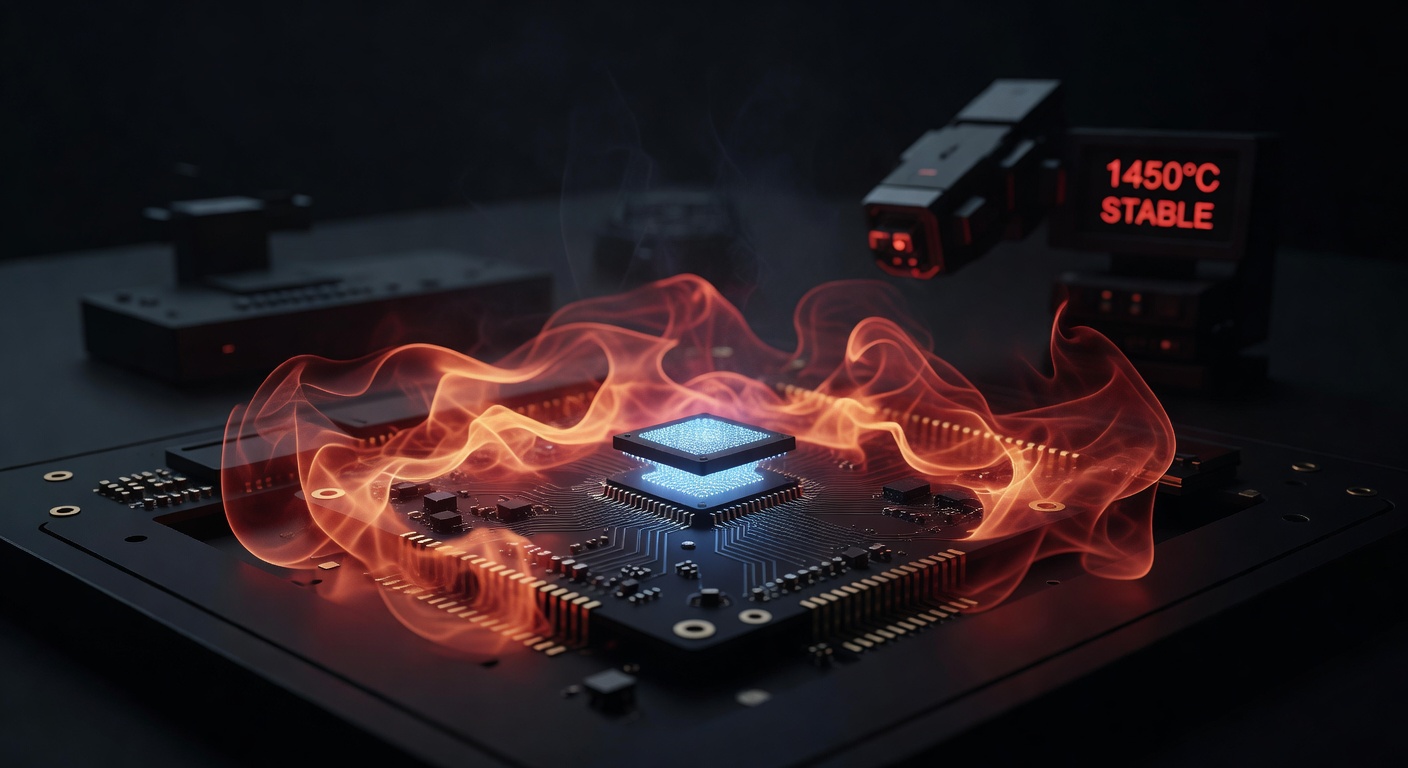
The Heat Problem Nobody Could Solve
Here's something wild: almost every piece of technology you own has a hard limit. Your phone, your laptop, the satellites orbiting Earth—they all start to freak out and fail around 200°C (about 390°F). That's roughly the temperature of a pizza oven.
For decades, this has been the unsolved problem in electronics. Engineers kept hitting this thermal ceiling like a bird flying into glass, and nobody could figure out how to break through.
But what if I told you that's just changed? Dramatically.
Meet the Memristor That Refuses to Die
Researchers at USC have built something that sounds like science fiction: a teeny-tiny memory chip that works perfectly at 700°C (1300°F). That's hotter than molten lava. That's hotter than the surface of Venus. And the chip? It just keeps humming along.
This device is called a memristor—basically a nanoscale component that can store data and run calculations. Think of it like the world's tiniest, toughest computer brain.
The secret sauce? It's built from three layers: tungsten on top (the metal with the highest melting point), a ceramic material in the middle, and graphene on the bottom. Graphene is basically a single layer of carbon atoms arranged in a honeycomb pattern, and it's absurdly strong.
How It Accidentally Became Revolutionary
Here's my favorite part of this story: it wasn't supposed to work this way.
Joshua Yang, the lead researcher, was actually trying to build something completely different. It didn't work. But then something strange happened—something better happened. It was one of those "happy accidents" that sometimes changes everything.
When they dug into why it worked, they discovered something elegant at the atomic level. Normally, extreme heat causes metal atoms to wander through a chip like confused tourists, eventually creating a short circuit. But graphene is like a bouncers at a club for tungsten atoms—they show up, the graphene basically says "nope," and they wander off somewhere else.
No bridge, no short circuit, no failure. The device just keeps working.
Why This Actually Matters
You might be thinking, "Cool science experiment, but... when will this affect my life?" Fair question. Here are some genuinely game-changing applications:
Space Exploration: Venus has been the graveyard of landers for decades because they can't handle the heat. This chip could finally let us explore our neighboring planet properly.
Geothermal Energy: Deep underground, where geothermal energy comes from, it's scorching. A chip that can survive there could unlock cleaner energy production.
Nuclear and Fusion Reactors: These need electronics that can handle extreme conditions. Suddenly, that's possible.
Your Car: Even everyday tech gets hot. A chip rated for 700°C would be incredibly robust when your car's engine compartment hits 125°C.
And honestly? There's probably stuff we haven't even thought of yet that becomes possible once we can use electronics in environments that were previously impossible.
The AI Connection
You noticed the original article mentioned AI. Here's my take: this isn't a direct "AI breakthrough" in the training-models sense. But it is groundbreaking because heat management is a massive constraint in AI infrastructure. Data centers get hot. Processing billions of computations generates serious thermal stress. If we can make chips that handle extreme temperatures better, we can push AI computing in new directions—maybe more efficient, maybe more powerful.
What Comes Next?
The team didn't even test the upper limit. 700°C was just as hot as their equipment could go. The researchers suspect it goes higher—possibly much higher.
They've also figured out the mechanism well enough that they can probably identify other material combinations that work the same way. That's crucial for scaling this from "cool lab demo" to "actual industrial production."
The Bottom Line
This is one of those discoveries that feels small (it's a tiny chip!) but could be genuinely transformative. For generations, engineers have accepted that heat was an immutable limit. Someone just proved that's not true.
And the best part? It happened partly by accident, which reminds us that sometimes the biggest breakthroughs come from being willing to investigate the unexpected.
Source: https://www.sciencedaily.com/releases/2026/04/260406192904.htm