
The Little Engine That Could (Literally Go to Mars)
Okay, I need to tell you about something that's genuinely got me excited this week, because it feels like the kind of breakthrough that doesn't get enough attention.
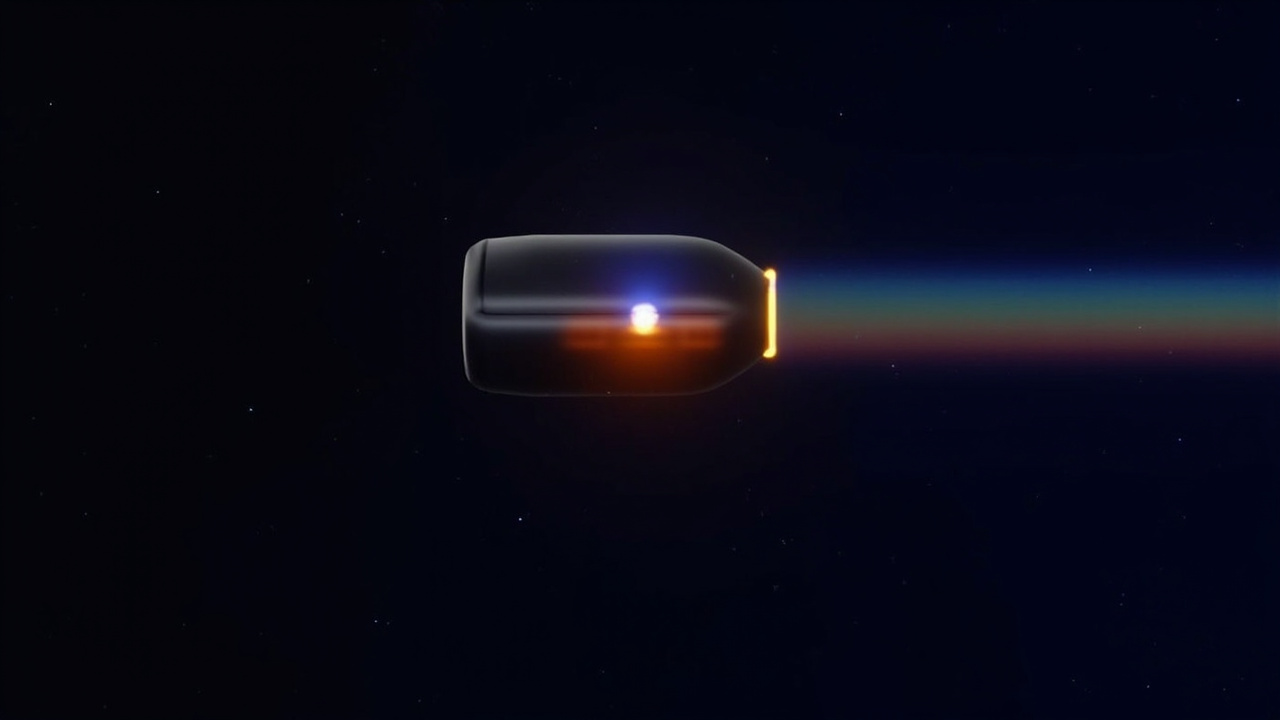
Scientists at MIT have developed a propulsion system that could let tiny satellites — we're talking about spacecraft no bigger than a briefcase — travel all the way to Mars. Not orbit Earth. Not circle the Moon. Mars.
How? By solving a problem that space engineers have struggled with for decades.
Two Worlds, One Fuel
Here's the deal: space missions typically need two different kinds of propulsion. You've got chemical thrusters, which are like the sprinter of rocket engines — they deliver big bursts of power quickly. Perfect for escaping Earth's gravity, making sudden course corrections, or braking into orbit around another planet.
Then you've got electric thrusters, which are more like marathon runners. They can't compete with chemical rockets on raw power, but they're incredibly fuel-efficient. They can push a spacecraft along for years using barely any propellant.
The problem? These two systems have always required separate fuels, separate tanks, and separate everything. For small satellites already working with tiny budgets and minimal space, carrying two different propulsion systems just wasn't practical.
Until now.
The Magic of One Propellant
A team at MIT, led by former postdoc Amelia Bruno, figured out how to run both types of engines on the exact same fuel. Not similar fuels — the same fuel from the same tank.
The key was discovering that a "green monopropellant" called ASCENT (developed by the U.S. Air Force as a safer alternative to the highly toxic hydrazine) could power miniature electric thrusters called electrospray thrusters.
"These tiny thrusters are about the size of a dime," Bruno explains. "They use electric fields to charge particles in the liquid propellant and shoot them into space, creating thrust. And it turns out ASCENT works perfectly for this."
Why This Matters So Much
Let me break down why I'm genuinely excited about this:
Small satellites are cheap. Like, dramatically cheaper than traditional spacecraft. We're talking orders of magnitude difference in cost. But they've been limited to Earth orbit because they couldn't carry the fuel needed for long-distance travel.
The flexibility is game-changing. Imagine a tiny spacecraft that can cruise slowly to the asteroid belt using its electric thrusters (consuming barely any fuel), then switch to chemical mode to quickly maneuver when it spots something interesting. All using the same tank.
It's safer. Traditional spacecraft fuels like hydrazine are so toxic they require elaborate protective equipment. ASCENT is much friendlier to work with, which means smaller teams can actually build and launch these systems.
What's Next?
The MIT team is currently working with NASA on something called the Green Propulsion Dual Mode mission. It'll be a CubeSat (basically a standardized small satellite format) equipped with both types of thrusters, all drawing from a single fuel source.
If the mission goes well, we could see pocket-sized spacecraft doing real interplanetary science — orbiting Mars, studying asteroids, maybe even doing reconnaissance for future human missions.
"We could send CubeSats to Mars, or the asteroid belt," says Paulo Lozano, a professor at MIT who worked on the study. "You could have a lot more flexibility to do a lot more things."
My Take
Here's what really gets me about this: space exploration has always been constrained by cost. We can only launch so many big, expensive missions before the budget runs out.
But what if we could send dozens of tiny spacecraft instead? What if a university team or a startup could afford to send their own little probe to Mars?
This technology won't replace the massive science missions we're used to — the Webb Space Telescopes and Perseverance rovers of the world. But it could complement them beautifully. More eyes on the sky, more data, more exploration — all because we figured out how to combine two rocket engines into one efficient package.
Sometimes the coolest breakthroughs aren't the biggest ones. Sometimes they're the smallest engines that end up taking us the farthest.
Source: MIT's new spacecraft engine could send tiny satellites to Mars - Science Daily