
Okay, confession time: I used to think ice was boring. Frozen water? Groundbreaking (pun absolutely intended). But lately, I've been falling down a rabbit hole of ice research, and wow — everything I thought I knew was wrong. There isn't just ONE kind of ice. There are DOZENS. And now, scientists have discovered another one that's so extreme, it defies imagination.
Let me introduce you to hexagonal close-packed ice, or hcp ice for short. (Yeah, the naming could use some work.)
Wait, There Are Different Types of Ice?
Here's the wild thing nobody tells you in school: when scientists talk about ice, they're usually thinking about good old "Ice I" — the hexagonal crystals that make up the ice cubes in your drink. But under different conditions of temperature and pressure, water can arrange itself into crystal structures that look completely different.
Scientists have now catalogued ice all the way from Ice I through Ice XXII, and each one forms under increasingly bonkers conditions. We're talking pressures millions of times higher than what you feel at the beach, and temperatures that would make your oven jealous.
The newest kid on the block? Hcp ice, which might officially become Ice XXIII if the scientific community gives it the thumbs up. And honestly, this one might be the most fascinating of all.
What Makes This Ice So Special?
Picture a block of ice in your mind. Got it? Now forget everything about that image, because hcp ice is nothing like what you picturing.
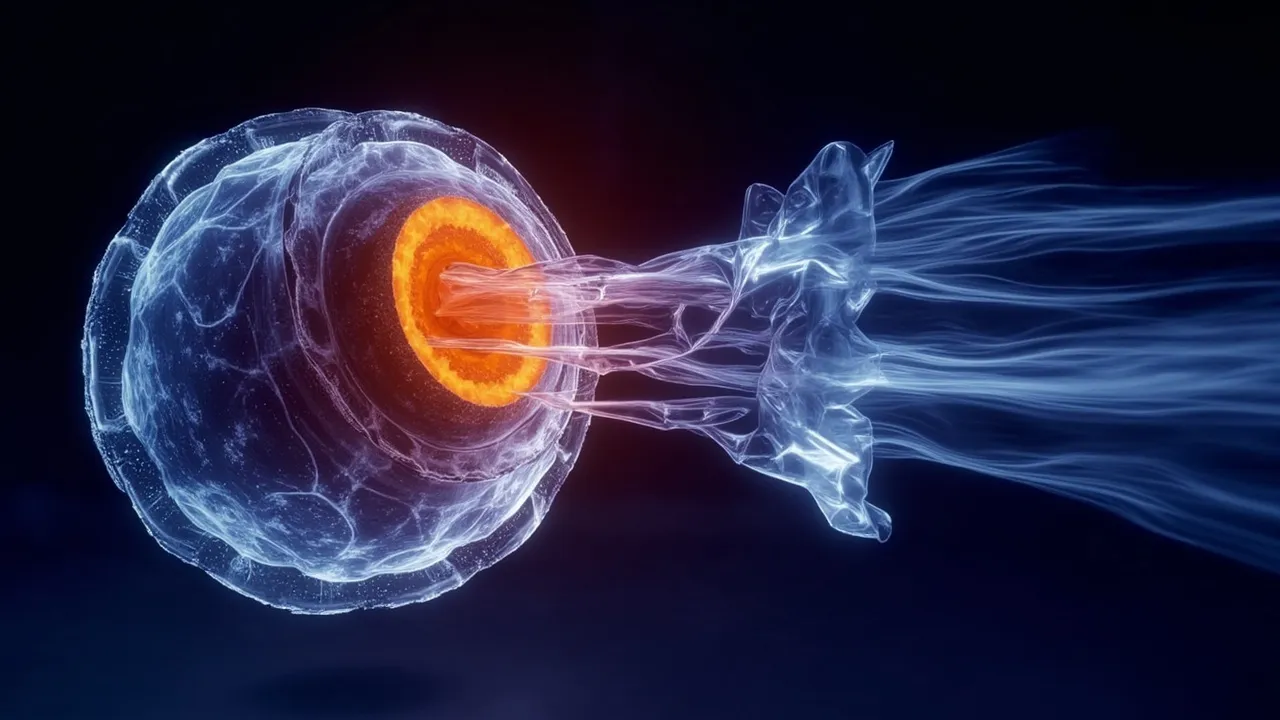
This is what's called superionic ice, and it's honestly one of the most mind-bending substances I've ever read about. Here's how it works: in superionic ice, the oxygen atoms lock themselves into a rigid crystal structure — kind of like the bars of a cage. But the hydrogen atoms? They're free to bounce around inside that cage like hyperactive kids at a birthday party.
Here's where it gets really interesting: those wandering hydrogen atoms carry an electrical charge. That means superionic ice isn't just some exotic curiosity — it's actually a conductor, like a wire carrying electricity.
Scientists had theorized superionic ice existed for decades before they finally created it in a lab back in 2019. That first version, now called Ice XVIII, has oxygen arranged in what's called a face-centered cubic (fcc) pattern. Think of it like stacking oranges in a grocery store — nice and orderly.
But the new hcp ice that Forestier and his team discovered? It's a hexagonal arrangement, which is different. And it emerges when you push the conditions even further, cranking up the pressure to nearly 2 million times Earth's atmospheric pressure at sea level, and heating things up to temperatures around 2,630 Kelvin (that's about 4,280 degrees Fahrenheit — hot enough to melt many types of steel).
How Did They Even Find This?
I love imagining the setup for this experiment. The team at France's Atomic Energy and Alternative Energies Commission (CEA) trapped tiny teeny samples of water between two diamond tips — like squeezing a droplet between two of the hardest materials on Earth.
They used laser-absorbing diamond layers and probed the samples with powerful X-ray beams at a facility in Grenoble, France. Then they just... turned up the heat and pressure. And watched.
At lower pressures, they saw the expected fcc superionic ice forming. But as they pushed further — we're talking pressures exceeding 200 gigapascals — the hcp structure started taking over. By the end of the experiment, the hcp ice was dominating completely, with those fcc peaks nearly vanishing.
It's like watching a scientific transformation in real-time, and honestly? That sounds like one of the coolest experiments imaginable.
Why Should You Care About a Fancy Type of Ice?
Here's where this gets really exciting (at least for space nerds like me): this discovery might help explain some mysterious things about our outer solar system.
Uranus and Neptune are called the "ice giants," but don't picture them as frozen planets. Deep inside these worlds, water, ammonia, and methane exist as incredibly hot, dense fluids — what astronomers casually lump together as "ices" because they behave similarly under extreme conditions.
When Voyager 2 flew past these planets decades ago, it measured something strange: their magnetic fields are wildly out of whack. Earth's magnetic field is pretty well aligned with our planet's rotation axis. But Uranus and Neptune? Their magnetic fields are tilted at crazy angles and asymmetric in ways that don't match what we'd expect from their interiors.
Scientists have long suspected that a thin layer of electrically conducting fluid somewhere in these planets generates those oddball fields. And superionic ice? That's looking like the prime suspect for what surrounds that layer.
The new hcp ice discovery is especially intriguing because it appears to form at even deeper, more extreme conditions than fcc ice. That means deep within these ice giants, hcp ice might be the dominant form — which could completely change how scientists model the interiors of these distant worlds.
As the researchers themselves put it, this discovery "could have important implications for the stratification and dynamics of their superionic mantles."
The Universe Keeps Getting Weirder
I don't know about you, but I find something deeply satisfying about discoveries like this. We're not just cataloguing the universe anymore — we're understanding its nuances, its layers, its hidden complexities.
A few decades ago, we didn't even know superionic ice existed. Now we're discovering that there are different varieties of it, and that these varieties might shape the behavior of entire planets billions of miles away.
Every time I read about discoveries like hcp ice, I'm reminded that the universe isn't just stranger than we imagine — it's probably stranger than we can imagine. And that's pretty wonderful, isn't it?
The next time you pour yourself a glass of water with regular old Ice I, take a moment to appreciate that somewhere out there, water might exist in forms that would make your freezer look like a desert.
Source: https://www.popularmechanics.com/science/a73780491/new-ice-neptune