
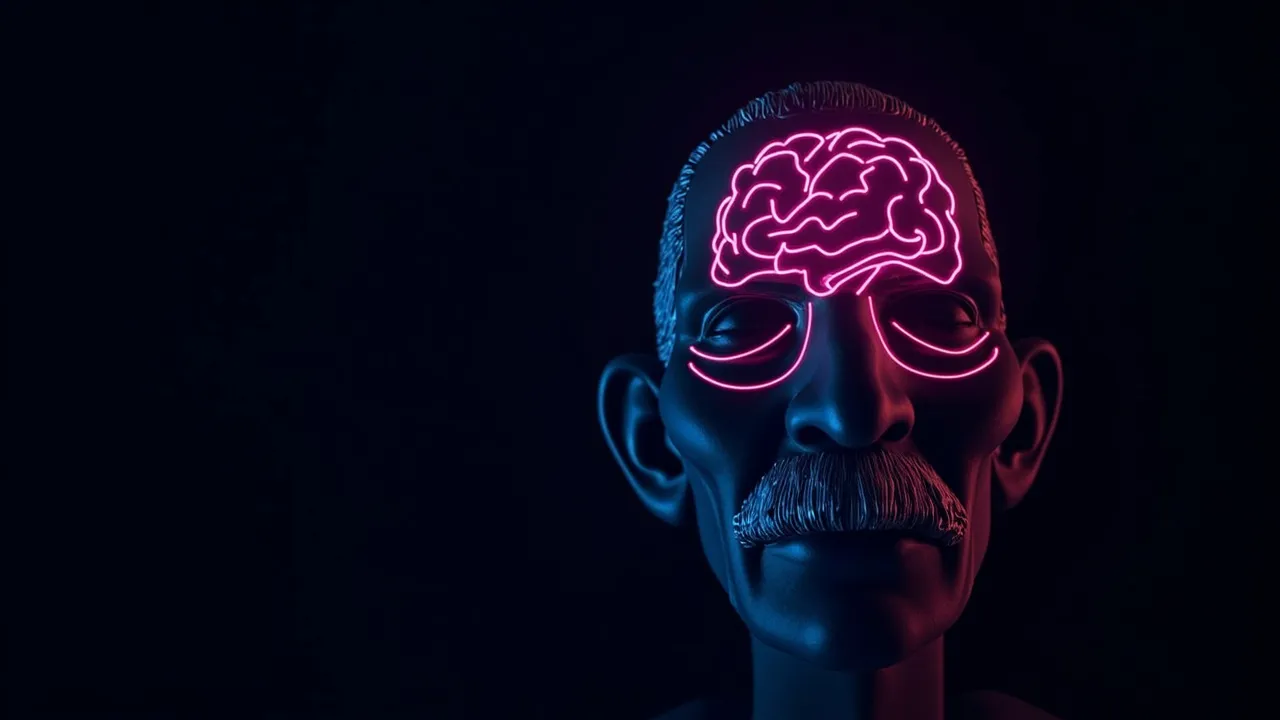
The Brain: A Fortune Teller in Your Skull?
Have you ever walked into a room and immediately "felt" that someone was annoyed with you, even though they hadn't said a word? Or maybe you've found yourself repeating the same mistakes in your relationships, thinking, "Why do I always end up with people who are hard to talk to?"
For a long time, we thought these were just personality quirks or "bad luck." But a fascinating new study suggests that these patterns are actually hard-wired into how our brains function. And the wildest part? Sigmund Freud—the father of psychoanalysis—was basically on the right track over 130 years ago.
The "Prediction Machine" Theory
In the world of modern neuroscience, there is a massive concept called the prediction paradigm.
Most people think the brain is like a camera: light hits the eye, the brain processes it, and you see the world. But neuroscientists say that's not quite right. Instead, your brain is more like a prediction machine.
Instead of waiting for information to come in, your brain is constantly guessing what’s going to happen next. It uses your past experiences to create a "blueprint" of reality. When your senses (sight, sound, touch) match your prediction, everything feels smooth. But when there’s a mismatch—a "prediction error"—your brain has to work hard to figure out what went wrong.
Freud’s "Projection" vs. Your Brain’s "Predictions"
This is where it gets really cool. Freud talked about something called projection. You’ve probably heard this in movies: it’s when you attribute your own hidden feelings to someone else. If you're feeling grumpy, you might walk into a room and think, "Everyone here looks so moody!"
The researchers behind this new study (published in the journal Entropy) realized that Freud’s idea of projection is almost exactly what neuroscience describes as a prediction error.
When your brain has a very strong "prediction" (based on your past), it can actually warp how you see the present. If you’ve experienced a lot of rejection in the past, your brain develops a "rejection prediction." Now, when a friend gives you a slightly short text message, your brain doesn't see it as "they're busy"; it sees it as "they're mad at me!"
Your brain isn't just observing reality; it is actively shaping it to fit what it expects to see.
Why Do We Get Stuck in Bad Habits?
This explains one of the biggest mysteries of human behavior: Why do we repeat the same mistakes?
Whether it's a bad habit, a toxic relationship pattern, or a constant feeling of anxiety, our brains love stability. In neuroscience terms, your brain wants to reduce "uncertainty."
Sometimes, it is actually easier for your brain to stick to a wrong prediction than to deal with the chaos of a new one. This is why people can get stuck in "rigid" mental models. If your brain has decided that "the world is a scary place," it will work overtime to find evidence that proves it, even when things are actually going great!
My Take: The Mind is a Loop
Personally, I find this absolutely fascinating. It bridges the gap between the "soft" science of psychology (how we feel) and the "hard" science of neuroscience (how neurons fire).
It means that our "personality" is essentially a collection of highly trained prediction models. The good news? Since these models are built on experience, they can be updated! We can "re-train" our prediction machines through new experiences, therapy, and mindfulness, teaching our brains that the world isn't quite as predictable (or as scary) as they thought.
So, next time you feel like you're "reading someone's mind," just remember: your brain might just be making a very educated guess!
SOURCE: https://www.sciencedaily.com/releases/2026/10/261018084028.htm