
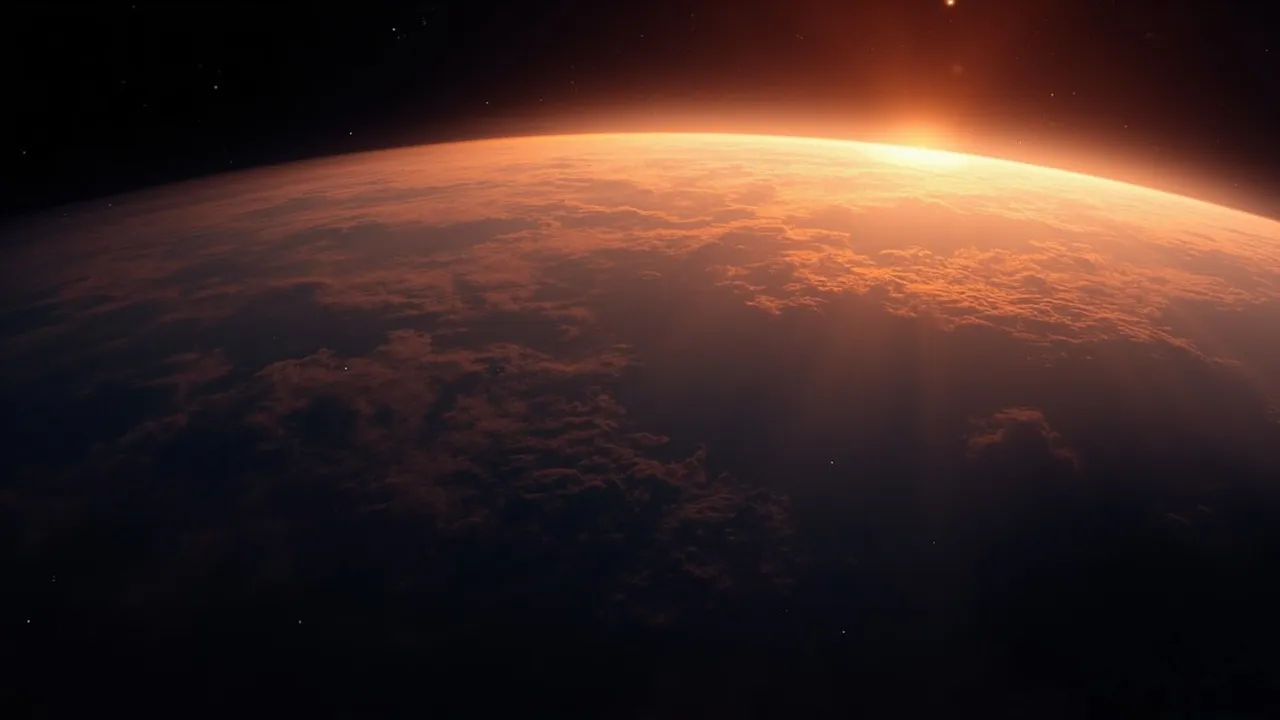
Okay, I have to admit — I've never given Venus much thought. I mean, Mars gets all the attention as humanity's potential backup plan, right? But recently I've been diving into some fascinating research about our closer neighbor, and honestly, it's blowing my mind a little.
Here's the deal: Venus looks boring from far away. Just a pale yellow ball. But when scientists point ultraviolet telescopes at it? Totally different story. Dark splotches and bright streaks rage across the planet's upper atmosphere like cosmic weather patterns. And get this — we've known about these features for about a hundred years, and nobody knows what's causing them.
That mysterious stuff has a nerdy name: the "unknown absorber." Creative, right?
The Cloud Collection Experiment
Here's where it gets interesting. A team of researchers decided to ask a weird question: What if we could somehow collect all that cloud material into a little lab container and study it directly?
Think about it this way. Remember when you blew smoke rings in middle school (not that I did that, of course)? Smoke looks white and wispy floating through the air. But collect all those particles into a jar? You've basically got tar. The same principle applies to Venus — the clouds might look pale yellow from Earth, but the actual liquid inside could be something completely different when concentrated.
This idea is actually brilliant when you think about it. Scientists took observations from spacecraft and telescopes, fed them through complex computer models that track how light bounces around inside clouds, and then calculated what the liquid inside those droplets would have to look like if you could somehow squeeze it all together.
What Did They Find?
The numbers are pretty striking. At certain wavelengths, the unknown material would need to absorb light incredibly well — we're talking about an absorption coefficient of about 1,278 cm⁻¹. For those not fluent in physics-speak, that's seriously strong. The mystery material would either have to be ridiculously good at absorbing light, exist at very high concentrations, or both.
Now here's where my imagination started running wild. The researchers suggest that carbon-based molecules could potentially fit the bill. Not living things or anything — just organic compounds in the chemistry sense. They estimated that something like 10 grams per liter might do the trick.
For reference, they're not claiming chlorophyll or blood pigments are floating around up there. But those familiar molecules serve as useful benchmarks because we know they absorb light very efficiently.
The Plot Twist
Here's what really got me: The absorption pattern doesn't match what you'd expect from messy chemical reactions. When you dissolve most organic compounds in concentrated sulfuric acid (which is what Venus's clouds are made of), they tend to form dark, tar-like mixtures that absorb light across pretty much all colors.
But Venus's mystery absorber seems to be more selective. It absorbs strongly in ultraviolet and blue wavelengths, then drops off sharply. That suggests something more chemically organized — a specific compound rather than random gunk.
This actually makes the mystery harder, not easier. We're not just looking for any dark stuff. We need something that can survive in corrosive sulfuric acid, stay chemically stable, and absorb light in exactly the right way.
Why Should You Care?
Beyond just pure cosmic curiosity (which, honestly, should be enough), this research matters for a few reasons. First, understanding Venus helps us understand Earth. They're similar in size and probably started with similar ingredients, but one became a hellish pressure cooker while the other stayed habitable. Climate science could learn a lot.
Second, here's something that quietly blew my mind: if complex organic molecules can persist and show distinctive signatures in Venus's clouds, that gives astrobiologists new things to look for when searching for life elsewhere in the universe.
The study was published in Astrobiology, and honestly, I love that such a creative approach to an old problem made it into a journal with that name. Sometimes the best science comes from asking "what if" questions that sound almost silly at first.
So next time you look up at the evening sky and spot Venus shining bright, remember: that innocent-looking pearl might be hiding something surprisingly dark in its clouds.