
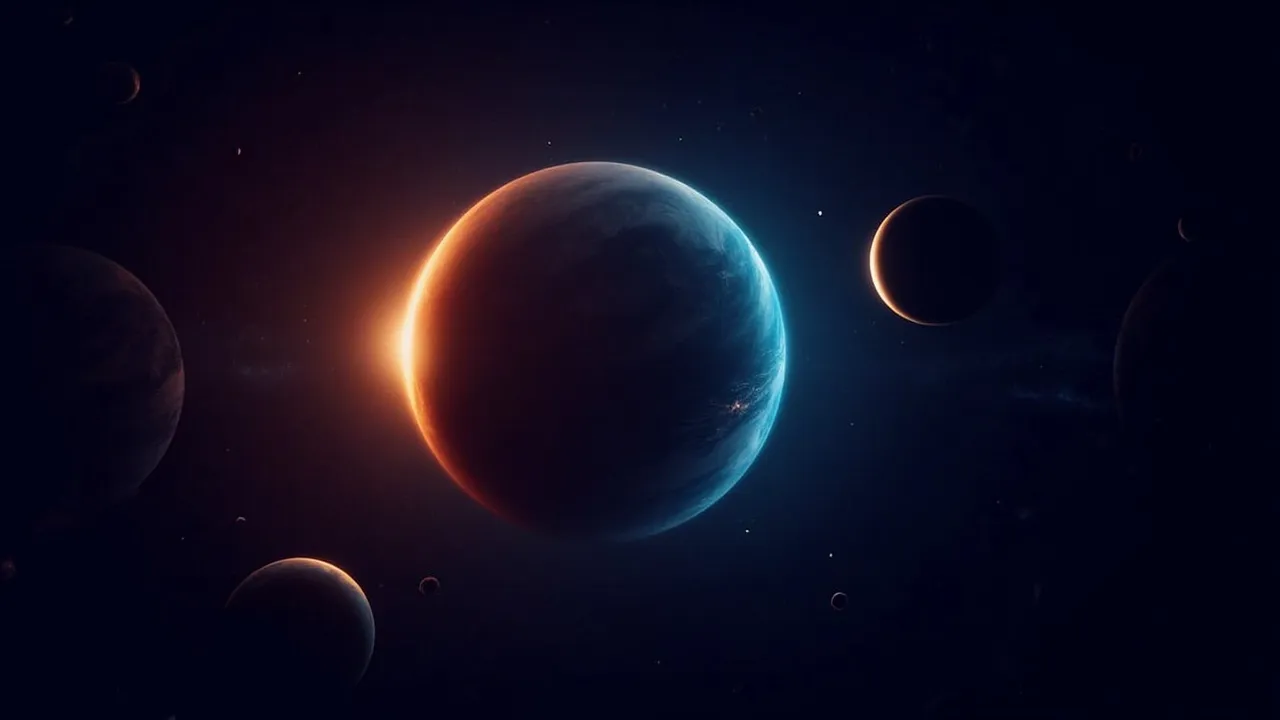
Okay, I have to admit—when I first read about this discovery, I had to double-check that I wasn't reading a headline from a sci-fi novel. Apparently, planets can be lopsided. And not in a subtle way, either.
A team of astronomers just revealed that WASP-17b, a giant exoplanet located about 1,300 light-years from Earth, has an atmosphere that puffs out farther on one side than the other. Think of it like a beach ball that someone sat on—just slightly squished and uneven. Wild, right?
So What's Going On Here?
WASP-17b belongs to a category of planets called "hot Jupiters." As you might guess from the name, these are enormous gas giants (similar to our own Jupiter) that orbit incredibly close to their host stars. This proximity means they get absolutely scorched—temperatures reaching thousands of degrees. Under these extreme conditions, things get weird.
Using NASA's James Webb Space Telescope (JWST), researchers from Cornell University and the University of Bristol made a fascinating observation: when the planet passed in front of its star, starlight filtered through different parts of its atmosphere, revealing that the atmospheric "edge" extends farther outward on one side.
Here's the thing that really got me excited about this story—the asymmetry isn't random. It appears on what scientists call the planet's "evening" side, which is where powerful atmospheric winds carry heat away from the permanently sunlit hemisphere toward the dark side. All that moving hot gas causes the atmosphere to expand outward more on that side.
It's like watching air escape from a balloon, except the air is plasma and the balloon is a planet the size of Jupiter.
A New Way to "See" Alien Atmospheres
What makes this discovery even cooler is how the researchers pulled it off. They used a technique called "transmission strings" (or transit mapping), developed by astrophysicists Dr. David Grant and Dr. Hannah Wakeford at the University of Bristol.
Here's the basic idea: traditionally, when astronomers study exoplanet atmospheres, they kind of blend everything together—like taking all the colors from a painting and mixing them into one muddy shade. This new method keeps everything separate, examining light that passes through different regions of the atmosphere as the planet crosses in front of its star.
Lead author Dr. Lili Alderson compared it to going from understanding you have a ring to figuring out exactly where the gemstones are located. I love that analogy because it captures how much more detail we're gaining.
Why Does This Matter?
Here's the thing that gets me genuinely pumped about this research: it confirms what theoretical models predicted. Scientists have been running computer simulations of how hot Jupiters should behave, and now we're seeing those predictions play out in real observations.
Dr. Hannah Wakeford put it beautifully: "Planets are temperamental, their atmospheres complex and chaotic. The fact that all of these numbers came together and showed us this very structured, dynamical picture of this giant world over 1,000 light-years away was just really exciting."
This isn't just about WASP-17b either. With over 6,000 confirmed exoplanets out there, having a reliable method to map their atmospheres in three dimensions opens up incredible possibilities. We can finally move beyond treating these worlds as simple circles and start understanding them as the complex, dynamic objects they really are.
The James Webb Space Telescope continues to blow my mind. Just when I think we've reached peak "wow, space is amazing," it finds something like this—a lopsided planet 1,300 light-years away that confirms our theories about how extreme heat reshapes alien worlds.
And honestly? I can't wait to see what it discovers next.
Source: ScienceDaily, October 2026 https://www.sciencedaily.com/releases/2026/10/261015073205.htm