
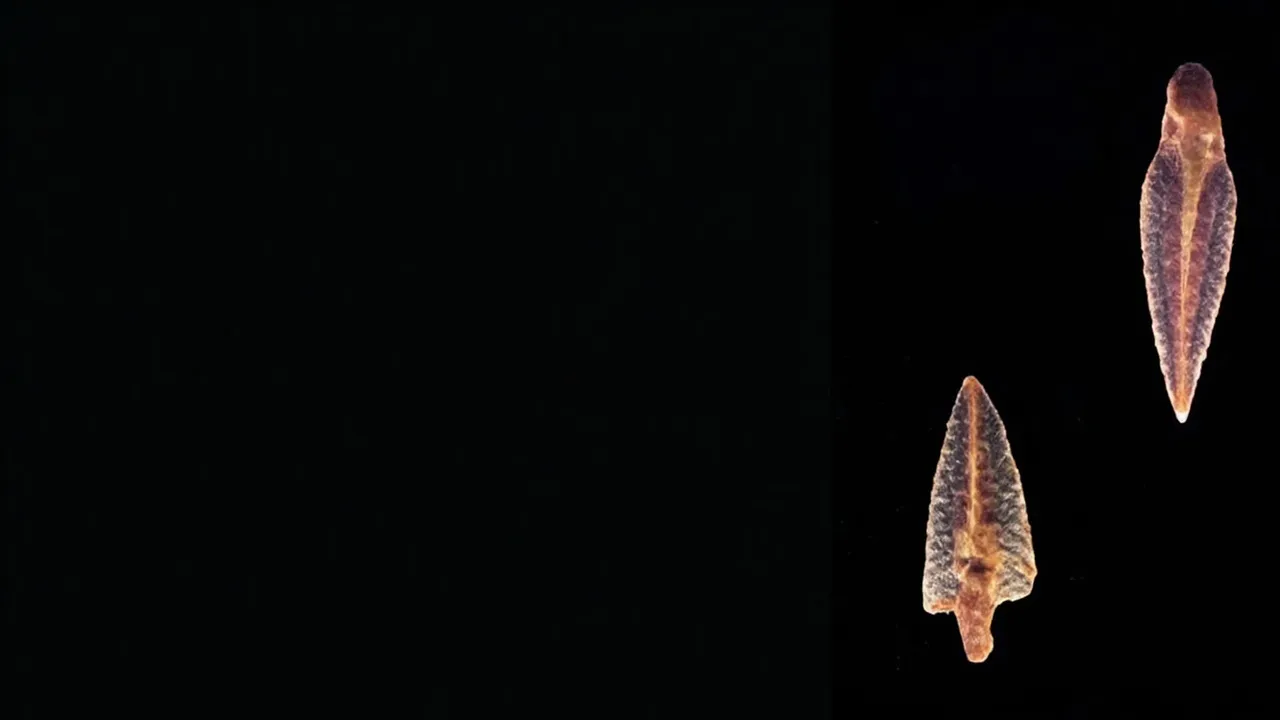
Picture this: You're an archaeologist carefully sifting through layers of dirt at a rock shelter in Uzbekistan, high up in the mountains. The year is somewhere around 80,000 BCE. And suddenly, you find something that makes your heart skip a beat — a tiny stone point, no bigger than your thumbnail, with clear marks showing it was shot from something.
Not thrown. Shot.
From a bow.
This is exactly what happened at the Obi-Rakhmat site, and the implications are honestly kind of mind-blowing.
So What's the Big Deal?
Here's the thing about human history — a lot of what we think we know was written a long time ago, in Western Europe, during the second half of the 1800s. Those early anthropologists had their biases (understatement of the century). They imagined that Europeans — specifically French and German scientists — had figured out where modern humans came from. Their original theory? That we descended directly from Neanderthals, right there in Europe. Convenient, right? "Civilizational superiority" claimed before breakfast.
It took about a century for scientists to catch up to what genetics was screaming at them: Homo sapiens originated in Africa. Full stop. But even now, the details of how our ancestors spread across the globe remain fuzzy.
For example, we know Homo sapiens reached Australia around 65,000 years ago — 10,000 years before we supposedly arrived in Europe. And that gap? It's been bothering archaeologists for a while.
Which brings us back to Uzbekistan.
A Rock Shelter in the Mountains
Obi-Rakhmat is a rock shelter nestled in the Talassky Alatau mountains in Uzbekistan, sitting at about 1,250 meters elevation. It was discovered back in 1962, but recent excavations have been uncovering layers of history stretching back over 40,000 years — and possibly further.
What makes this site special is its consistency. The stone tools found there — points, blades, and smaller bladelets — show a remarkably continuous tradition across more than 10 meters of accumulated sediment. Think about that: that's layer after layer of human activity, preserved in stone.
Initially, researchers thought this lithic industry belonged to something called the "Initial Upper Paleolithic" — a technical term for an early phase of modern human technology. But here's where it gets interesting: the tool styles at Obi-Rakhmat seem to trace back not to the Levant (the region around modern-day Israel and Lebanon), but to something older — the Levantine Early Middle Paleolithic.
This is significant because the Middle Paleolithic, associated with more archaic humans, basically vanished from the Near East around 100,000 years ago. So what's an apparent descendant of that tradition doing in Central Asia 20,000 years later?
The Hybrid Kid
As if the stone tools weren't confusing enough, the human remains at Obi-Rakhmat add another layer of mystery. In a layer dating to about 70,000 years ago, researchers found the skull of a child. And here's where things get really wild: the features show a mix of Neanderthal characteristics and characteristics of anatomically modern humans.
Could this be evidence of interbreeding between different human groups? Many scientists think so. Central Asia might have been a meeting point — a zone where populations collided and, well, got to know each other.
But About Those Tiny Arrowheads...
Let's get back to the main event.
The research team, working across multiple disciplines, identified these incredibly small stone points in the oldest layers of the site. We're talking points less than 2 centimeters wide, weighing just a few grams. They showed clear impact damage — not from regular use or grinding, but from hitting something at high velocity.
Now, you might be wondering: how do we know these weren't just knife tips or something else? Great question. The researchers compared the damage patterns to experimental data — basically, they made their own tiny stone points and shot them at targets to see what happens. The microscopic wear patterns matched.
And here's the crucial part: these little points wouldn't have worked on heavy spears. They were too fragile. The only thing they could have been mounted on? Light, fast projectiles. Arrows shot from low-poundage bows.
The Physics of Pointy Things
Here's where I find the science genuinely beautiful.
Spears and arrows operate on completely different physical principles.
A spear — whether you're holding it, thrusting it, or throwing it — relies on mass and force. You're putting your whole body behind it, and the impact is meant to be heavy. Bigger, heavier points make sense here.
But an arrow? Arrows travel at high speed over distance, and that speed is generated by the bow — not by your arm. The problem is, speed decreases rapidly. An arrow loses energy fast, both in flight and upon impact. To compensate, it needs to be sharp. Really, really sharp.
The researchers note that the cutting edge width of these ancient points matches the diameter of arrow shafts found in ethnographic studies — shafts designed for low-poundage bows. And this makes sense across cultures and time periods. It's not cultural tradition; it's physics. The constraints of ballistics create similar solutions, over and over again.
Why This Changes Everything
Here's what the researchers are suggesting: these arrowheads at Obi-Rakhmat, dating to 80,000 years ago, are directly comparable to arrowheads used by Homo sapiens in the Rhône Valley in Europe — except those European arrowheads are 25,000 years younger.
If you're following along, that means our species had developed sophisticated bow-and-arrow technology at least 80,000 years ago, possibly in or through Central Asia, and carried that knowledge with them as they eventually spread into Europe.
This doesn't just push back the timeline. It suggests a different route. Instead of Homo sapiens moving directly from Africa through the Levant and into Europe, maybe there was an earlier, more easterly route through Central Asia.
The researchers even suggest that archaeologist Ludovic Slimak's 2023 proposal — that Central Asia might be the origin point for the Upper Paleolithic — deserves serious attention.
What Does This Mean for Human History?
Honestly? We're in for a rewrite.
The traditional narrative has Homo sapiens leaving Africa around 60,000 years ago and spreading outward in a relatively straightforward path. But finds like this one — and the 65,000-year-old Australian evidence — suggest earlier, more complex movements.
Central Asia isn't just a corridor. Depending on the climate, it could have been a refuge during ice ages or a crossroads where different human populations met, traded ideas, and maybe even interbred. The stone tool traditions there might represent a thread of technological development that runs parallel to — not just leading up to — the European Upper Paleolithic.
And if our ancestors had bows 80,000 years ago? That's a fundamental change in how we understand human hunting strategies, territorial expansion, and technological development. Bows aren't just weapons; they're force multipliers. They allow hunting from a distance, taking down prey without getting close, covering more ground in search of resources.
That's not just archaeology. That's human ecology, rewritten.
So the next time you pick up a pencil or tap out a message on your phone, remember: somewhere in a mountain shelter in Uzbekistan, tiny hands — or the hands of those who came before — were crafting something revolutionary. A point. A projectile. A small, sharp thing that would change the trajectory of our species forever.
And it took us 80,000 years to even realize it was there.