
So What Exactly Did They Find?
Picture this: It's July 2, 2025, and the Einstein Probe — a space telescope with the cool nickname "lobster-eyed" due to its unique fishbowl-like design — is doing its usual thing, scanning the sky for X-ray sources. Then suddenly, it picks up something really unusual.
The source, nicknamed EP250702a, wasn't just bright — it was insanely bright. We're talking one of the most luminous instantaneous outbursts ever recorded in the universe. At its peak, this thing was spitting out energy at a rate that makes your head spin.
But here's what really got scientists excited: the behavior was all wrong for a typical cosmic explosion.
Why This Wasn't Your Average Space Explosion
Now, I'm going to get a bit technical here, but stick with me because it gets fun.
Usually, when astronomers see something super bright and X-ray-y in space, they assume it's a gamma-ray burst — basically the universe's version of a cosmic firecracker. These events are powerful, sure, but they follow a pretty predictable pattern.
This wasn't following the script.
The Einstein Probe caught X-ray emission from this source about a day before any gamma-ray bursts appeared. That sequence is super rare. Dr. Dongyue Li, the study's lead author, put it perfectly: "This early X-ray signal is crucial... It tells us this was not an ordinary gamma-ray burst."
Then came the flares — intense bursts of X-ray energy shooting out over roughly 15 hours. After that? The source dimmed by more than 100,000 times over about 20 days. Its X-ray energy also shifted from "hard" (higher energy) to "soft" (lower energy) rays, which tells us something about how the energy source was evolving.
The "Intermediate-Mass Black Hole Eating a White Dwarf" Hypothesis
Here's where things get really wild.
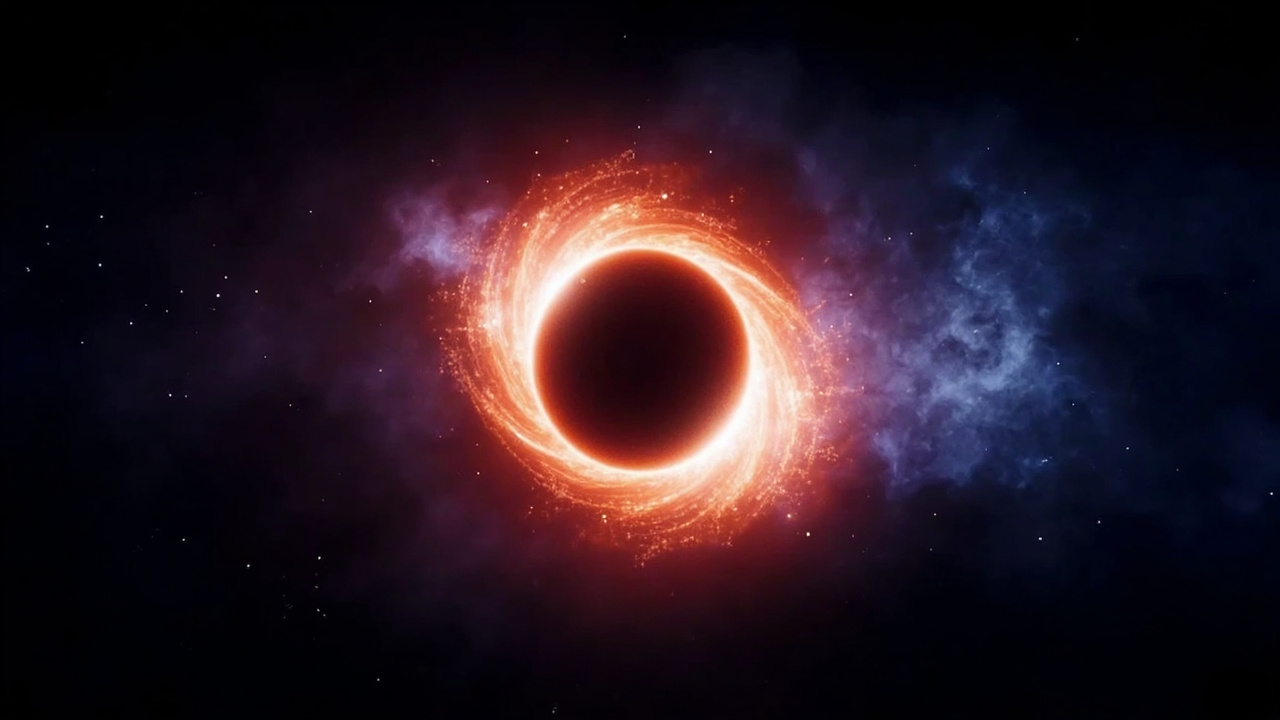
After scientists threw every model they had at this event, one explanation kept coming out on top: an intermediate-mass black hole (roughly a few hundred to a hundred thousand times our sun's mass) ripping apart and devouring a white dwarf star.
Think about that for a second. A white dwarf is already a cosmic corpse — what happens when a sun-sized ball of dense electron-degenerate matter gets too close to a black hole? The black hole's immense gravity tears the star apart, and its material gets slowly consumed in a process that produces exactly the kind of bizarre, bright, evolving X-ray signal we saw.
If this interpretation holds up, it would be the first direct observational evidence of this type of feeding event. That's a big deal, because intermediate-mass black holes are notoriously hard to spot. They're too small to be "active" supermassive black holes that blast out tons of light, but too big to be the stellar-mass black holes we've detected through gravitational waves. Catching one in the act of eating dinner? That's like hitting the astronomical jackpot.
Where Was This Happening?
Another interesting detail: the event occurred in the outer region of a distant galaxy, not near its center. Most high-energy cosmic events like this tend to happen near galactic cores, where black holes are more likely to lurk. Finding it out in the cosmic suburbs was yet another clue that something unusual was going on.
The Global Astronomy Community Came Together
I love this part of the story. Once the Einstein Probe flagged the anomaly, astronomers worldwide pointed their telescopes at the same patch of sky. NASA's Fermi Gamma-ray Space Telescope, the Einstein Probe's Follow-up X-ray Telescope, and observatories around the planet all joined forces. It's a beautiful reminder that science is often a team sport, and when the universe shows us something cool, we actually work together to figure it out.
Researchers from the University of Hong Kong were key contributors to the analysis, and the findings were published as a cover article in Science Bulletin — a pretty major validation of how significant this discovery might be.
What Does This Mean for Astronomy?
This detection showcases exactly why missions like the Einstein Probe are so valuable. Its wide-field, high-sensitivity X-ray vision is designed to catch exactly these kinds of fleeting, unexpected events. Without this capability, EP250702a might have slipped past unnoticed.
If the white dwarf interpretation is correct, we're not just adding another entry to the cosmic catalog — we're filling in a gap in our understanding of how black holes grow and evolve. Intermediate-mass black holes have long been "missing links" between the small black holes we know well and the supermassive giants that power active galaxies. Watching one feed gives us a direct window into their behavior.
And honestly? There's something deeply satisfying about the fact that the universe is still surprising us. We've been studying black holes for decades, and somehow, in 2025, we get to witness something that might be a first for humanity.
This is the kind of discovery that reminds me why I love writing about space. We're all basically sitting in a cosmic theater, watching the universe put on a show, and every now and then, something completely unexpected takes the stage.
Source: ScienceDaily