
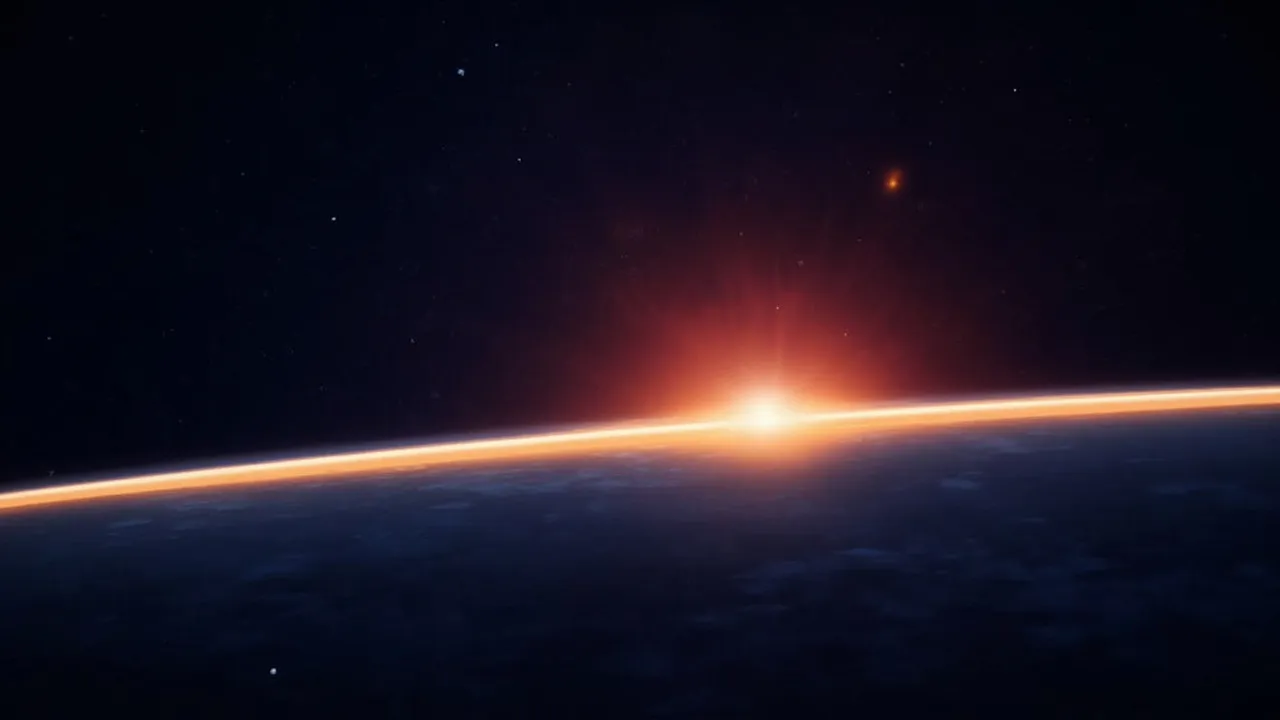
Picture this: you're cruising through space, feeling all safe and cozy inside your little planetary neighborhood, when suddenly—surprise! Your protective bubble disappears, and you're left totally exposed to the galaxy's junk. Sounds like a sci-fi nightmare, right?
Well, according to some fascinating new research, this might have actually happened to Earth. And not just once—possibly multiple times over the past 14 million years.
What's the Heliosphere, Anyway?
Let me break this down in simple terms. The Sun is constantly blasting out charged particles in something called the solar wind. As these particles stream outward, they create this enormous protective bubble around our entire solar system—the heliosphere. Think of it like Earth having its own personal force field, shielding us from harmful cosmic radiation and interstellar gunk.
Pretty cool, right? Our Sun is basically looking out for us in a big way.
But here's where things get interesting. A team of researchers funded by NASA recently discovered that this protective bubble might not always have been there when we needed it.
The Sun's Wild Ride Through the Galaxy
Here's something wild about space: nothing stays still. Our entire solar system is actually traveling around the center of the Milky Way, and during its 4.6-billion-year journey, it's passed through all sorts of different cosmic neighborhoods.
The research team ran computer simulations to trace the Sun's path through the galaxy, and what they found was fascinating. Apparently, the Sun has passed through enormous cold clouds of gas and dust at least three times in the past several million years—around 2-3 million years ago, 6-7 million years ago, and 13-14 million years ago.
During these encounters, the heliosphere got seriously squeezed. Like, compressed down to smaller than Earth's orbit squeezed. That means our planet would've temporarily found itself floating outside the Sun's protective bubble.
Yikes!
The Climate Connection
Now, here's where it gets really interesting. The timing of these heliosphere crunches actually lines up with some climate mysteries here on Earth.
Scientists found traces of interstellar dust in deep-sea sediments, Antarctic snow, and even Moon samples that match up with those exact time periods. It's like finding fingerprints at a crime scene—the evidence is right there.
And get this: when the simulations modeled what would happen if Earth's atmosphere was directly exposed to these dense, cold clouds of galactic hydrogen, the results showed increases in atmospheric water vapor and changes in the upper atmosphere. Those effects eventually trickled down to influence conditions closer to Earth's surface.
Could these moments of cosmic exposure have contributed to ancient ice ages? The researchers think it's definitely possible. We've always looked at Earth's orbit, greenhouse gases, and ice coverage to explain climate shifts—but maybe we've been missing a big piece of the puzzle all along.
What This Means for Understanding Our Planet
I don't know about you, but I find this stuff absolutely mind-blowing. We've spent centuries studying Earth's climate, and we're still discovering new factors that might have shaped it.
This research suggests that sometimes, the biggest influences on our planet's weather might come from far beyond our atmosphere—from the Sun's journey through the galaxy and the cosmic environments we've passed through.
The team is now working on building what they call a "digital twin" of the heliosphere—a detailed computer model that could help scientists predict how our protective bubble responds when it encounters dense interstellar clouds. This could eventually help us identify other star systems that might have similarly protective environments, which is huge for the search for habitable planets.
The Big Picture
Here's what sticks with me about this research: we're not as isolated as we might think. Earth doesn't exist in a vacuum (pun intended). Our planet's history has been shaped by forces far larger than anything on our surface—from the Sun's behavior to our journey through the Milky Way.
The next time you're enjoying a beautiful sunny day, maybe take a moment to appreciate that protective bubble keeping us safe from the cosmic storm. And if you're feeling ambitious, maybe thank the Sun. It's been doing a pretty important job for about 4.6 billion years.
Pretty impressive, if you ask me.
Source: https://www.sciencedaily.com/releases/2026/09/260901070523.htm