
Okay, folks, let me tell you about something that happened on July 4th, 2025 — and no, it's not about fireworks, though what astronomers witnessed that day was arguably more spectacular.
A team of researchers caught an event they designated EP250704a, and at first glance, it looked like your standard short gamma-ray burst. You know, the kind that happens when two neutron stars spiral toward each other in a deadly cosmic dance, collide, and merge in an explosion so powerful it ranks among the most violent events in the entire universe. The initial flash? Less than half a second. Quick, bright, done.
Except... it wasn't done.
The Universe's Longest Kiss Goodbye
Here's where things get interesting. Instead of fading away like a proper gamma-ray burst should, this source kept going. And going. For nearly ten whole minutes, it continued spitting out soft X-rays — not the explosive gamma rays we normally see, but gentler, lower-energy X-ray light.
Now, you might be thinking, "Ten minutes? Big deal." But in cosmic terms, this is like watching a firework display after you've already packed up your lawn chair. This extended activity was carrying serious energy, but it was happening at wavelengths that our usual instruments would have completely whiffed on.
Professor Bin-Ban Zhang from Nanjing University put it perfectly: "What appears to be a typical short gamma-ray burst can actually conceal a much longer and richer episode of activity at soft X-ray energies."
Translation: We've been missing the real show this whole time.
Why Did We Miss This?
Here's the thing about how astronomers usually hunt these cosmic catastrophes. Most X-ray telescopes are narrow-field instruments — they need to be pointed at something specific. When a gamma-ray alert comes in from missions like Swift or Fermi, these telescopes swing into action to observe the aftermath. But they weren't watching during the opening act.
The Einstein Probe is different. It has wide-field monitoring capabilities that let it watch vast stretches of the sky simultaneously. It's like the difference between having a security camera pointed at your front door versus having eyes in the back of your head. This probe just happened to be looking in the right place at the right time.
A Magnetar Takes the Stage
So what was powering this mysterious extended X-ray glow? The researchers organized an all-hands-on-deck follow-up campaign, pulling in observations from X-ray telescopes, optical telescopes, and even radio dishes. They needed to figure out what had produced this unusual signal.
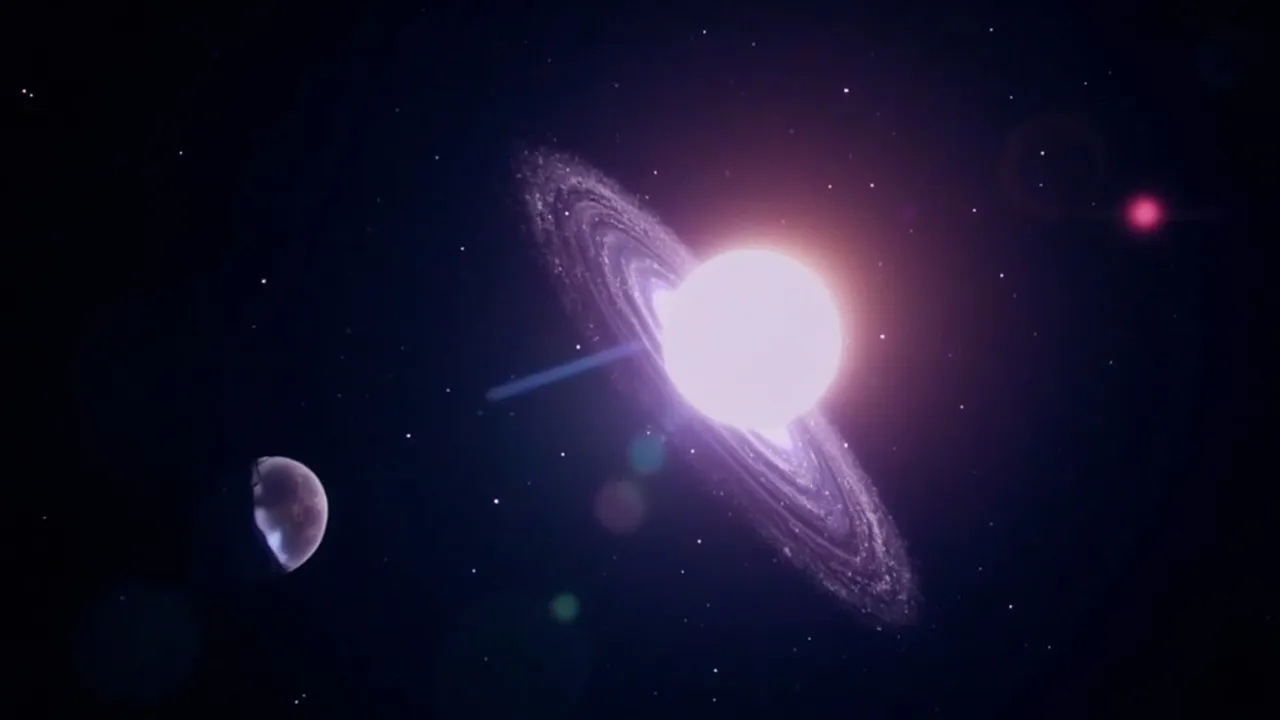
The verdict? Evidence strongly suggests the merger left behind a rapidly rotating, highly magnetized neutron star — what scientists call a magnetar. This newborn magnetar acted like a cosmic battery, continuously pumping energy into the surrounding material long after the initial gamma-ray flash had faded.
Yi-Han Iris Yin from The University of Hong Kong, who led the high-energy emission analysis, explained that the event's rapidly changing brightness, evolving spectrum, and later X-ray and optical afterglows all pointed to continued activity from this central engine. In other words, the real action was happening at the collision site itself, not from the outward-moving blast wave.
Why Should You Care?
Here's where this gets really exciting. Since 2017, when astronomers first detected both gravitational waves and electromagnetic radiation from merging neutron stars simultaneously, these events have become one of the hottest topics in astrophysics. They're essentially laboratories for studying physics in conditions we could never replicate on Earth.
This newly discovered soft X-ray component opens up an entirely new way to study these mergers. It's not just about catching gamma-ray flashes anymore — it's about watching what happens in the aftermath, powered directly by the remnant object left behind.
Professor Eleonora Troja from the University of Rome put it well: these fast X-ray transients could be key electromagnetic counterparts to gravitational-wave sources, potentially originating from compact object mergers that our previous instruments simply couldn't see.
In plain English? We're adding a new tool to our cosmic detective kit. One that might help us understand what exactly goes on during and after some of the universe's most extreme collisions.
The Bigger Picture
Every time we develop better technology to look at the sky, the universe reminds us that we've been missing more than we realized. This discovery isn't just about adding another footnote to our understanding of gamma-ray bursts — it's about fundamentally changing how we think about neutron star mergers.
The next time you hear about detecting gravitational waves from a neutron star collision, remember: we might only be seeing part of the story. The universe, it seems, has been holding out on us.
And honestly? I can't wait to see what else we've been missing.