
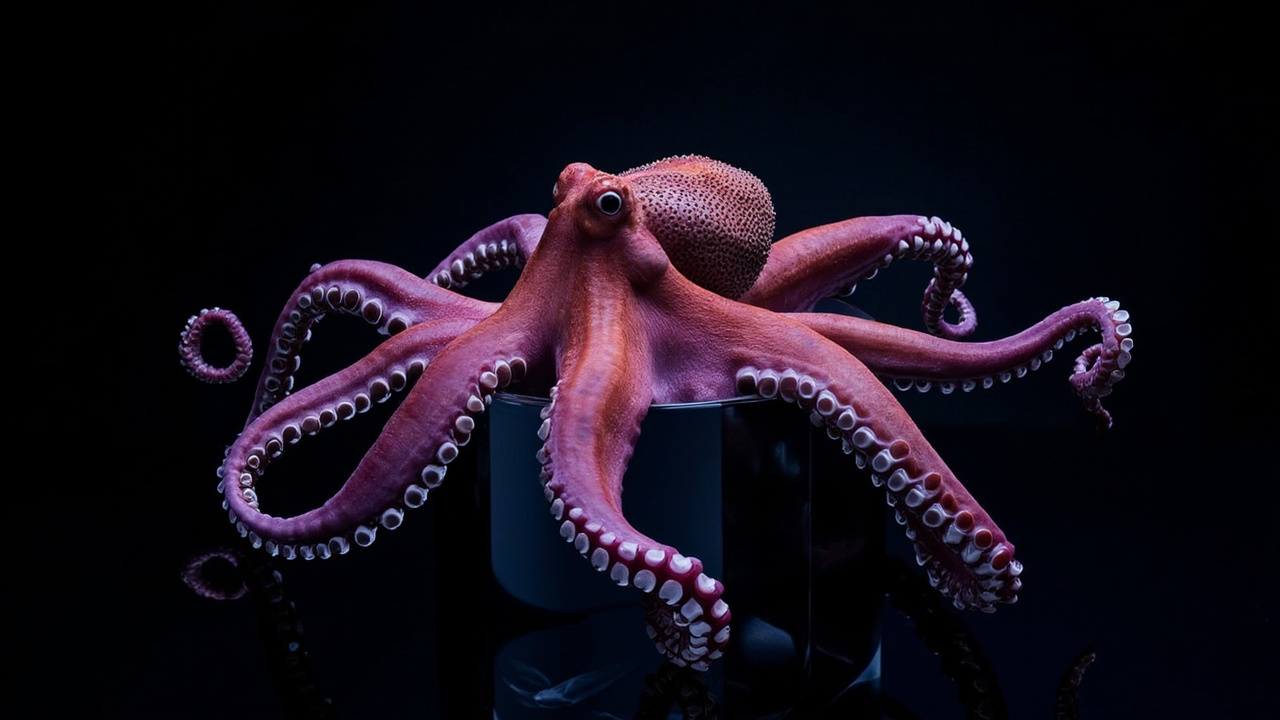
Wait, Octopuses Can Use Mirrors? Scientists Are Freaking Out — And Honestly, So Am I
Okay, I need to tell you about something that made me genuinely audibly gasp while reading research papers (my roommate was concerned).
Octopuses can learn to use mirrors. Not in a "oh that's cute" way, but in a "this challenges everything we thought we knew about intelligence" way.
The Setup
Researchers at Dartmouth decided to test something pretty wild: could octopuses figure out that a mirror shows them something real, just from a different angle?
Here's what they did. They placed octopuses in front of a mirror. Then they showed the animals a virtual crab image that was behind them — only visible through the reflection. The octopus couldn't see it directly. To get their reward (an actual crab, yum), they had to figure out where that reflected crab actually was in the real world and turn around to find it.
No attacking the mirror. No confusion. Just... figuring it out.
And get this — they succeeded about 73% of the time. That's not random guessing. That's understanding.
Why This Matters So Much
Here's the thing that really got me. The researchers put it this way: octopuses and humans share a common ancestor that was basically a worm hanging out 350 to 500 million years ago. We're talking ancient evolutionary separation.
Yet somehow, both species figured out that mirrors show you stuff about the world you can't see directly. That's not a simple trick — that's spatial reasoning, problem-solving, and a genuine understanding that "what I see in this reflection is somewhere else in the room."
Let me put this another way. Your cat probably can't do this. (Sorry, cat people.)
These Creatures Keep Defying Expectations
If you've been paying attention to octopus news, this shouldn't totally shock you. These animals have demonstrated some wild abilities. They solve puzzles, they use tools, they've been known to escape from aquariums and wander around on land (looking at you, Inky). They can recognize individual human faces. Some species even carry around coconut shells to use as portable armor.
But this mirror thing? This is different. This is about how they think, not just what they can do.
The research team thinks this might come down to their hunting style. Octopuses are ambush predators — they lurk, they sneak, they pounce. And when you're the one doing the hunting (instead of being hunted), it helps enormously to know your territory.
"Hunters are very effective when they have a mental map of their territory, so that they know where they are in relation to their environments." — Peter Tse, Dartmouth
So maybe, just maybe, octopuses aren't just reacting to what's directly in front of them. Maybe they're building internal maps of their world, the same way you probably navigate your neighborhood or think about where your couch is relative to your TV.
The Bottom Line
Look, I'm not going to pretend I fully understand how a creature with nine brains (a central one and eight mini-brains in each arm) processes reality. But I do know this: every time we study octopuses closely, they surprise us.
And honestly? I love that. It keeps us humble. Intelligence isn't just a human thing or even a mammal thing. It's emerged again and again in different life forms, solving similar problems in completely different ways.
The next time someone tells you that humans are the only "really smart" animals, you can point them to an octopus using a mirror to find a crab around a corner.
That's pretty smart to me.
Source: ScienceDaily