
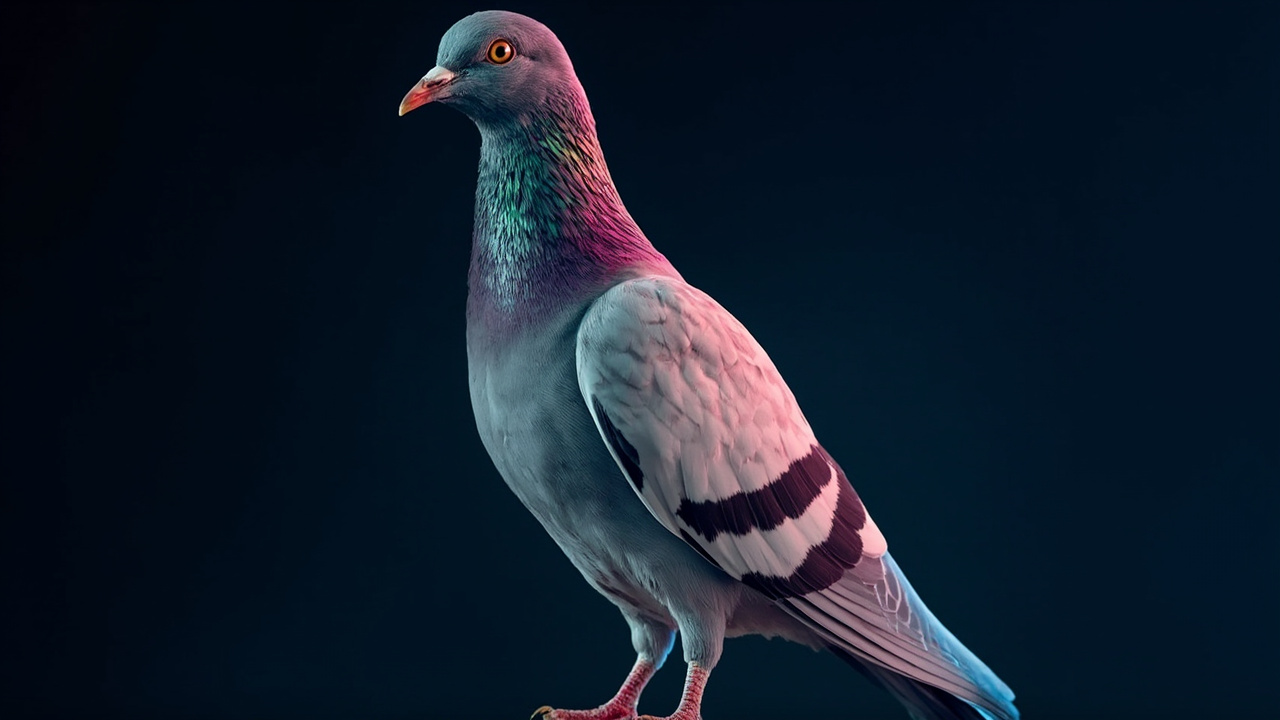
Okay, I have to be honest with you — I've never been what you'd call a "pigeon person." They seem to just... exist. Walking around, pecking at things, looking vaguely judgmental. But lately, I've been going down a rabbit hole of animal navigation research, and I stumbled across something that genuinely blew my mind.
Pigeons might be using their LIVERS as compasses.
Yeah, you read that right. Their livers. Not their eyes, not some fancy brain region, but an organ most of us associate with filtering blood and processing toxins. And the cells in question aren't even the liver's main workers — they're immune cells called macrophages that happen to have a party trick nobody saw coming.
The Iron Connection
Here's what's wild: macrophages in the liver are essentially garbage collectors. They break down old red blood cells, and in the process, they accumulate iron. A lot of it. So much, in fact, that the researchers who studied this found that liver tissue has the strongest magnetic response of any organ in a pigeon's body.
The iron forms into tiny nanoparticles inside these cells, making them superparamagnetic — which is a fancy way of saying they react to magnetic fields. So essentially, pigeons are walking around with these little iron-loaded sensors floating in their livers, detecting the Earth's magnetic field like a built-in compass.
But here's the really cool part — and this is what made me actually laugh out loud while reading this research — when scientists removed these macrophages from pigeons, the birds got completely lost. But ONLY on cloudy days.
On sunny days, they figured it out just fine.
This tells us something fascinating: pigeons aren't relying on just ONE navigation system. They've got backup plans. Magnetic compass from the liver on overcast days, sun position when it's visible. It's like they have multiple apps open for navigation, switching between them based on conditions.
Why Hasn't Anyone Found This Before?
For decades, scientists were convinced birds must detect magnetic fields through their eyes — maybe through special light-sensitive molecules. Others thought there might be magnetic particles in their beaks. Both ideas made sense on paper, but neither got solid experimental support.
The thing is, nobody was really looking at the liver. Why would you? It's not exactly an obvious choice for sensory perception. But this team from the University of Bonn, University of Duisburg-Essen, and the Max Planck Institute decided to look more broadly, and boom — there it was. The liver practically glowing with magnetic properties compared to other organs.
"When we removed the macrophages, we saw a dramatic effect on navigation," the researchers noted. On cloudy days, pigeons without these liver cells essentially lost their ability to orient themselves. They could fly, sure, but they had no idea where home was.
A Communication Highway to the Brain?
The researchers also found that these iron-rich macrophages sit suspiciously close to nerve fibers in the liver. This proximity suggests a potential pathway for magnetic information to travel from the liver to the brain — basically, the liver detects the magnetic field, sends a signal through nearby nerves, and the brain interprets it as directional information.
This is kind of revolutionary because it ties together two systems we don't usually think about as connected: the immune system and the nervous system. The macrophages aren't just immune cells doing immune cell things — they might be functioning as sensory organs too.
"What looks like a 'gut feeling' in bird navigation may actually have a physical basis," one researcher pointed out.
I'm not going to lie, I love that framing. Maybe when someone says they have a "hunch," they're actually running on some ancient biological compass system that birds have been using for millions of years.
What Does This Mean for Us?
Here's where it gets interesting: if pigeons have this system, other animals probably do too. Migratory birds, sea turtles, salmon — they all navigate across vast distances using Earth's magnetic field. Maybe they're all using similar iron-based macrophage systems in various organs.
And honestly? The implications for biology are pretty staggering. We've basically discovered a completely new type of sensory mechanism that nobody was looking for. A sensory system that lives in an organ we thought we understood pretty well.
So next time you see a pigeon casually pecking at the ground like it doesn't have a care in the world, remember: that unassuming little bird might be carrying around a biological compass in its liver, navigating by magnetic fields while you步行 down the street wondering if you left the stove on.
Science is wild, y'all. Never stop being amazed.
Source: https://www.sciencedaily.com/releases/2026/05/260529043640.htm