
markdown formatted blog content
Okay, I need you to sit down for this one.
Scientists just... weather forecast a world 20 light-years away. And get this—the forecast actually works.
I don't know about you, but when I think about studying weather on other planets, I usually assume we're talking about vague impressions or educated guesses. "Yeah, Mars has dust storms sometimes. Neptune has crazy winds." But decoding the specific weather patterns of a distant object? That sounds like something out of science fiction.
Well, my friends, science fiction is getting reality a run for its money.
Meet SIMP 0136: The Weird Cousin in Space
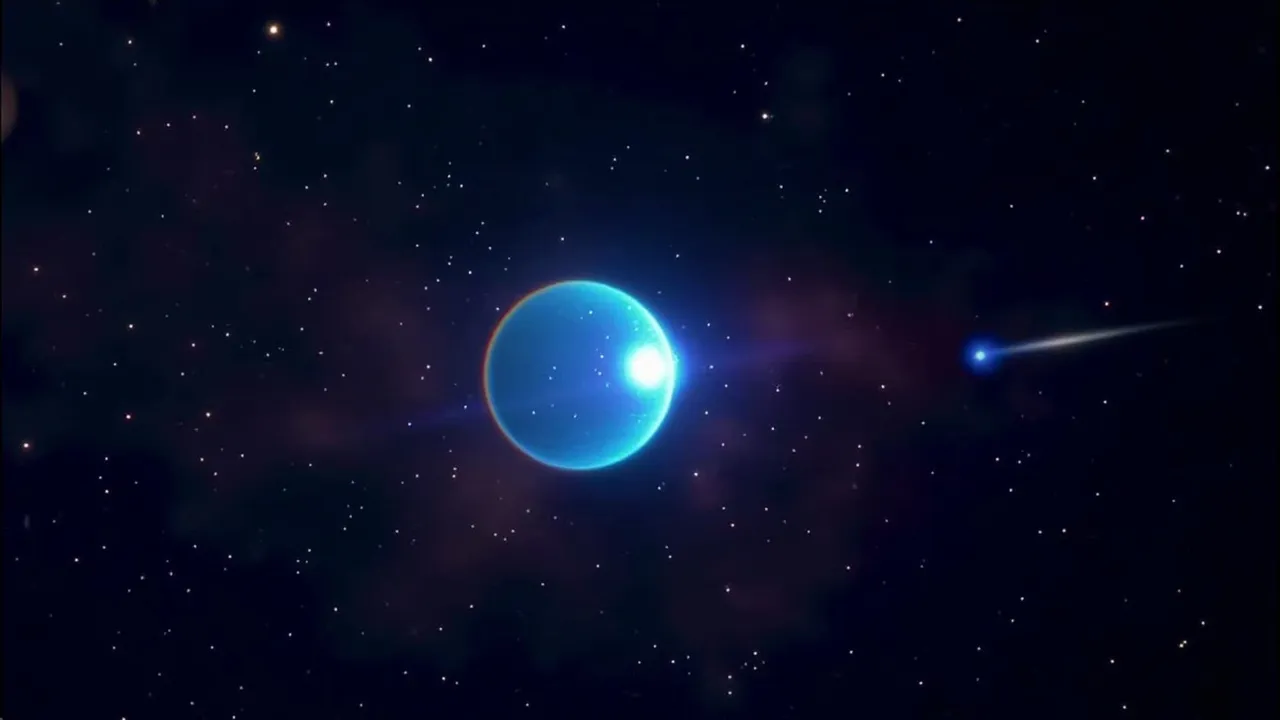
So let me introduce you to SIMP 0136. No, that's not a typo or someone's angry autocorrect—it's the name of a brown dwarf hanging out about 20 light-years from Earth. Brown dwarfs are these fascinating cosmic oddballs. They're bigger than gas giant planets like Jupiter, but they don't quite have enough mass to spark into full-blown stars. Think of them as stellar rejects—objects that almost made it to star status but didn't quite get the memo.
SIMP 0136 has been on astronomers' radar for a while because it shows signs of having something like northern lights (how cool is that?!). But recently, researchers at Trinity College Dublin decided to really dig into what was going on with its atmosphere.
The James Webb Space Telescope: A Game Changer
Here's where things get interesting. The team used the James Webb Space Telescope (JWST)—you know, the fancy successor to Hubble that's been absolutely blowing our minds with gorgeous space photos—to study how SIMP 0136's light changes as it rotates.
Now, this isn't as simple as just pointing a telescope and looking. The researchers had to get creative with how they analyzed all that data. They used something called Principal Component Analysis, which is basically a mathematical technique that helps find hidden patterns in complicated datasets.
But here's what I love about their approach: they didn't start with assumptions about how the atmosphere "should" behave. They just let the data speak for itself. How refreshing is that? Sometimes the universe surprises us when we stop telling it how to behave and actually listen.
The Plot Twist: Hidden Order in Chaos
And surprise us it did!
SIMP 0136's atmosphere looks incredibly complicated. There are massive cloud systems churning away, rapidly evolving and changing how the brown dwarf appears. You'd think trying to make sense of all that chaos would be impossible.
But here's the incredible part: nearly ALL of that atmospheric variability can be explained by just TWO factors.
Two.
Let that sink in for a moment.
All that wild, turbulent, planetary-scale weather—reduced to basically temperature changes and variations in cloud structure. It's like discovering that your neighbor who seems to live the most chaotic life actually just has two simple routines they follow.
The researchers also identified three recurring "weather states" that keep appearing and disappearing as SIMP 0136 rotates. Some regions are hotter with thinner clouds, others are cooler with thick cloud layers stretching high into the atmosphere. These states shift and interact, creating a dynamic but surprisingly organized atmospheric patchwork.
A Personal Connection Across Space and Time
Now here's where this story gets almost poetic.
The lead researcher, a PhD student named Merle Schrader, realized something remarkable. The light from SIMP 0136 that the JWST captured in 2023? It left the brown dwarf during the year Schrader was born.
Twenty years. That light traveled through space for two decades to reach us, carrying information about this mysterious world's weather. And it just happened to arrive when someone who could study it was born, educated, and ready to analyze it.
There's something deeply beautiful about that, don't you think?
Why Should You Care?
Look, I know what you're thinking: "That's cool, but how does this affect my life?"
Here's how: understanding weather patterns on brown dwarfs helps us understand atmospheric physics on a fundamental level. These objects serve as natural laboratories for studying extreme weather conditions that we simply can't replicate on Earth.
And this research method? It's not just limited to SIMP 0136. The technique can be refined and applied to other brown dwarfs we know less about. We're essentially developing a new toolkit for decoding alien atmospheres.
The more we understand about how atmospheres work across the universe, the better we understand our own place in the cosmos. Plus, come on—it's just genuinely amazing that we can look 20 light-years away and figure out that a world has three recurring weather patterns governed by cloud structures.
That's the kind of thing that makes you want to look up at the night sky and just... marvel.