
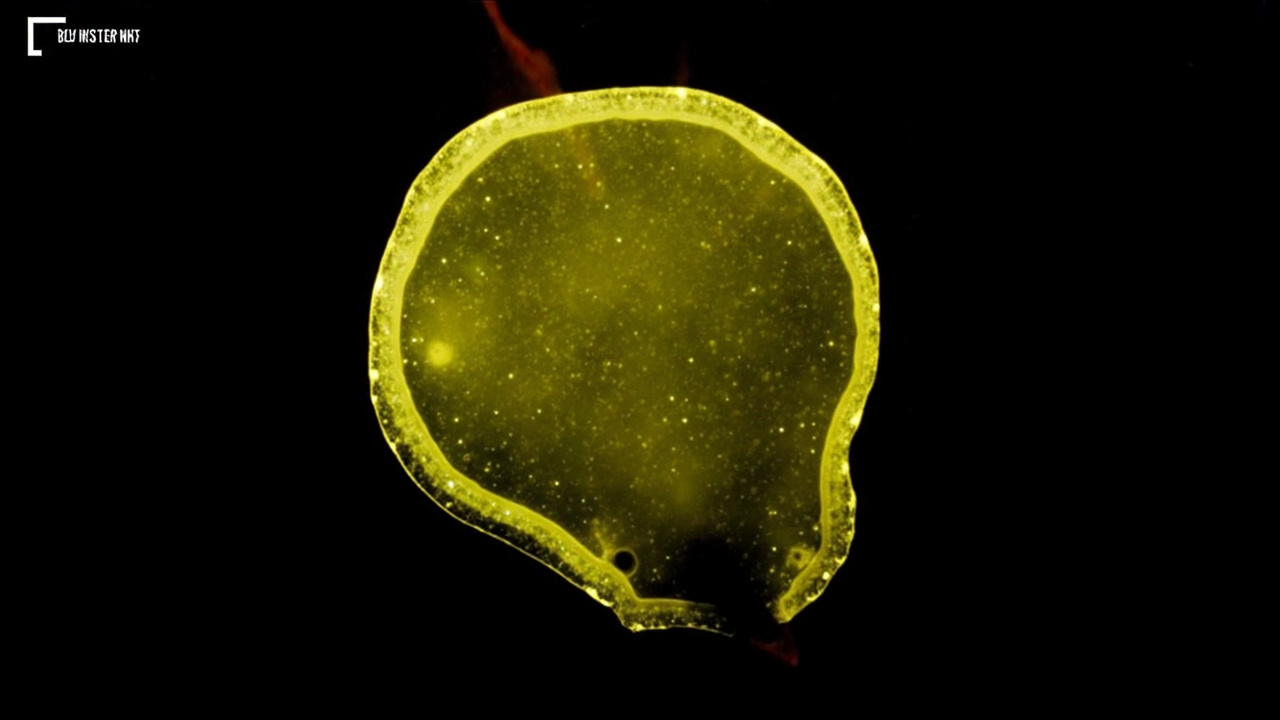
So here's something that'll make you look at that weird yellow stuff on your lawn very differently.
I recently stumbled upon research about slime molds, and now I can't stop thinking about them. These squishy, bright yellow blobs are everywhere—in forests, gardens, under rotting logs. They look like something that crawled out of a sci-fi movie. But according to some fascinating scientific work, they might actually be conscious. Yep, conscious. As in, experiencing something.
Let me break down why this is so interesting.
Meet the Blob
Physarum polycephalum—that's the fancy name for one of the most famous slime molds—doesn't have a brain, nerves, or anything even remotely close to what we'd call a nervous system. It's just a bunch of individual cells that merge together into one giant mass with multiple nuclei floating around inside.
Sounds simple, right? Well, here's where it gets weird.
Researchers have watched these blobs solve math problems, navigate through mazes to find food, and even push through bright blue light—something they naturally hate—because they were hungry enough to reach the yummy stuff on the other side. They use rhythmic contractions, almost like a heartbeat, to shuffle parts of themselves around until they find what they're looking for.
No brain. No neurons. Just... blob-ness.
The Consciousness Curveball
In the 1990s, a theory called the Cellular Basis of Consciousness emerged, and it's pretty radical. It suggests that life and sentience are basically the same thing. Not just complex life like dolphins and dogs and humans—but ALL living organisms, including the tiniest bacteria.
According to this view, bacteria engage in what looks a lot like learning. They form memories. They make decisions. Some even show a primitive form of altruism, where individual cells will sacrifice themselves to help other cells in their group survive.
And bacteria have another trick: they talk to each other. Marine bioluminescent bacteria, for example, emit molecules that tell them when there are enough of them around to all light up together. It's like a tiny bacterial committee deciding it's time for a group photo.
What Would That Even Feel Like?
Here's the part that really gets me. Researchers think that if these organisms are conscious, what they experience would be radically different from what we experience.
Our consciousness feels like a full movie—there's a "self" watching everything unfold, making choices, feeling emotions. But for a slime mold or a bacterium? Their version of consciousness would be more like intuition. A pull toward the good stuff. A push away from the bad. No inner monologue. No sense of "me" watching "me" make decisions.
It's consciousness without self-awareness. And honestly, I don't know if that makes it more or less mind-blowing.
Why Should You Care?
Look, I know this sounds like the kind of thing that only matters in dusty academic journals. But here's why I think it's genuinely important for the rest of us:
First, it challenges everything we think we know about where consciousness comes from. We've always assumed you need complexity—a big brain with billions of neurons firing away. But if slime molds can exhibit problem-solving and what looks like intentional behavior, maybe consciousness is more fundamental than we thought.
Second, it makes you wonder about the line between "alive" and "not alive." Is a slime mold just a mindless biological machine, or is there something it's like to be a slime mold? I genuinely don't know how to answer that, and I find that kind of thrilling.
And third, it makes me look at that patch of yellow goo on my lawn and think: "What are you thinking, little blob? What's it all about for you?"
Maybe the answer is "not much." But maybe—and this is the part that keeps me up at night—maybe it's more than we can possibly imagine.
So the next time you see one of these mysterious blobs, maybe give it a little nod of respect. You might be looking at something that, in its own strange way, is very much aware.