
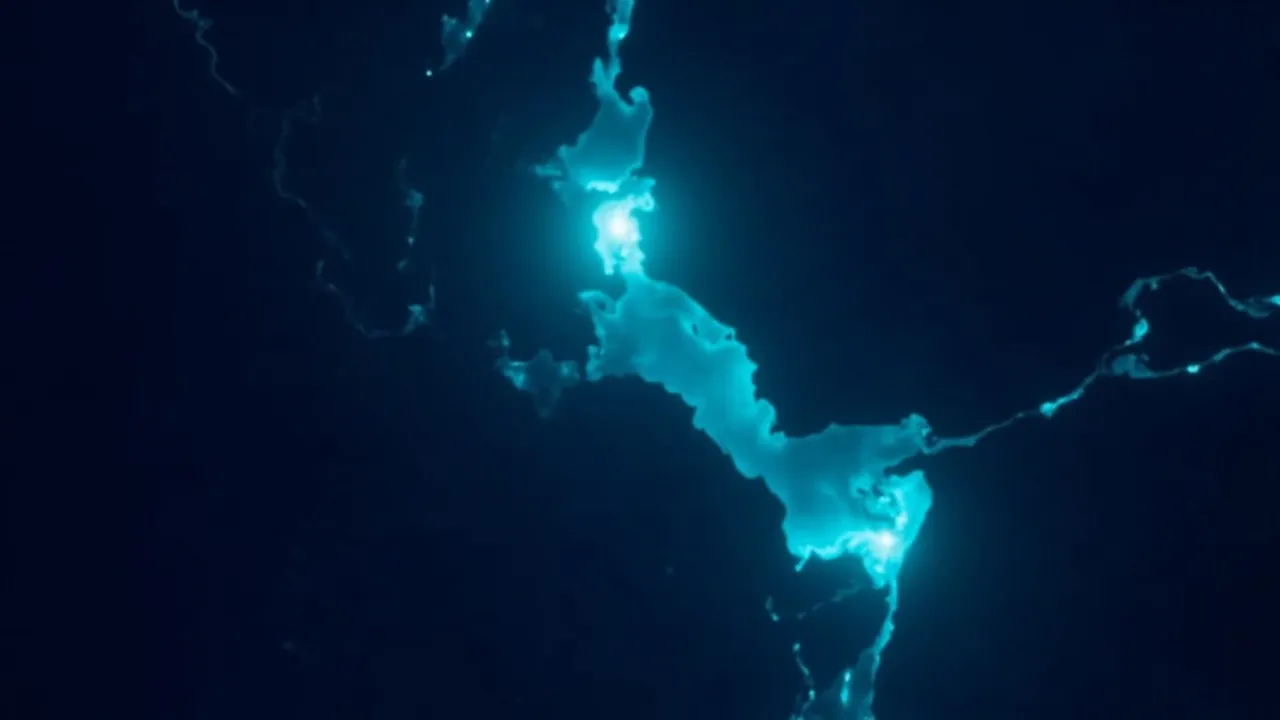
When the Sea Decides to Dress Up
Okay, I have to tell you about something that just blew my mind. You know how sometimes you learn something about our planet that makes you go "wait, WHAT?" That's this.
The Black Sea — fittingly named, right? — is usually, well, black. Dark, deep, moody waters. But every spring and summer, it undergoes what I can only describe as a makeover. Large stretches of it turn this brilliant turquoise color that's so vivid it's visible from SPACE.
NASA's PACE satellite captured this exact phenomenon on June 22, 2026, and the images are absolutely stunning. I mean, we're talking about a body of water that's normally described as "dark" suddenly looking like someone spilled blue paint across the Mediterranean.
So... What's Actually Happening Here?
Here's where it gets really interesting. This isn't pollution, it's not some weird chemical reaction — it's tiny living things doing their thing.
Scientists say the turquoise color comes from something called coccolithophores (try saying that five times fast). These are microscopic phytoplankton — we're talking organisms so small you couldn't see them with your naked eye — but here's the cool part: they're coated in tiny calcium carbonate plates.
When these little guys multiply in enormous numbers during late spring and early summer, their reflective shells scatter sunlight in a way that gives the ocean that milky blue appearance. It's basically millions upon millions of microscopic mirrors floating at the surface.
A Tale of Two Algae
What I find fascinating is that the Black Sea basically has two "moods" throughout the year, depending on which microscopic algae is dominating.
During the turquoise season? That's the coccolithophores doing their thing.
But at other times of year, different algae called diatoms take over. These little critters have silica shells instead of calcium carbonate, and they generally make the water look darker.
So it's not just a seasonal color change — it's literally a completely different ecosystem profile depending on the time of year. Pretty wild when you think about it.
Even the Bosphorus Gets in on It
Here's a fun detail: the seasonal bloom doesn't stop at the Black Sea's borders. It extends into the Bosphorus — that famous narrow waterway running through Istanbul that connects the Black Sea to the Sea of Marmara.
An astronaut on the International Space Station photographed this in May 2026, about a month before the satellite captured the wider scene. The images show the blooming phytoplankton tracing swirling currents on both sides of the channel. It's like watching art being painted in real-time.
Why Should You Care?
Now, I know what you might be thinking: "That's pretty, but why does it matter?"
Fair question! Here me out: these phytoplankton blooms are actually super important for understanding our planet's health.
First, because they're so visible from space, satellites give scientists an incredible tool for monitoring marine ecosystems in areas where collecting water samples is really difficult. Think remote regions, huge expanses of ocean — satellite observations are game-changers.
But here's the part that really blows my mind: these microscopic organisms play a HUGE role in Earth's carbon cycle. As they grow, they absorb carbon from the atmosphere and surrounding water. And when they die? A portion of that carbon sinks to the seafloor, where it can remain stored for incredibly long periods.
In other words, these invisible-to-the-naked-eye creatures are literally helping transfer carbon from our atmosphere into long-term storage. That's a pretty important job for something you can't even see.
The Bigger Picture
I don't know about you, but I find this stuff absolutely fascinating. There's this entire world happening in our oceans that we're only beginning to understand — changes happening on a scale that's visible from space, driven by organisms smaller than a grain of sand.
It makes you think about how interconnected everything is, doesn't it? A satellite 676 kilometers above Earth can detect the presence of microscopic plankton. Those tiny organisms help regulate our climate. And every summer, they put on a show that transforms an entire sea.
The Black Sea isn't black because of pollution or anything dramatic like that. It's just doing its thing, playing host to an invisible ecosystem that reveals itself in the most beautiful way possible.
Sometimes the most extraordinary things in our world are the ones happening right under our noses — or rather, 676 kilometers above our heads.