
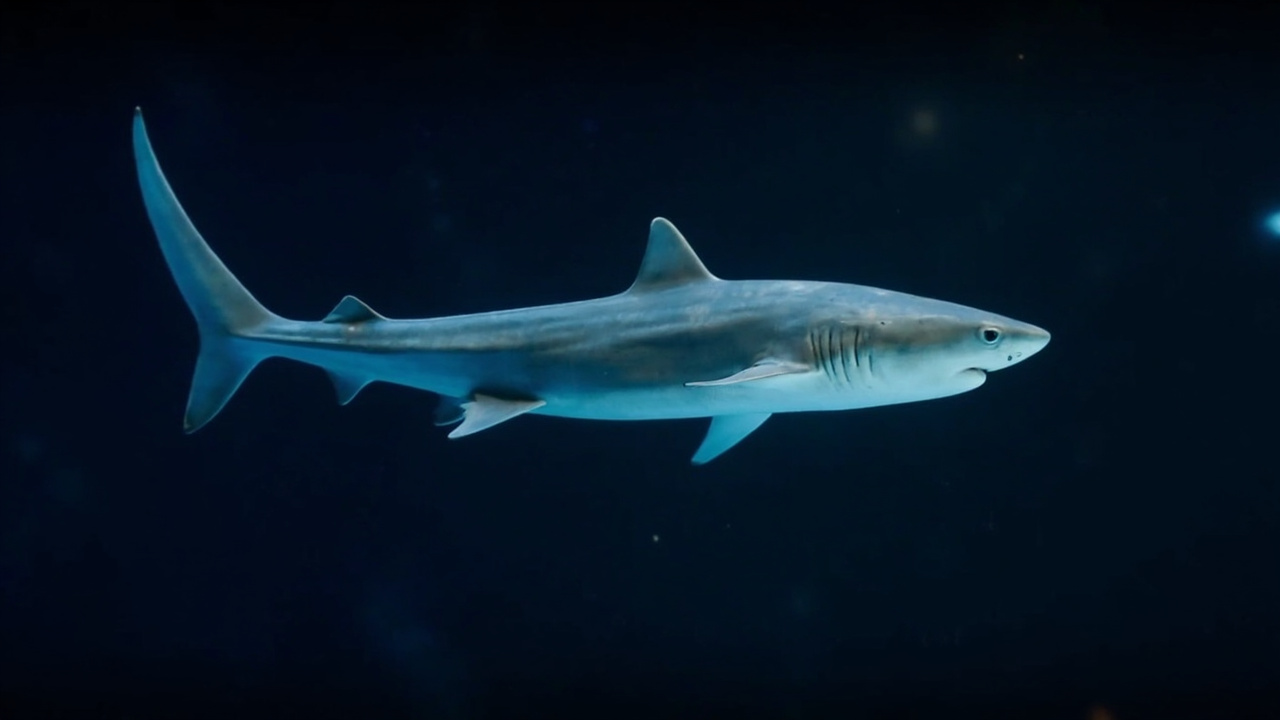
Okay, I need you to picture this with me.
You're floating 1,000 meters down in the pitch-black Pacific Ocean. Your remotely operated vehicle is cruising through the darkness when suddenly... something emerges from the shadows. It has a long, flat snout that looks like a medieval sword, jaws that can literally extend outward to snatch prey, and teeth shaped like little nails. Its skin is a ghostly pinkish-white, almost translucent in certain light.
You'd probably think you'd stumbled onto an alien planet.
But no, my friends—this is good old planet Earth, and this bizarre creature is called the goblin shark.
And here's the amazing news: for the FIRST TIME EVER, scientists have managed to film these incredible animals ALIVE in their natural deep-sea environment. No fishing hooks. No trauma. No premature death. Just... watching them do their thing in the wild.
Finally Meeting the Real Deal
For over a century, our only glimpses of living goblin sharks came from accidental catches. Fishermen would pull them up on lines, and researchers would get brief, tragic windows to study them before the poor animals succumbed to the stress of being dragged to the surface.
Can you imagine? We knew these sharks existed, but we could never actually see them being sharks.
That all changed recently, thanks to a team from the University of Hawai'i at Mānoa. They documented not one, but TWO healthy goblin sharks living their best lives in the deep.
The first sighting came from archived footage—researchers were going through recordings from a 2019 expedition when they spotted a goblin shark casually swimming near an unnamed seamount northwest of Jarvis Island. The second encounter was even more dramatic: a camera captured footage of another goblin shark in the Tonga Trench.
Lead researcher Aaron Judah put it perfectly when he said that seeing this "most iconic of all deep-sea sharks" looking healthy in its natural habitat was "a unique honor."
And honestly? I think he's underselling it. This is a HUGE deal.
Living Fossils Swimming Among Us
Here's what really gets me about goblin sharks: they're essentially windows into prehistoric times.
These odd-looking creatures are the last surviving members of a shark family that goes back nearly 125 million years. That's older than most of the land masses we have today. When dinosaurs were roaming the Earth, goblin sharks were already down there in the deep, doing their thing.
Scientists often call them "living fossils," and that description is honestly the coolest thing I've ever heard. We're talking about an animal that watched continents shift, survived ice ages, and just... kept swimming. And we had no idea they were this widespread.
A Record-Breaking Discovery
Oh, and did I mention the depth thing?
The goblin shark spotted in the Tonga Trench was swimming nearly 700 meters deeper than scientists ever knew these creatures could go. This doesn't just break records for the goblin shark—it sets a new depth record for the entire order of mackerel sharks, which includes great whites, basking sharks, and mako sharks.
You know, the ones we actually know something about.
This discovery also massively expands where we know goblin sharks live. Before, we only had confirmed sightings in limited pockets: off the western United States, Australia, Japan, and a few spots in the Atlantic and Indian Oceans.
Now? The Central Pacific is very much on the map.
Why Should You Care?
Here's the thing that really got me about this research: it shows us why we still need good old-fashioned exploration and natural history work.
Every time we send cameras deeper, every time someone reviews archived footage with fresh eyes, we might discover something completely new. The ocean covers more than 70% of our planet, and we've mapped less than 25% of it.
That's kind of terrifying when you think about it.
But it's also exciting! We're living in an era where we can still make fundamental discoveries about creatures sharing our planet. The goblin shark was out there all along, just... vibing at depth. We just couldn't see it until now.
As Judah pointed out, this new information means goblin sharks can now be included in regional management plans and biodiversity lists for areas where they were previously unknown to exist. That's huge for conservation efforts.
So the next time someone tells you we've discovered everything there is to discover about our planet, you can tell them about the pink, sword-nosed, ancient shark that's been quietly swimming around the deepest parts of the ocean, waiting for us to finally say hello.
And honestly? If you ask me, that's pretty magical.
Source: ScienceDaily