
Okay, I need you to sit down for this one.
Astronomers just found something in space that shouldn't exist. Or at least, according to everything we thought we knew about how the universe works, it really shouldn't exist.
Using the James Webb Space Telescope (JWST)—our most powerful eye on the cosmos—researchers from MIT and other institutions spotted a bright red dot sitting in the very early universe, just a few hundred million years after the Big Bang. That sounds normal enough. JWST has been finding ancient galaxies left and right.
But this one? This one is weird. Really, really weird.
So What Exactly Did They Find?
At first glance, the object looks like an enormous star. We're talking about something roughly the size of our entire solar system. That's already pretty wild, but here's where things get bonkers: it's producing about 100 billion times more energy than any star should be able to generate. Like, if regular stars are standard lightbulbs, this thing is throwing out energy levels you'd expect from something with a black hole at its core.
That's... not how stars work. Stars are powered by nuclear fusion—smashing hydrogen atoms together to create helium and release energy. There's a physical limit to how much energy a star can produce based on its mass. This object blows right past that limit.
The researchers are calling it a "black hole star"—and honestly, that name feels like they're underselling how strange this is.
What's Going On Here?
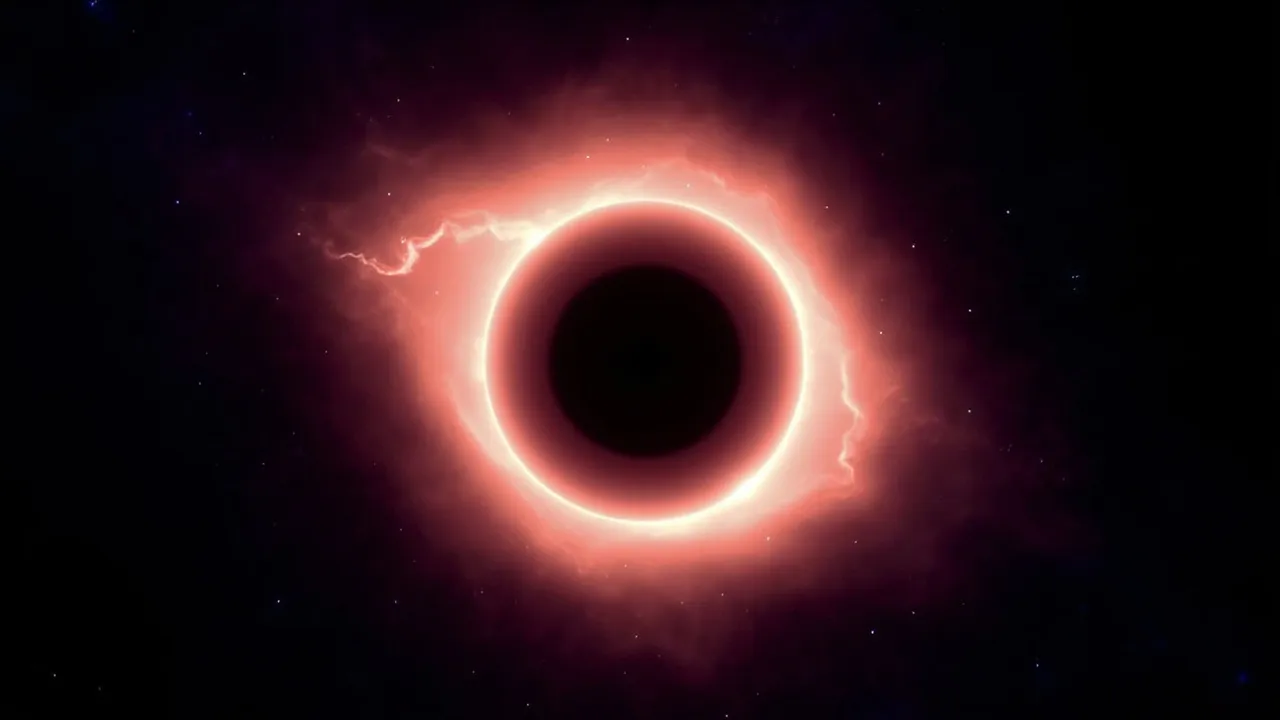
The leading theory is that this might be a black hole wrapped inside an impossibly massive cloud of hydrogen gas—a cosmic cocoon, if you will. Instead of nuclear fusion powering the whole show like a regular star, the black hole at the center would be doing the heavy lifting, energetically speaking.
Lead researcher Rohan Naidu from MIT described it this way: "We think there is a central black hole that is 100,000 times as massive as the Sun. And around this black hole, there would be this very extended envelope of gas that looks like a star the size of the solar system."
Imagine wrapping a black hole in a hydrogen blanket so thick and vast that from the outside, it just looks like one gigantic, glowing star. That's apparently what we're looking at here.
The "Little Red Dots" Mystery
Here's why this matters beyond just "cool space thing." JWST has been spotting these little red dots everywhere in deep space images of the early universe. They're small, they're red, and they basically vanish by the present day. Scientists have been scratching their heads over what they actually are.
Well, this discovery might finally explain them.
If these "black hole stars" exist in the early universe and then disappear over time, that could be exactly what those mysterious little red dots have been trying to tell us. We've been looking at objects that shouldn't exist according to our old models—and now we might have proof.
Why Is This Such a Big Deal?
The object showed something called a "Balmer break" in its light spectrum—the deepest break ever observed in any astronomical object. That essentially rules out ordinary stars as the source. Plus, its light showed almost no heavy elements, just hydrogen and helium. It was truly unlike anything we've cataloged before.
When researchers ran simulations to figure out what could create something this red without dust involved, they found something surprising: an extremely dense screen of hydrogen could do it. Dense enough to mimic a stellar surface on a massive scale.
What Does This Mean for Us?
Honestly? This is the kind of discovery that reminds me why space is so endlessly fascinating. We're not just finding new galaxies or stars out there—we're potentially discovering entirely new categories of astrophysical objects.
The researchers themselves admitted their understanding is "evolving very rapidly." That's scientist-speak for "we've found something that punched a hole in our textbooks, and we're still figuring out what that means."
I don't know about you, but I'm absolutely here for a universe where black holes can wear hydrogen coats and pretend to be stars. The cosmos has been holding out on us, and JWST is finally revealing its secrets.
Source: ScienceDaily — JWST spots a bizarre "black hole star" 100 billion times brighter than a star