
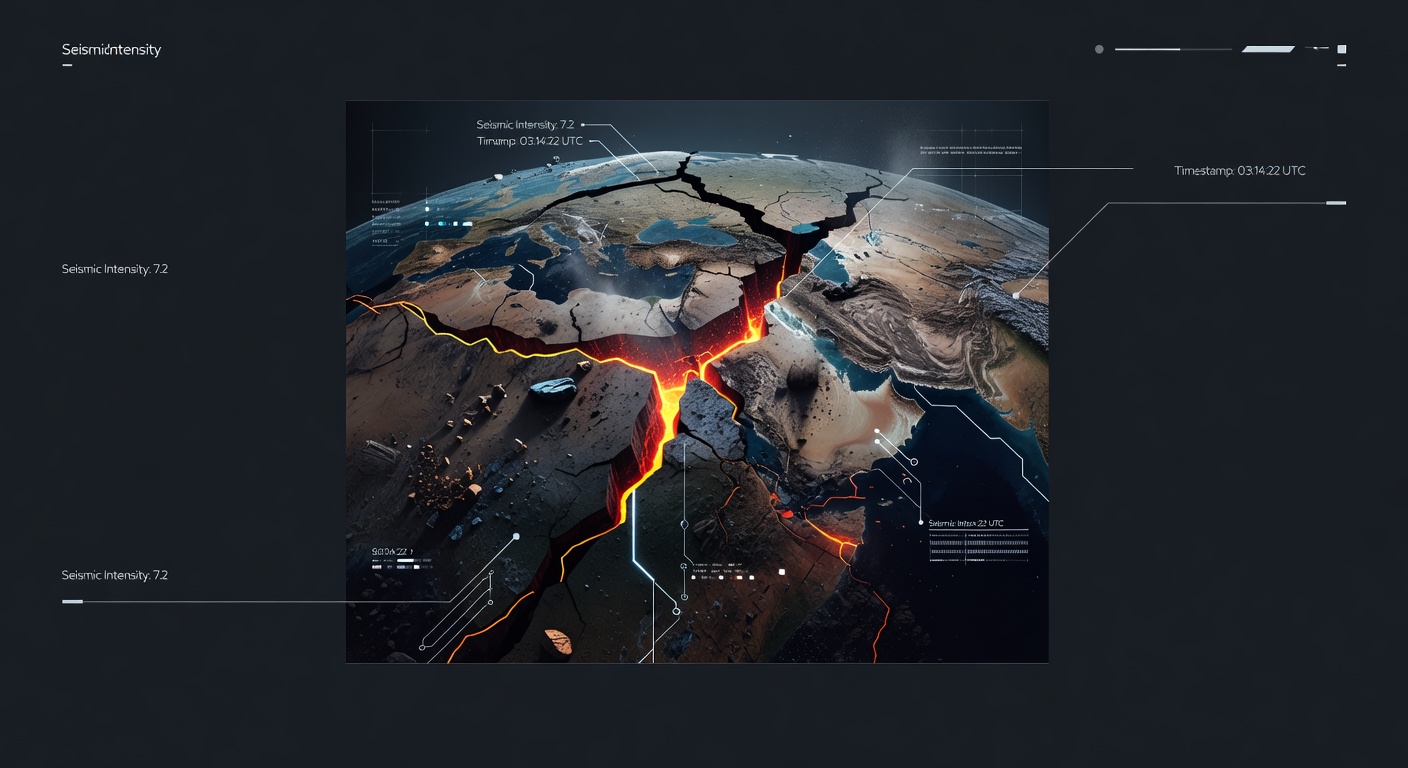
We Finally Caught an Earthquake Splitting the Earth on Camera—And It's Messy
Here's something wild: for the entire history of earthquake science, researchers have been basically working blind. They detect earthquakes with sensitive instruments scattered around the planet, but actually seeing the ground move during a quake? That almost never happens. Until now.
When a CCTV Camera Becomes a Scientific Goldmine
In March 2025, a magnitude 7.7 earthquake ripped through central Myanmar near the Sagaing Fault—the strongest to hit the country in over a century. It was devastating. But buried in the tragedy was an incredible scientific gift: a security camera had recorded the exact moment the fault ruptured.
Think about how rare this is. Imagine if we'd been studying traffic accidents for a hundred years using only insurance paperwork and sound recordings, then suddenly someone handed us high-definition video. That's basically what happened here.
The Ground Moved 8.2 Feet in Just 1.3 Seconds
When researchers at Kyoto University analyzed the footage frame by frame, they discovered something both expected and astonishing. The ground on one side of the fault had lurched sideways by 2.5 meters (about 8 feet) in just 1.3 seconds. That's moving at 3.2 meters per second—faster than a sprinting human.
For context, that amount of sideways movement is pretty normal for this type of earthquake. But the speed? That short burst of movement tells us something important: earthquakes don't happen gradually. They're more like an explosion of motion—everything happens in a flash.
Surprise: Nature Doesn't Color Inside the Lines
Here's where it gets interesting. Scientists had theorized based on indirect measurements that faults might move in slightly curved patterns during earthquakes, but nobody had really confirmed it. The CCTV footage showed exactly that—the ground didn't slide perfectly straight. It curved a little.
This might seem like a minor detail, but it's actually pretty significant. It means that when we're trying to predict how much shaking will happen during future earthquakes, we've been oversimplifying how faults actually behave. The real world is messier than our models.
Why This Changes Everything (Kind Of)
The researcher leading the study, Jesse Kearse, describes the rupture like "a ripple traveling down a rug when you flick it from one end." That mental image is actually perfect—it's not a slow, spreading tear. It's a concentrated pulse of energy that races along the fault line incredibly quickly.
This distinction matters because understanding how earthquakes move tells us about what they'll produce. If we can model these movements more accurately, we get better at estimating ground shaking—which directly affects building codes, emergency planning, and how safe our structures are.
The Bigger Picture
What fascinates me most about this story isn't just the cool video footage (though that's definitely awesome). It's that scientists discovered their assumptions about earthquakes had some gaps in them. And it only took one security camera in the right place at the right time to expose those gaps.
The research team is already planning to use this data to build better physics models of what controls fault behavior. Each new observation takes us a step closer to understanding these powerful natural events—not perfectly, because nature is complicated, but better than we did yesterday.
Sometimes the best scientific breakthroughs don't come from expensive, purpose-built equipment. Sometimes they come from a $200 security camera pointing in the right direction when the Earth decides to shake.