
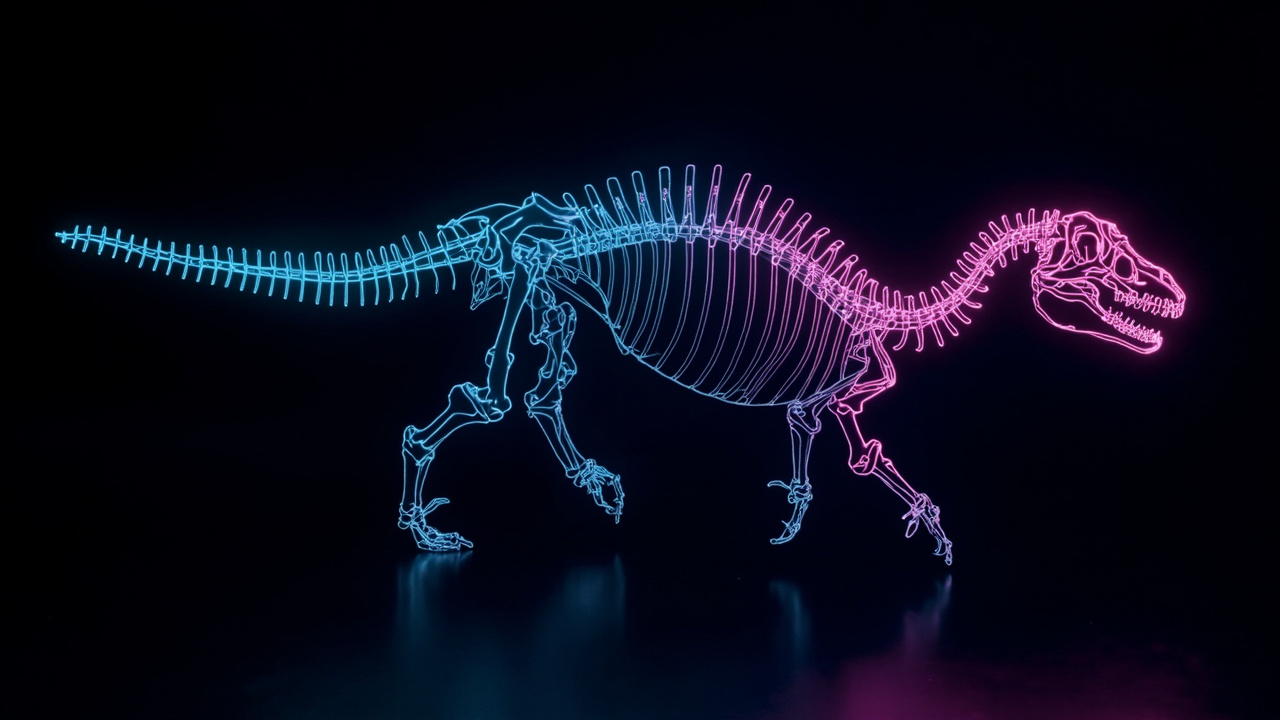
The Dinosaur That Doesn't Play by the Rules
When you think of sauropods, you probably picture those iconic long-necked titans like Brachiosaurus or Diplodocus — the ones that look like someone stretched a giraffe to absolutely ridiculous proportions. For decades, our understanding of these creatures has been pretty straightforward. We've got these massive plant-eaters, and we know roughly how they fit together on the evolutionary tree.
Then along comes Bicharracosaurus dionidei, and it's basically the dinosaur equivalent of a plot twist.
Meet the New Kid on the Block
Here's the thing that makes this discovery genuinely cool: researchers in Argentina found the fossil remains of a sauropod that's roughly 65 feet long — which, yeah, is still absurdly huge by any normal standard, but actually kind of medium-sized in the sauropod world. The scientists recovered over 30 vertebrae from the creature's neck, back, and tail, plus some ribs and part of the pelvis.
The fossil dates back about 155 million years, placing it firmly in the Jurassic period. And it's definitely an adult, which tells us we're not looking at a juvenile that might have grown even bigger.
The Identity Crisis
Here's where things get weird. When researchers looked at the skeleton's features, they found themselves basically staring at a dinosaur patchwork quilt. Some of the bones — particularly the spine — look really similar to Giraffatitan, a long-necked giant that was discovered way over in Tanzania. But then you look at other vertebrae, especially in the back, and they're nearly identical to Diplodocus and its North American cousins.
It's like discovering a creature that inherited traits from two completely different families, and now scientists have to figure out what that actually means.
Why This Matters (More Than You'd Think)
Alexandra Reutter, a doctoral student who led the research, and her team came to an interesting conclusion: Bicharracosaurus appears to be related to the Brachiosauridae family — which would make it the first brachiosaurid ever found in South America from the Jurassic period.
Let that sink in for a moment. We thought we understood how sauropods evolved. But almost everything we know came from fossils found in North America and a few other Northern Hemisphere sites. For years, there was basically just one major fossil site down south — in Tanzania.
This changes everything.
Filling in the Massive Blanks
Professor Oliver Rauhut, the study's lead researcher, explained that this discovery is like finally getting the missing chapters in a book. Scientists have been trying to understand sauropod evolution across the Southern Hemisphere, but it's been like trying to solve a jigsaw puzzle with 90% of the pieces missing.
The fossil site in Argentina's Chubut province is now giving researchers actual comparative material — real bones they can hold and study — that help them piece together how these giants evolved differently on different continents during the Late Jurassic.
Turns out, when continents are separated by millions of miles of ocean, the dinosaurs living on them don't always take the same evolutionary path. Who knew?
A Dinosaur Named After a Farmer
Here's one of my favorite parts of this story: the fossil was first discovered on a farm by a shepherd named Dionide Mesa. The researchers decided to honor him by literally putting his name into the dinosaur's scientific designation. The genus name comes from "bicharraco," which is a colloquial Spanish term for "big animal" — which, honestly, is pretty on-the-nose.
The remains are now housed at the Museo Paleontológico Egidio Feruglio in Trelew, Argentina, where they'll help scientists continue unraveling the mysteries of these incredible creatures.
The Takeaway
Bicharracosaurus dionidei is a perfect reminder that we don't know nearly as much about Earth's history as we think we do. There are still massive gaps in the fossil record, especially from the Southern Hemisphere. Every discovery like this one has the potential to completely rewrite our textbooks.
And sometimes that dinosaur is just hanging out on someone's farm, waiting for someone to notice it.