
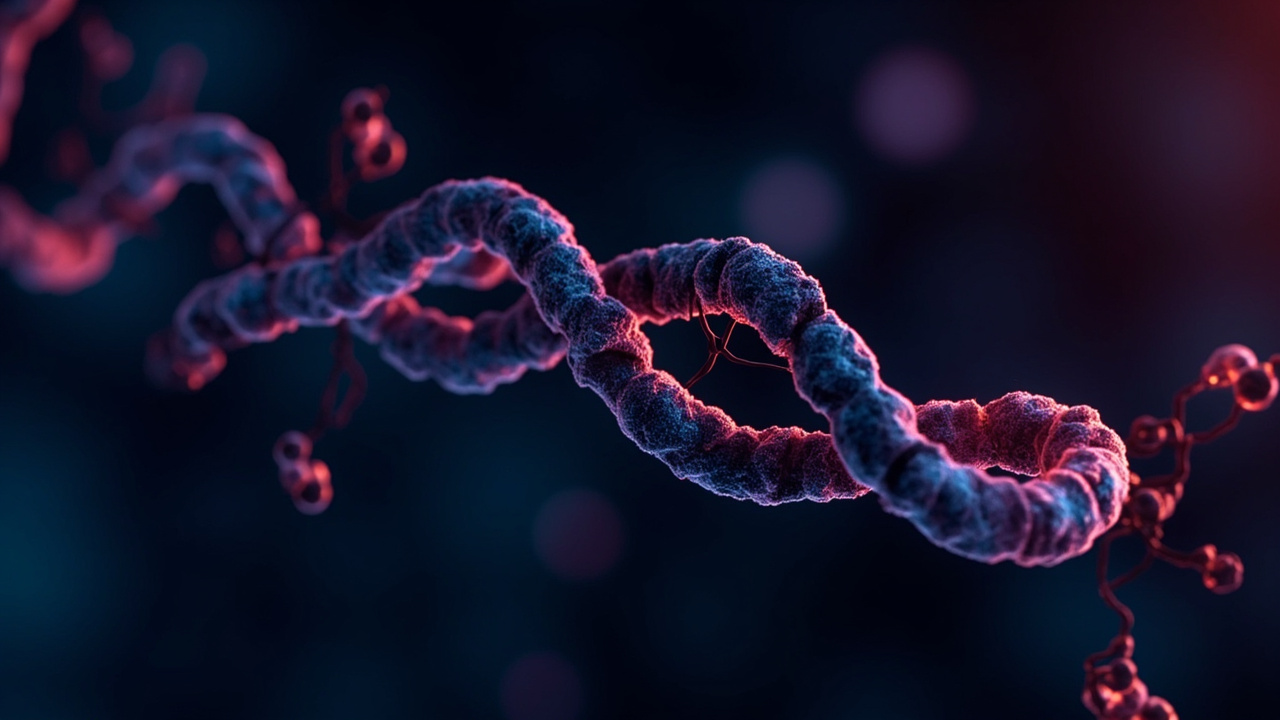
The Discovery That Has Paleontologists Losing Their Minds
Imagine if I told you that we just pulled actual dinosaur proteins out of a fossil. Not impressions of them. Not mineral replacements that look like they used to be there. Actual proteins. You'd probably think I was making it up, right? Well, that's basically what just happened in the paleontology world, and honestly, it's kind of a big deal.
A team of researchers led by the University of Liverpool found something remarkable inside a dinosaur hip bone from South Dakota: traces of collagen, which is the same protein that makes up much of our own bones and connective tissue. We're talking about a 22-kilogram Edmontosaurus sacrum that's been sitting in the ground for 66 million years, and it still has its original organic molecules clinging to it.
The Scientific Skepticism That Led Here
Here's the thing—paleontologists have believed for decades that fossils are basically just rock. Dead, mineralized, completely sterile shells of their former selves. Any organic material? Gone. Destroyed by time, heat, pressure, and bacterial decay. That's just how the world works, right?
Except... some scientists kept finding evidence that suggested otherwise. Starting back in the early 2000s, paleontologist Mary Schweitzer reported finding soft tissues in a T. rex fossil. Then came reports of preserved collagen and blood vessel-like structures in hadrosaur fossils (the relatives of our Edmontosaurus friend). But every time someone made these claims, the rest of the scientific community would basically say: "Nice try, but that's probably just contamination from modern times" or "You're seeing what you want to see."
And you know what? That's actually reasonable scientific skepticism. When something challenges what we think we know, we should be skeptical. The problem was figuring out: were these really ancient molecules, or was someone's lab accidentally contaminated with modern proteins?
Multiple Tests, Same Answer
This is where the new research gets really clever. Instead of relying on a single test method, the Liverpool team used multiple independent approaches to examine the same fossil:
- Protein sequencing to identify the actual protein structure
- Mass spectrometry (several different kinds) to analyze the chemical composition
- Microscopy to look at the bone structure itself
- Amino acid detection to find hydroxyproline, which is a smoking gun for collagen since it's almost exclusively found in bones
When multiple different testing methods all pointed to the same conclusion? That's when you know you're onto something real. It's much harder to argue "contamination" when completely independent lab techniques are all telling the same story.
Why We Should Actually Care
So we found some old proteins in a bone. Cool, but... so what, right?
Actually, this changes everything about how we can study dinosaurs. If proteins survived for 66 million years, that means we might be able to extract information directly from the molecules themselves, not just from bone shape and fossilization patterns.
Think about what becomes possible:
Evolutionary relationships we can't see from bones alone – Different species might have subtle protein differences that would tell us exactly how closely related they were to each other.
Information about how they lived – Growth patterns, aging, disease, even diet might leave molecular fingerprints we can now detect.
A whole new dataset – Museums around the world have thousands of fossils collected over the past century. If collagen survived in this one, it might have survived in others too. We might be sitting on a goldmine of ancient protein data that nobody thought to look for.
The Really Mind-Bending Part
But here's the question that keeps me up at night: How is this even possible?
Proteins are delicate things. They fall apart all the time in our bodies—that's why we need to keep eating them. Under the heat, pressure, and time that geological processes involve, they should completely disintegrate. They should be gone. Turned into sludge. Incorporated into other molecules. Just... gone.
Yet somehow, in the right conditions, in the right rocks, some of these protein fragments are hanging on like tiny molecular survivors. Scientists are still trying to figure out exactly what those "right conditions" are. Is it the specific type of mineral that replaces the bone? Is it being sealed away from oxygen? Is it about temperature stability deep underground?
We don't fully know yet, and that's actually the exciting part.
What Happens Now?
This discovery opens up a whole new chapter in paleontology. Researchers are going to be going back through museum collections, pulling out fossils they thought were "just rocks," and testing them for organic molecules. Ancient papers with electron microscopy images might suddenly reveal hints of preserved collagen that nobody noticed before because nobody was looking for it.
The debate in paleontology isn't totally settled—some scientists will want to see this replicated in other fossils, and that's fair. But the evidence here is pretty compelling. And it's making us realize that maybe, just maybe, fossils aren't as dead as we thought.
The dinosaurs died 66 million years ago, but in a weird way, little pieces of them are still here, waiting in the rocks for us to find them.