
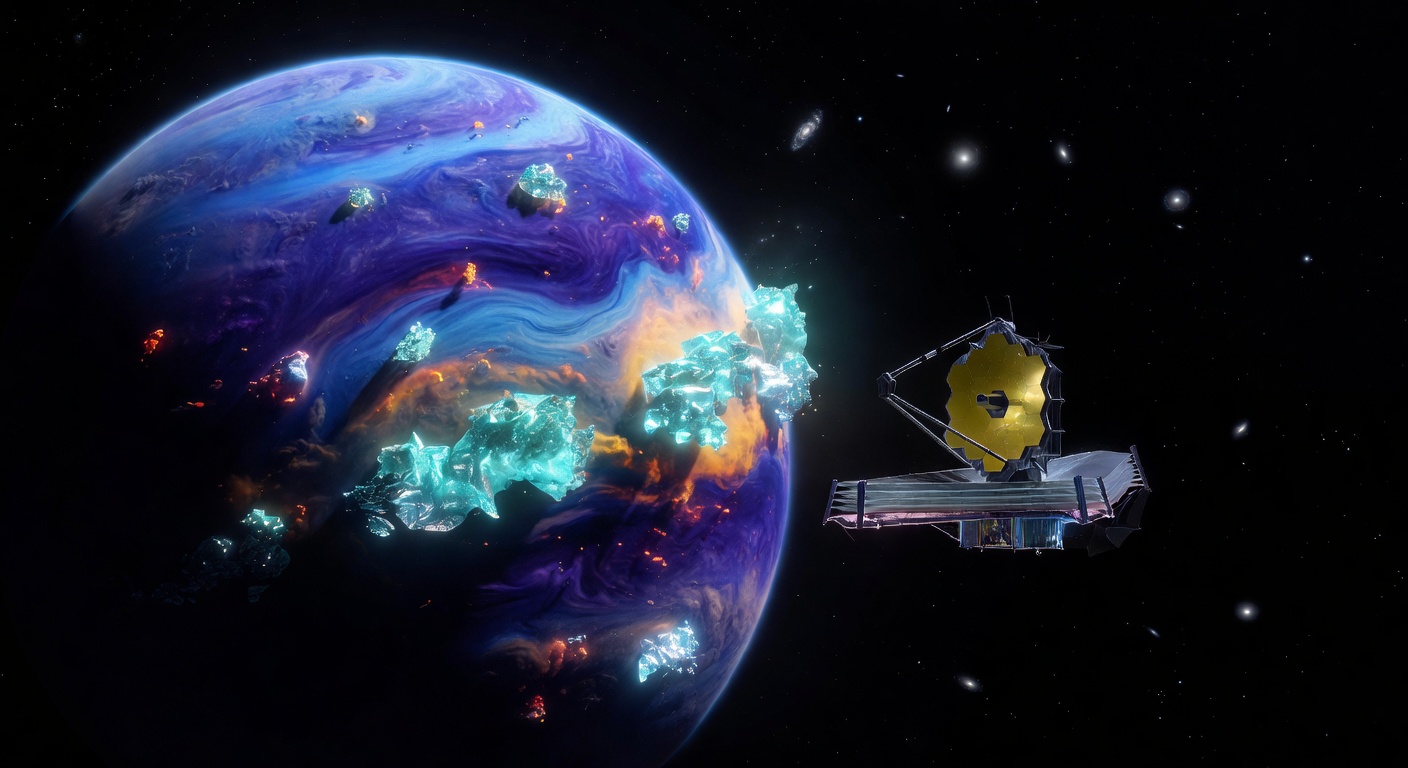
When Your Models Get Completely Blindsided
You know that feeling when you're absolutely certain how something should work, then reality just throws a curveball and smacks you in the face? That's basically what happened to a team of astronomers recently. They were studying a distant gas giant called Epsilon Indi Ab using the James Webb Space Telescope, expecting to see one thing, and instead found something that made them go, "Wait... that's not supposed to be there."
The planet is located in the constellation Indus (way down in the southern sky, so sorry Northern Hemisphere folks), and it's roughly similar to Jupiter—except it's heavier, about 7.6 times Jupiter's mass. But here's where things get interesting: in its atmosphere, scientists discovered thick water ice clouds. Which might not sound shocking, except these clouds basically broke the textbooks.
Why This Is Actually Mind-Blowing
Let me explain why this matters. For decades, astronomers have been obsessed with studying exoplanet atmospheres. It's kind of the Holy Grail of space research because understanding what's in distant planets' atmospheres gets us one step closer to eventually finding life somewhere out there. But for a long time, we were basically playing blind—we could detect that planets existed, but we couldn't really see what they were made of.
Then the James Webb Space Telescope launched in 2022, and suddenly everything changed. For the first time ever, we had a tool powerful enough to actually peer into the atmospheric composition of planets around other stars. It was like upgrading from binoculars to a microscope.
The Jupiter Problem Nobody Talks About
Here's the thing about studying Jupiter-like planets: most of the gas giants we've found orbiting other stars are absolutely scorching hot. That's because the easiest way to detect exoplanets and study their atmospheres is to watch them pass in front of their host stars—like watching a transit. Planets close to their stars are way more likely to do this, but they're also way hotter, so they're not great analogues for studying planets like our own Jupiter.
That's why what Elisabeth Matthews and her team did was so clever. Instead of relying on that standard transit method, they used JWST's mid-infrared instrument to directly image Epsilon Indi Ab. They literally photographed the planet's thermal glow. It's kind of like finally seeing someone in the dark by detecting their body heat instead of waiting for them to walk past a streetlight.
The Discovery That Broke Everything
When the team looked at the images, they were hunting for ammonia. Jupiter's atmosphere is dominated by ammonia gas and ammonia clouds, so they figured Epsilon Indi Ab would follow the same script. But the ammonia levels were way lower than the models predicted.
So what's blocking the ammonia clouds? Water ice clouds. Think of them like the cirrus clouds you see streaking across Earth's sky on a clear day—thin, wispy, beautiful. Except on this alien planet, they're thick, uneven, and totally unexpected.
The temperature at Epsilon Indi Ab is somewhere between -70°C and +20°C (it orbits pretty far from its star), so having water ice clouds makes some physical sense. But the fact that they're there at all means our computer models of how planetary atmospheres work are... well, incomplete.
Why Your Favorite Space Models Just Got Embarrassed
Here's the embarrassing part for scientists: most atmospheric models for exoplanets don't even include clouds. At all. Why? Because clouds are a nightmare to simulate. They're chaotic, uneven, and incredibly complicated. So researchers often just... left them out.
"Yeah, we're not modeling clouds because they're too hard" is basically the scientific equivalent of saying "I didn't do my homework because math is hard." Except it actually matters when you're trying to understand alien planets.
This discovery is basically a big neon sign flashing: "Hey, you NEED to figure out how to model clouds if you want to understand these worlds." And that's a good thing, even though it's frustrating for the researchers who spent years on models that just got significantly outdated.
Where Does This Lead Us?
The really cool part is that this is just the beginning. Elisabeth Matthews makes a great point: if aliens somewhere in the galaxy were looking back at our solar system through a telescope as powerful as JWST, they could study Jupiter in detail. But Earth? That would require a much, much more advanced telescope than we currently have.
So what we're doing now is basically practice. We're learning to study Jupiter-like planets so that eventually—maybe in 20 or 30 years—we'll have telescopes powerful enough to study Earth-like planets and actually search for signs of life. Epsilon Indi Ab is like our training ground.
This discovery also shows us that exoplanet atmospheres are way more complex and varied than our initial models suggested. Every new observation throws another puzzle piece on the table, and we're slowly figuring out how to assemble the whole picture.
The Bottom Line
The universe is spectacularly good at surprising us. We built the most powerful space telescope ever created, pointed it at a distant gas giant, and instead of confirming what we thought we knew, it showed us how much we still have to learn. That's not a setback—that's progress. And honestly? That's what makes science so fascinating.
The ice clouds of Epsilon Indi Ab might seem like a small detail, but they're a reminder that exploring the cosmos is still full of mysteries. And we're just getting started.