
The Plot Thickens on Mars
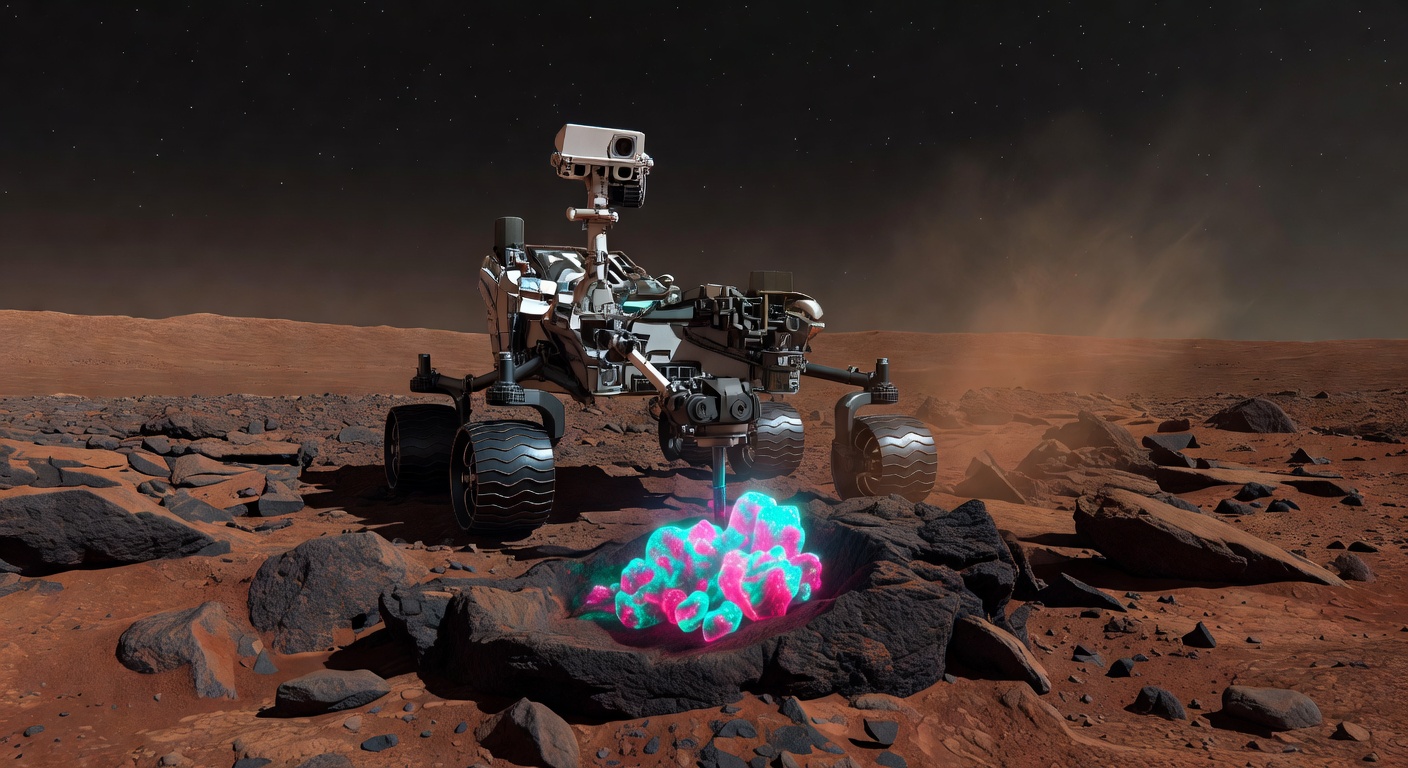
Okay, so here's the thing about space exploration that gets me every time: sometimes the most groundbreaking discoveries happen when robots are just... doing their job. That's what happened when NASA's Curiosity rover—basically a car-sized scientist rolling around on another planet—decided to run an experiment in 2020 that revealed something genuinely mind-blowing.
In a region of Mars called Glen Torridon, Curiosity found over 20 different organic molecules. Not just a couple. Not just the usual suspects. We're talking about a real chemical party happening in Martian rocks.
Why This Matters (And Why We're Not Freaking Out Yet)
Before you start imagining ancient Martian civilizations, let me pump the brakes a little. Finding organic molecules on Mars doesn't mean we've found proof of life. Think of it like this: if you find a wooden spoon in an old house, it tells you someone was there and cooking, but the spoon itself didn't do the cooking.
What's genuinely exciting here is that scientists found compounds that are absolutely essential for life as we understand it. One molecule even has a structure similar to the building blocks of DNA—something that's never been detected on Mars before. That's the kind of discovery that makes planetary scientists lose sleep in the best way possible.
The Real Head-Scratcher
Here's where it gets interesting: we still can't figure out where these molecules came from. Did they come from ancient Martian organisms? Did they form through plain old chemical processes in the Martian soil? Or did meteorites bring them to Mars billions of years ago? It's like finding a mystery letter in your attic—you know someone wrote it, but you have no idea who.
Amy Williams, a University of Florida researcher who helped design this experiment, puts it perfectly: finding preserved organic matter tells us that Mars could have supported life, even if it doesn't prove that it actually did.
How They Actually Found This Stuff
This is the kind of experiment that makes you appreciate how clever our robots have become. Curiosity used a special instrument called SAM (Sample Analysis at Mars—NASA loves their acronyms), which can analyze the chemistry of Martian rocks with incredible precision.
The clever part? Scientists used a chemical called TMAH to essentially crack open the larger molecules like you'd crack open a walnut. This breaks them down into smaller pieces that the rover's instruments can examine. It's like having a tiny kitchen sink chemistry lab sitting on Mars, millions of miles from the nearest human.
But here's the kicker—Curiosity only brought about two cups of this TMAH chemical with it. You can't exactly ask for a refill from Earth. So scientists had to be super strategic about where to use it. They picked Glen Torridon specifically because it's rich in clay minerals that form in the presence of water. These clays are like nature's preservative jars—they're fantastic at keeping organic molecules safe for billions of years.
What This Means for Future Missions
The success of this experiment is already changing how we plan future missions. Upcoming rovers headed to Mars, and even NASA's Dragonfly mission to Saturn's moon Titan, are going to carry similar chemistry kits specifically designed to hunt for organic molecules.
Why? Because now we know that these molecules can stick around on Mars for 3.5 billion years without getting destroyed. That's huge. It means if ancient life ever existed on Mars, we might actually be able to find its chemical fingerprints.
The Big Picture
Here's what gets me about this discovery: it proves that Mars wasn't just a boring, dead rock floating through space. It was a place with chemistry happening, with conditions that could have supported life. Whether or not that life actually existed is still a mystery we're working to solve.
The real answer to whether Mars ever had life isn't going to come from a rover rolling around the surface. It's going to come from scientists back on Earth, examining actual Martian rocks in laboratories. That's why NASA is so focused on bringing Martian samples back home. Once we can study these rocks with all our best tools and expertise, we might finally get the answer to one of the biggest questions humanity can ask: Are we alone?
For now, Curiosity has done something pretty amazing—it's shown us that Mars is worth looking at more closely. And honestly, in the search for life in the universe, that's exactly the kind of discovery that keeps the dream alive.