
The Universe's Greatest Mystery Is About to Get Solved (Maybe)
Okay, so here's a wild fact: everything you can see—stars, planets, your cat, the pizza you had for lunch—makes up only about 15% of all the matter in the universe. The remaining 85%? Complete mystery. Scientists call it "dark matter," and basically no one knows what it is.
For decades, physicists have been scratching their heads wondering where all this invisible stuff is hiding. And last month, they activated a machine that might finally give us some answers.
Going Deep Underground (Literally)
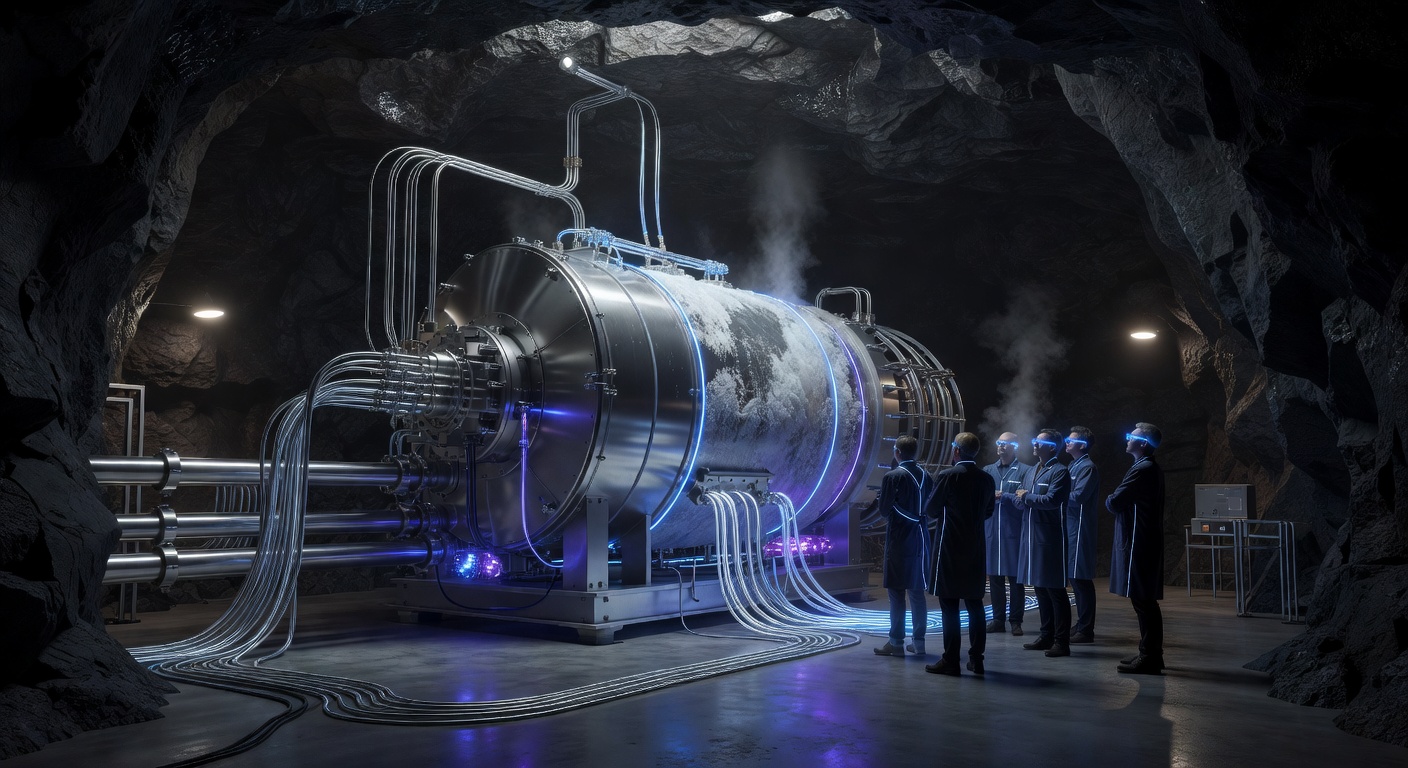
The Super Cryogenic Dark Matter Search—or SuperCDMS if you want to be cool about it—just reached its operating temperature. And I'm not talking about a walk-in freezer. I'm talking about a few thousandths of a degree above absolute zero. That's hundreds of times colder than the vacuum of space.
Where's this arctic laboratory? Buried 6,800 feet underground in an active nickel mine near Sudbury, Ontario. I know what you're thinking: why bury it so deep? The answer is brilliantly simple. By going deep underground, the detector is shielded from cosmic rays and other interference from space that would contaminate the results. It's like trying to hear a whisper at a rock concert—you need to get away from the noise.
Engineering at the Extremes
The actual detector is basically a 13-foot cylinder made of incredibly pure materials: lead to block radiation, polyethylene to reduce neutrons, and crystals of silicon and germanium that are so clean they could practically pass a health inspection.
The cold temperatures are absolutely crucial here. At these extreme colds, atoms barely vibrate at all, which means the detector can sense the tiniest interactions. If a dark matter particle (called a WIMP, which I love because physicists have a sense of humor) passes through and hits an atom, the detector will pick up the subtle vibrations and electrical signals. Nothing else produces such a unique signature at these temperatures.
Why This Actually Matters
Here's the thing that gets me excited: we've been looking for dark matter for decades. SuperCDMS's predecessor ran from 2011 to 2015 and found nothing, which sounds disappointing but actually isn't. Negative results narrow down where dark matter could be hiding. This new version is way more sensitive—it's got more sensors, better artificial intelligence to analyze the data, and years of improved technology backing it up.
Noah Kurinsky, one of the engineers who helped design the detectors, said "every day will be new" when they start taking real data. That's the kind of optimism that reminds me why people become physicists.
The Waiting Game
Here's the slightly less exciting part: we have to wait a few more months while the team calibrates everything and makes sure all the sensors are working properly. After nearly a decade of construction, a few more months is basically nothing. Then, finally, we'll see if this $35 million investment actually spots the stuff that holds galaxies together.
If SuperCDMS detects dark matter? It would be one of the biggest scientific discoveries of our lifetime. We're talking Nobel Prize territory. If it doesn't find anything? Well, that's also valuable because it tells us exactly where dark matter isn't, which narrows the search for the next generation of detectors.
Either way, something genuinely historic is about to happen 6,800 feet underground in a Canadian mine. And honestly? That's pretty cool.