
We're Finally Going Back to the Moon (And It's Actually Happening)
Remember when space exploration felt like this quaint thing our grandparents talked about? Well, buckle up, because NASA just launched Artemis II, and we're officially entering a new era of human spaceflight. Four astronauts just blasted off on a 10-day journey to circle the Moon—something no human has done since 1972. Wild, right?
The Big Picture: Why This Matters
Here's the thing that gets me excited about this mission: it's not just about going to the Moon for the sake of it. This is a test run. Think of Artemis II as NASA's way of saying, "We're going to prove we can do this safely, and then we're going to actually land people on the lunar surface." And after that? Mars is on the horizon.
For decades, we've been stuck in Earth's orbit, doing amazing things with the International Space Station and satellites, but we haven't ventured much beyond that cosmic backyard. Artemis II is changing that narrative.
Meet the Crew
Four astronauts are on this wild ride: Reid Wiseman, Victor Glover, and Christina Koch from NASA, plus Jeremy Hansen from the Canadian Space Agency. These aren't just any space travelers—they're the first humans in a generation to go this far from home. And they're not just passengers; they're actively testing systems and handling the spacecraft manually. It's like being a test driver for humanity's future.
How the Mission Works
The spacecraft, named "Integrity" by the crew (I love that they get to name it), launched from Kennedy Space Center on April 1, 2026, aboard the massive SLS rocket. After blasting into space, the mission follows a carefully choreographed sequence:
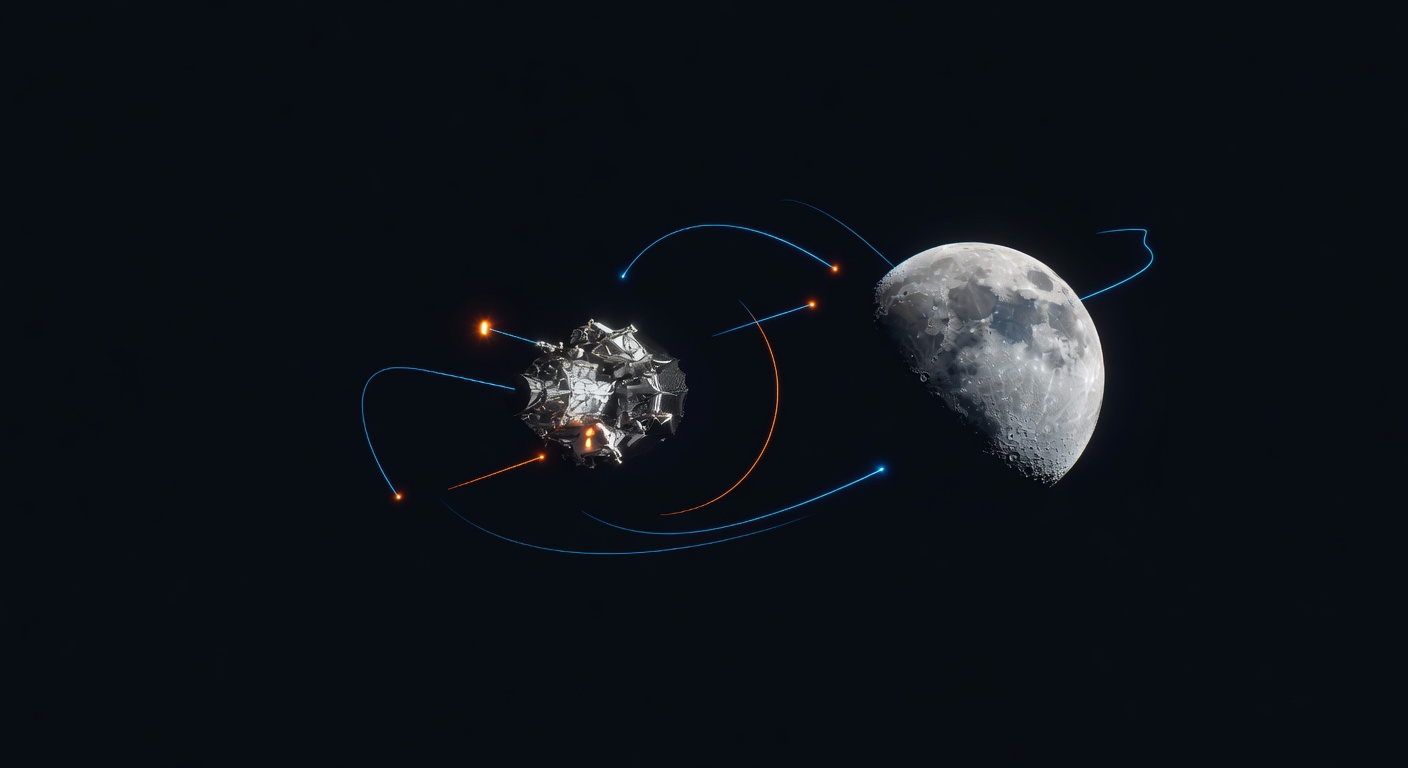
The journey begins in Earth orbit. The rocket places Orion into a high orbit about 46,000 miles above Earth. The astronauts spend time here testing how the spacecraft handles—basically making sure everything works before they commit to the Moon run.
Then comes the big burn. A few hours later, the spacecraft fires its engines to head toward the Moon. This "translunar injection" burn is crucial—it's the moment when Earth orbit gives way to a lunar trajectory.
Around the Moon they go. When Orion approaches the Moon on April 6, the crew will spend several hours observing and photographing. And here's something genuinely cool: they'll see parts of the far side of the Moon that have only been viewed by spacecraft until now. The long shadows from the partially illuminated surface will reveal crater details and mountain ranges in stunning detail.
Gravity does the rest. The Moon's gravity actually helps guide Orion back to Earth, which is elegant physics in action.
The Bigger Story
What I find most compelling about Artemis II is what it represents. For half a century, we stepped away from the Moon. Technology advanced by leaps and bounds, but we didn't go back. Now, finally, we're returning—not as a one-time stunt, but as the foundation for something permanent.
NASA isn't just sending astronauts to visit the Moon and come home. The plan is to establish a sustained presence there, to learn how to live and work on another world, and to use that knowledge to eventually reach Mars. Each mission builds on the last one.
The Small Satellite Surprise
One detail I appreciated: Orion will release four CubeSats—tiny satellites built by international partners from Argentina, Germany, South Korea, and Saudi Arabia. While the astronauts circle the Moon, these little tech demonstrations will be doing their own science experiments. It's a reminder that space exploration is increasingly a global endeavor.
What Happens Next?
This 10-day mission is just the beginning. If everything goes smoothly, NASA will use what they learn from Artemis II to prepare for Artemis III, which will actually land astronauts on the Moon's surface. After that, a lunar base. Then Mars.
It's a long campaign, but after 50 years of not going back, momentum is finally building again.
The Bottom Line
There's something uniquely human about the drive to explore. We want to see what's beyond the horizon, to push boundaries, to reach higher. Artemis II reminds us that this instinct is still alive and well. Sure, we have different technology and different challenges than the Apollo astronauts of the 1960s and 70s, but the fundamental goal remains the same: to go farther, to learn more, and to prove that we can thrive beyond our home planet.
For anyone who's ever looked up at the Moon and wondered what it would be like to go there, this mission is for you. It's happening. It's real. And honestly? The future of human space exploration just got a whole lot more interesting.