
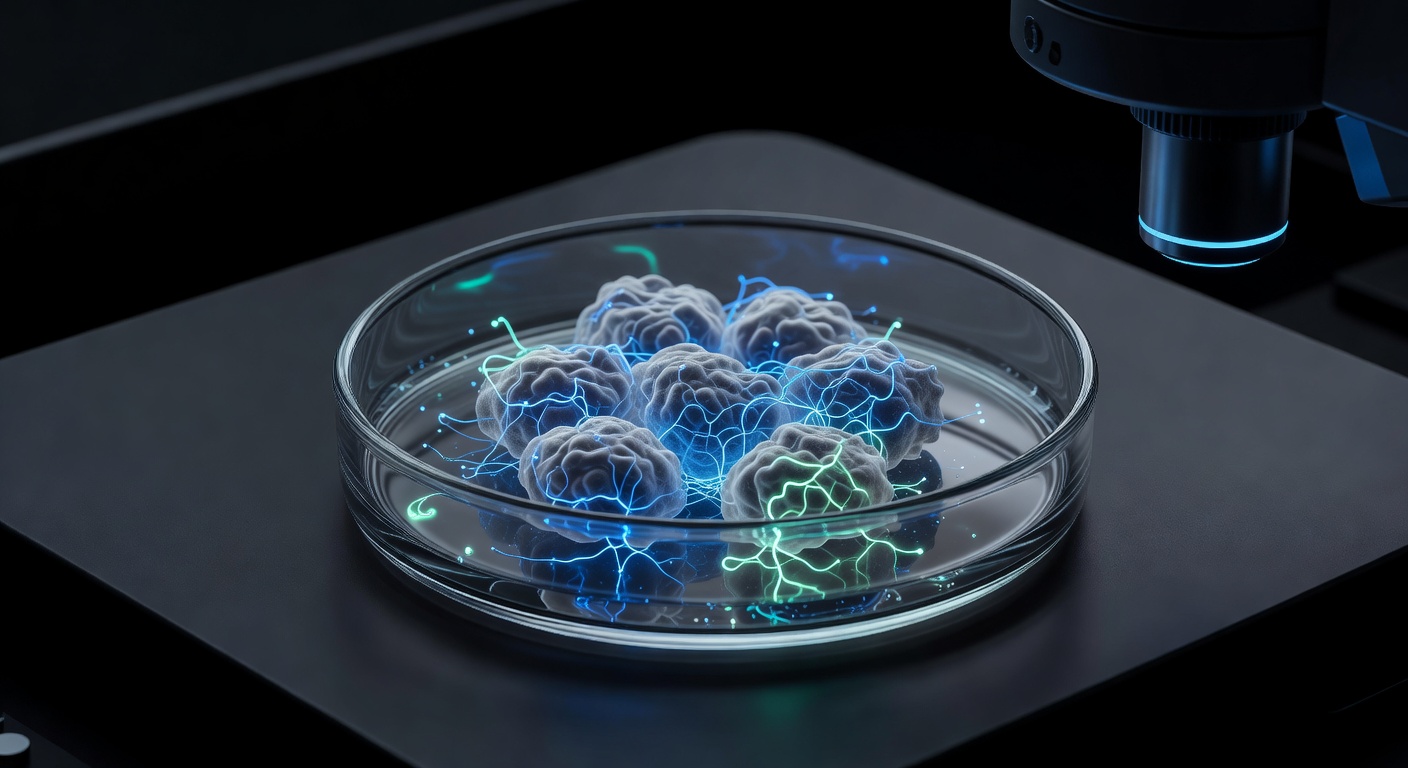
The Weird Science of Building Brains Without a Skull
Imagine if I told you scientists are literally growing brains in dishes right now. Not full brains, obviously, but actual clumps of brain tissue that can think... well, kind of. It sounds like science fiction, but it's happening in labs around the world, and honestly, it's both fascinating and a little unsettling.
The story starts back in 2013 when researchers figured out how to coax cells into forming miniature brain structures called organoids. The nickname "mini-brains" caught on immediately because, well, they look kind of like tiny brains and they act a little bit like them. But here's the thing—calling them that is actually pretty misleading, and the scientists working with them hate that label.
So What Exactly Are These Things?
Think of an organoid as a simplified model rather than a tiny copy. You start with cells—sometimes stem cells, sometimes regular skin cells that you've chemically convinced to become stem cells—and you let them grow in a dish. Over time, millions of neurons start connecting to each other and organizing themselves into structures that vaguely resemble parts of an actual brain.
The catch? They're really primitive compared to your brain. We're talking about structures that contain less than 0.002 percent of the neurons you have bouncing around in your skull. They lack blood vessel systems, they don't get sensory input from the world, and they're basically at a developmental stage that would be equivalent to a human fetus that's only a few weeks along.
Where This Gets Actually Cool
The real breakthrough isn't just making one organoid—it's connecting multiple organoids together into something called an assembloid. Researchers have started creating interconnected systems of these mini-structures that can model how different parts of the brain communicate.
One of the most impressive examples combines four different types of organoids to recreate how the brain processes pain signals. They've literally built a tiny pain pathway that connects brain tissue to spinal tissue, all in a dish. It's the kind of thing that makes you go, "Okay, that's pretty incredible," while simultaneously wondering if we're playing with fire here.
The Question Everyone's Actually Wondering
Here's where it gets philosophical: if we keep making these organoids more complex and more interconnected, could they eventually become... conscious? Could we accidentally create awareness in a petri dish?
The honest answer from people who actually study consciousness? "Maybe someday, but definitely not right now."
According to Alta Charo, a bioethicist at the University of Wisconsin, we can't really say we understand what consciousness even is or how to measure it. But she's pretty confident that current organoids aren't anywhere near developing anything resembling consciousness. They're just too simple, too disconnected from everything else, and too developmentally immature.
Neuroscientist Sergiu Pașca from Stanford, who helped create that impressive pain pathway assembloid, is equally clear: these aren't miniature brains. They're simplified, unfinished models missing huge chunks of what makes a brain... well, a brain. They don't have the physical structure of a real brain, they don't have sensory experiences, and they're not integrated with any kind of body.
When Should We Actually Start Worrying?
The scientists seem surprisingly chill about the whole thing, which is partly reassuring and partly funny. They're basically saying, "Look, if we somehow managed to grow these things to be 1,000 times larger, properly shaped, and somehow connected to a body, then we should probably have some serious conversations about what we're doing."
Right now? We're nowhere close to that scenario.
That said, researchers aren't completely ignoring the ethical implications. The U.S. National Academies of Sciences, Engineering, and Medicine published a report in 2021 specifically addressing the ethics of brain organoids. Their conclusion: these organoids don't meet any current criteria for consciousness, but we should keep an eye on things as the technology gets more advanced.
The Real Ethical Minefield
Here's what's actually getting more attention than the consciousness question: what happens when you implant organoids into living animals' brains? That's where things get genuinely murky from an ethical standpoint. Scientists are actively monitoring this and thinking carefully about the implications.
It's not about a lab-grown brain suddenly waking up and asking existential questions. It's about whether we have the right to modify animal brains in this way and what responsibilities come with that.
Bottom Line
We're genuinely in the early chapters of this story. The organoid technology is real, it's advancing quickly, and it's going to help us understand brain development and disease in ways we couldn't before. That's genuinely exciting for patients with neurological conditions.
But the doomsday scenario of accidentally creating consciousness in a petri dish? That's still firmly in the realm of science fiction. Right now, these organoids are more like extremely sophisticated biological models than anything remotely conscious.
Still, the experts are keeping their eyes open, and honestly, that's probably the smartest approach. Science moves fast, and it's better to think about the ethical questions before they become real problems rather than after.
Pretty wild stuff, right?