
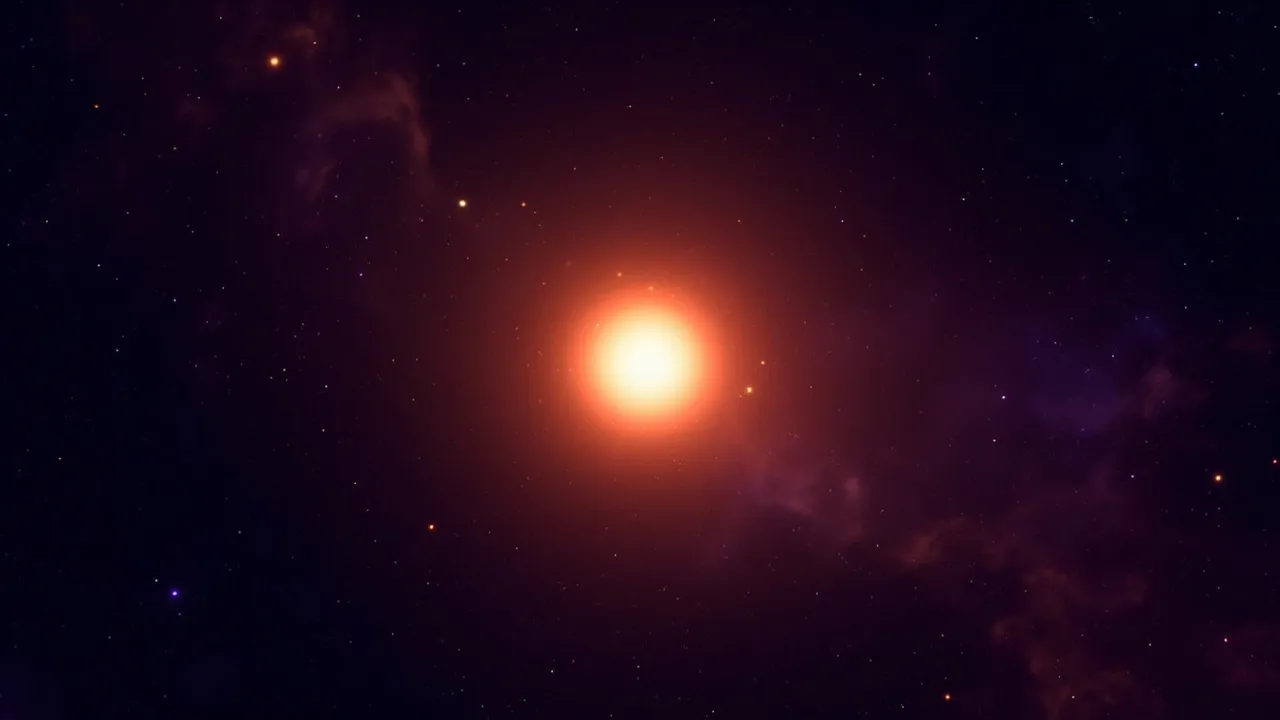
So here's something wild to chew on: you're made of the same stuff as distant stars. I know, I know — it sounds like something a hippie would say while staring at the night sky. But as it turns out, there's some actual science backing up this cosmic connection.
The Planet That Changed Everything
Let me introduce you to WASP-189b. No, it's not a robot from your favorite sci-fi movie — it's a planet located about 320 light-years away in the constellation Libra. And honestly? This world makes Earth look like a cozy little paradise.
We're talking about an "ultra-hot Jupiter" — a gas giant that orbits incredibly close to its star. So close, in fact, that temperatures on WASP-189b can reach a scorching 3,600 degrees Fahrenheit. At those temperatures, even rock-forming elements like magnesium and silicon — stuff you'd normally find locked up in solid minerals — actually vaporize into gas. Wild, right?
The "Duh" Moment Scientists Finally Proved
Here's where things get really interesting. Scientists have long suspected that planets and their host stars share similar chemical makeups. The reasoning is pretty intuitive: both form from the same cosmic nursery — a giant disk of gas and dust swirling around a young star.
Think of it like baking a cake. If you throw flour, sugar, and eggs into the same bowl, everything that comes out of that oven is going to share the same basic ingredients. Stars and their planets work the same way.
But here's the thing — and this is what gets me excited — nobody had actually proven this assumption before. We'd seen hints in our own Solar System, sure. Earth, Mars, Venus? They all contain similar proportions of rock-forming elements as our Sun. But we hadn't observed this relationship directly in a planetary system beyond our own.
Until now.
Breaking Down the Universe (Literally)
A research team led by Jorge Antonio Sanchez from Arizona State University pointed the Gemini South telescope in Chile at WASP-189b. Using an instrument called IGRINS (which sounds like something from a Transformers movie, honestly), they did something groundbreaking: they measured both magnesium and silicon simultaneously in the planet's atmosphere.
And guess what they found?
The ratio of magnesium to silicon in WASP-189b's atmosphere matched the ratio in its parent star. Almost exactly.
This is the first direct observational proof of what scientists have assumed for years. It's like finally having photographic evidence of that thing your grandmother always claimed happened — vindication!
Why Should You Care?
Okay, I can hear you asking: "That's cool for astronomers, but why does this matter to me?"
Great question. Here's why this matters:
First, it's a window into planetary origins. Understanding how planets form helps us understand our own Solar System's history. How did Earth end up here? Why is Venus a hellscape while we're enjoying relatively mild temperatures? These questions tie back to the building blocks that formed our world.
Second, it helps us hunt for habitable worlds. If we can study a star's chemistry, we can actually predict what kind of planets might orbit it — including whether those planets might have the right ingredients for life. The elements that make up a rocky planet influence everything: plate tectonics, magnetic fields, volcanic activity, even the chemistry of oceans and atmospheres.
Earth's elemental composition is partly why our planet can support life. The right balance of iron, magnesium, silicon, and other elements helped create the geological processes that cycle carbon, generate magnetic fields that protect us from solar radiation, and keep our planet's interior nice and geologically active.
The Bigger Picture
Look, I'll admit it: sometimes astronomy can feel a bit... abstract. We point telescopes at things millions of light-years away and try to make sense of cosmic statistics. But discoveries like this remind me why I find space science so endlessly fascinating.
We're not just cataloging distant objects. We're figuring out our own story — tracing the cosmic origins of every atom in your body back to ancient stars that lived and died before our Sun was even born.
That magnesium in your bones? Formed in the heart of a massive star that exploded billions of years ago. The silicon in your fingernails? Same story.
We're all, quite literally, made of star stuff — and now we have the observational evidence to prove the connection between the heavens above and the planets beneath our feet.
Pretty humbling when you think about it. And also kind of beautiful.
Source: https://www.sciencedaily.com/releases/2026/10/261012185015.htm