
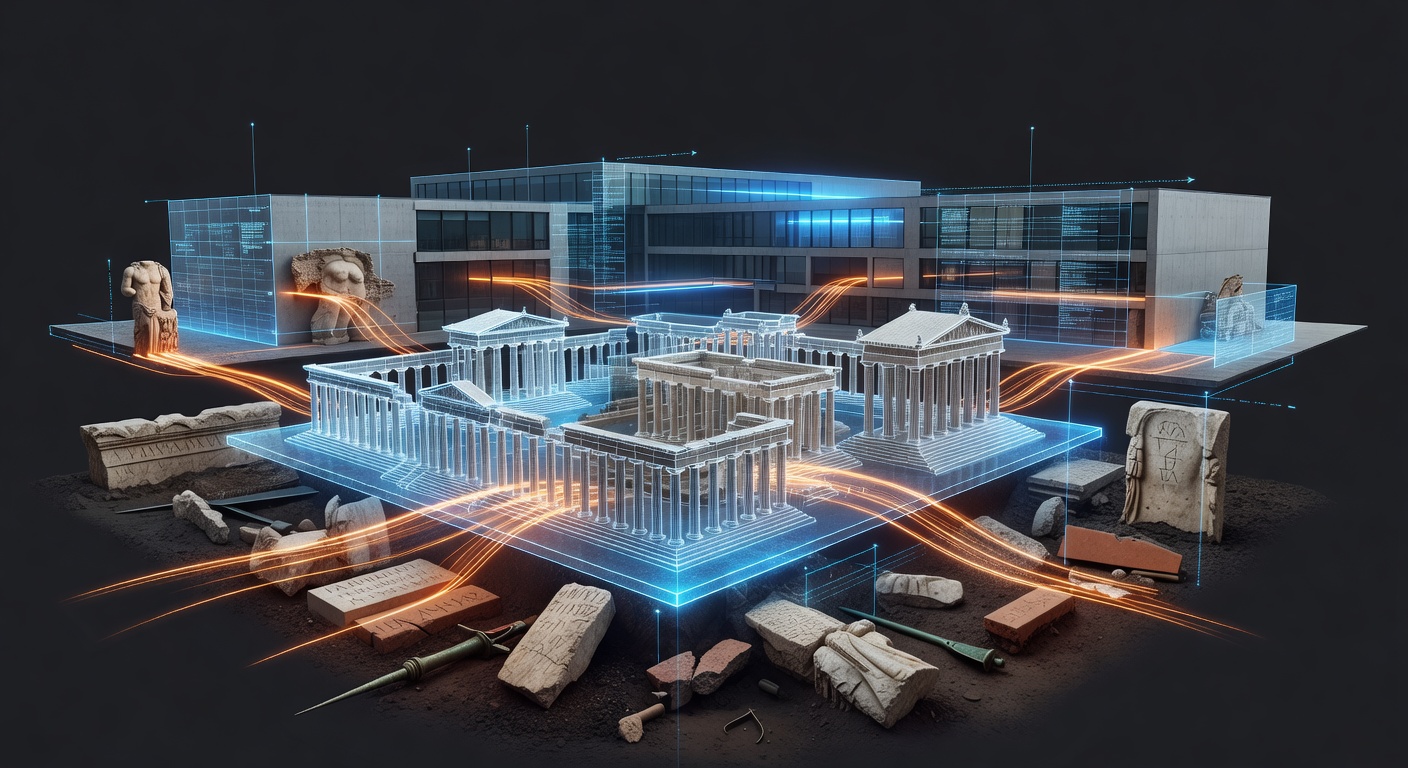
When Construction Workers Become Accidental Archaeologists
Imagine you're building a new school in Frankfurt, and suddenly your excavators unearth an entire ancient Roman sanctuary that's been perfectly preserved for nearly 2,000 years. This actually happened between 2016 and 2018 (and again in 2022) when construction crews working on the Römerstadtschule stumbled upon something extraordinary. What they found has now earned the attention—and serious funding—of Europe's top research institutions.
I find this genuinely thrilling because it reminds us that history isn't just in museums. It's literally under our feet, waiting to tell us secrets about civilizations we thought we fully understood.
A Mystery Wrapped in Stone and Ritual
So what exactly did they find? Picture this: a walled complex of eleven stone buildings, surrounded by roughly 70 shafts and pits scattered across more than 4,500 square meters. This wasn't some small neighborhood shrine. This was a major religious center, and it's unlike anything archaeologists have encountered before in this part of the Roman Empire.
What really gets interesting is the stuff inside. Researchers uncovered over 5,000 fragments of painted plaster—these buildings were decorated in vibrant colors, probably stunning to look at. There were bronze door and window fittings, Roman coins, and elaborate silver and bronze brooches. These weren't everyday items people lost. These were precious objects deliberately left behind as offerings.
The Creepy Part: What the Bones Tell Us
Here's where it gets genuinely unsettling. Inside those mysterious pits and shafts, scientists found thousands of remains from animals like fish and birds, along with ceramic vessels. The leading theory is that these are the leftovers from ritual feasts—ancient priests and worshippers making offerings to appease their gods by sacrificing animals and leaving them in these sacred spaces.
But there's something darker lurking in the data. Some of the evidence might suggest human sacrifice occurred here too. If that's true, it would be extraordinarily rare for this region. Human sacrifice in the Roman provinces? That would genuinely rewrite our understanding of religious practices in ancient Germany.
The Multi-God Mystery
What's particularly puzzling is that nobody can quite figure out which gods were being worshipped here. The archaeological evidence points to at least six different deities: Jupiter, Jupiter Dolichenus (a version of Jupiter that was popular in the eastern Roman Empire), Mercury, Diana, Apollo, and Epona. This isn't a single-god temple. This was a religious hub where people came to honor multiple powers.
That diversity alone suggests this sanctuary was incredibly important—probably serving an entire region, drawing worshippers from miles around. It's like an ancient religious crossroads.
Why This Matters Right Now
The German Research Foundation and Swiss National Science Foundation just committed over €1 million to fund three years of intensive research into this site. That's not spare change. That's institutions saying "this discovery is important."
A team of experts—archaeobiologists, classicists, archaeology specialists, and heritage conservators—are now getting serious about unlocking its secrets. They're analyzing 150 different samples of plant and animal remains. They're studying those 254 Roman coins. They're carefully examining every scrap of pottery to understand what people were eating, drinking, and offering up in prayer.
The Big Picture
What fascinates me most is how this changes our understanding of religious life in Roman Germania. We tend to think of the Romans as this unified civilization with standardized religious practices. But discoveries like this show us something messier and more interesting: local communities adapting Roman religion to their own beliefs and traditions, creating something genuinely unique.
The sanctuary's unusual layout—with no known parallels anywhere else in the Roman provinces of Gaul or Germania—tells us that whoever built this place wasn't copying a standard Roman blueprint. They were doing something different. Something that mattered deeply to them.
A school construction project gave us a window into how people 2,000 years ago sought connection with the divine. And honestly? That's pretty amazing.