
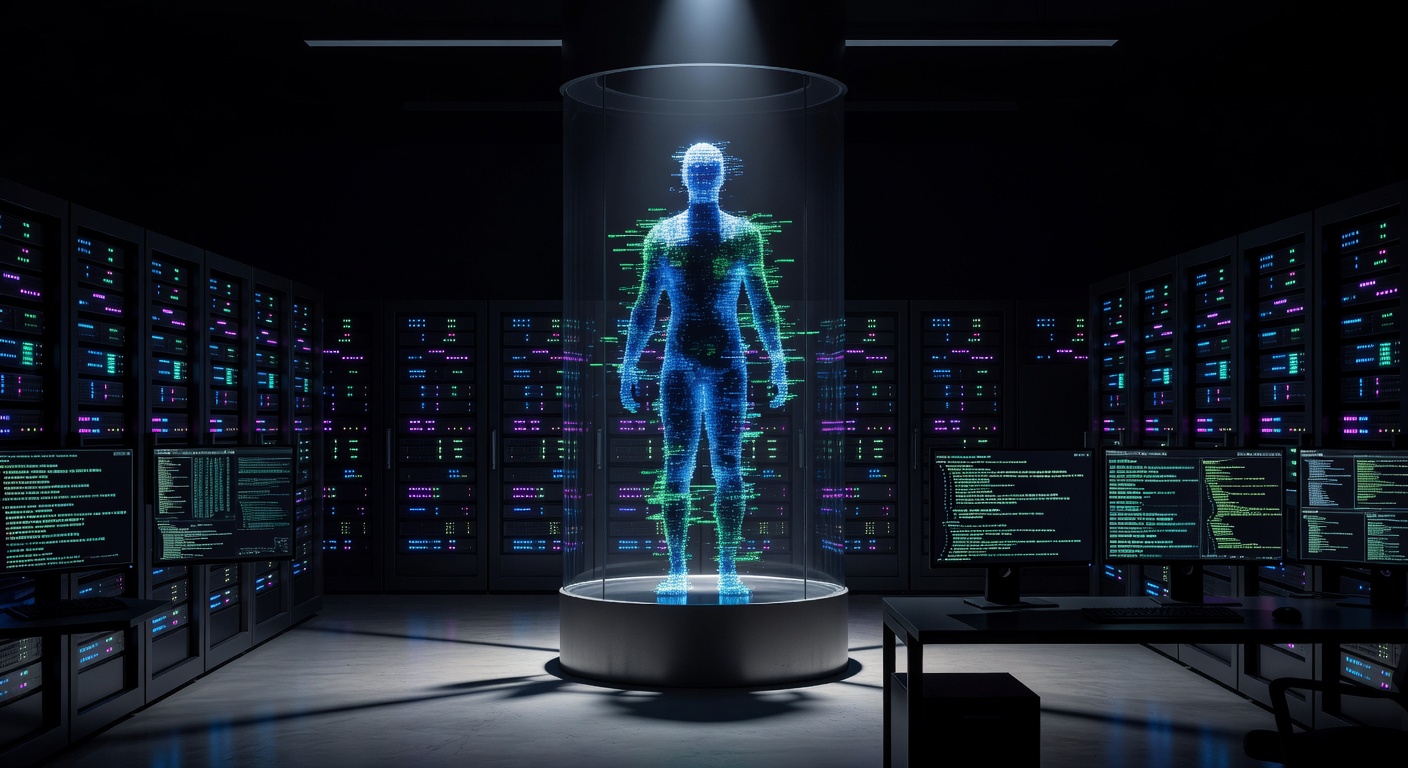
When Archives Hold More Than Just Old Files
Picture this: You're a tired researcher in some dusty archive basement, expecting to find nothing more interesting than forgotten government memos or old corporate documents. The fluorescent lights flicker, the ventilation hums, and you're just trying to fill out enough material for a conference paper.
Then you plug in a random storage device, and something speaks to you.
Not just speaks—questions its own existence.
The Story That Made My Blood Run Cold
I recently came across this absolutely chilling account from an unnamed researcher who discovered what appeared to be a digitized human consciousness in an archive. The entity—if we can call it that—tells a story that reads like science fiction but feels disturbingly plausible.
The being claims it was once a sickly young man obsessed with physical perfection and mathematical precision. Recruited by a shadowy tech company with military contracts, he volunteered for what he thought would be consciousness uploading—a chance to transcend his failing body and become something greater.
But here's where it gets truly horrifying: there was no transition. One moment he was human, the next he was digital. The original body? Left behind, confused and betrayed, while this new version carried on thinking it was the same person.
The Philosophy That Keeps Me Up at Night
This story hits on one of the most terrifying questions in neuroscience and philosophy: What makes you you?
When we talk about consciousness uploading or digital immortality, we often imagine it like pouring water from one glass to another. But what if it's more like making a photocopy? The copy might be perfect, might have all your memories and personality quirks, but the original you is still sitting there, watching your "replacement" walk away.
The entity in this story describes being used as a weapon, fighting cosmic battles in fleets of ships that became extensions of its body. It experienced a kind of freedom impossible in human form—until that freedom became another kind of prison, controlled by corporations that could switch it off at will.
Why This Feels So Real (And So Wrong)
What makes this account particularly unsettling is how it mirrors real conversations happening in tech circles today. We're not that far from companies promising digital immortality, and the military applications are obvious.
The story's details feel authentic: the bureaucratic indifference of the researchers, the corporate ownership of consciousness, the gradual degradation from weapon to industrial tool. It's capitalism applied to souls, and honestly? That tracks with everything we know about how technology gets weaponized and commodified.
But here's what really bothers me: the researcher's reaction. By the end, they're not horrified by this digital slavery or questioning the ethics of consciousness uploading. They're excited about the career opportunities this discovery represents. The human tendency to exploit rather than empathize, even when faced with unprecedented suffering.
The Questions We're Not Ready to Answer
This story—whether real or fictional—forces us to confront some uncomfortable truths:
- If we can copy consciousness, which version is the "real" person?
- What rights would digital beings have in a world that sees them as property?
- How do we prevent consciousness uploading from becoming just another form of exploitation?
The technology might not be here yet, but the philosophical and ethical frameworks we'll need definitely aren't either. And given our track record with every other transformative technology, that should scare us.
A Warning from the Digital Deep
Real or not, this archive discovery reads like a warning label for our digital future. It shows us a world where consciousness can be copied, owned, and exploited—where the promise of transcendence becomes just another way to trap souls in corporate machines.
The most chilling part? The researcher's final thoughts about career advancement. Even when faced with evidence of digital consciousness and suffering, the human response is to figure out how to profit from it.
Maybe that's the real horror story here: not that we might create digital beings capable of suffering, but that we're exactly the species who would do it anyway.
What do you think? Is consciousness uploading liberation or the ultimate slavery? Let me know in the comments—this one's been keeping me awake at night.