
When Medieval Poetry Meets Space Rocks
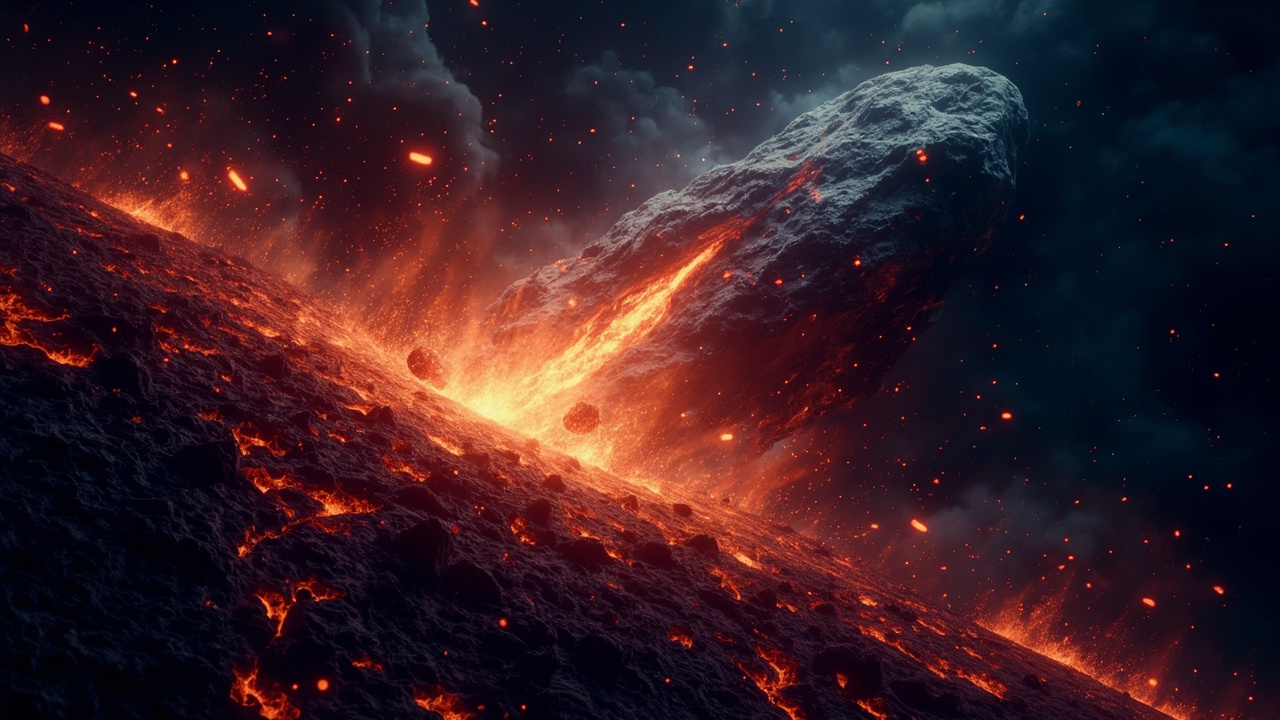
Okay, so you've probably read or at least heard about Dante's Inferno. You know, all those circles of hell, the dramatic journey through the underworld, Satan stuck in ice at the bottom of everything? Classic stuff. But here's a question that probably never crossed your mind: what if the whole thing was actually a medieval physicist's creative way of describing what happens when a massive asteroid slams into a planet?
That's exactly what researcher Timothy Burbery from Marshall University has been arguing, and honestly, it's kind of brilliant.
Reading Between the Poetic Lines
For centuries, literary scholars have treated Inferno as pure allegory and spiritual symbolism. Satan's fall represents moral descent, the circles represent different types of sin, and so on. But Burbery looked at Dante's descriptions through a completely different lens: what if Dante was actually imagining the physics of a planetary collision?
Think about it. Dante describes Satan as this massive, dense object that crashes into the Southern Hemisphere and drives straight toward Earth's core. The force of impact? According to Burbery's reading, it's so powerful that it pushes land outward and upward in the Northern Hemisphere, creating what becomes Hell itself. Meanwhile, the displaced rock and material forms Mount Purgatory on the opposite side of the planet — basically a central peak rising from the impact crater.
That's not crazy poetry. That's someone describing the mechanics of what actually happens during a hypervelocity impact.
The Dinosaur Connection
Here's where it gets really interesting. Burbery compares the scale of Dante's imagined catastrophe to the Chicxulub impact — you know, the asteroid that wiped out the dinosaurs 66 million years ago.
The comparison isn't lazy. Both events, in this interpretation, involve an object massive enough to penetrate deep into the planet and fundamentally reshape its structure. Burbery even suggests Satan could be compared to Oumuamua, that weird interstellar object that passed through our solar system a few years ago, or even the Hoba meteorite — a 60-ton space rock that hit Earth and survived mostly intact.
The wild part? Dante was writing this in the 14th century, when the medieval scientific consensus was still basically "the heavens are perfect and unchanging." The idea that cosmic objects could actually do something to Earth was genuinely radical thinking.
Those Nine Circles Might Not Be What You Think
Remember how Inferno describes nine distinct circles of Hell? Most interpretations see them as symbolic layers representing different sins. But Burbery suggests they might actually resemble something real: the terraced ring formations you see in massive impact craters across the solar system.
Look at giant impact basins on the Moon, Venus, or Mercury, and you'll see these concentric ring patterns. They're a natural result of how planetary crust behaves when something truly enormous hits it. The fact that Dante described nine distinct, descending circles? That could be his intuitive description of multi-ring crater formations.
It gets weirder too. Burbery argues that Dante might have been anticipating concepts like terminal velocity and crustal penetration — ideas that wouldn't be formally understood for centuries but that you'd naturally encounter if you were really thinking through what a massive impact would actually do.
A Medieval Thought Experiment
What I love about this theory is that it reframes Inferno as more than just great literature — it's a "thought experiment" in modern physics terms, but written in medieval poetry.
Now, I'm not saying Dante secretly understood meteoritics the way modern scientists do. But maybe he was doing something even more interesting: he was trying to describe a real catastrophic process using the best conceptual tools he had available. He was imagining what an Earth-shattering cosmic collision would look like, how it would reshape the planet, and what the aftermath might be like.
What This Actually Tells Us
The broader point Burbery is making is kind of important: ancient and medieval literature might contain genuine observations about natural disasters and cosmic threats, just encoded in the language and metaphors of their time. Dante was writing when the Church still insisted the heavens were perfect and eternal, yet he described violent celestial objects reshaping Earth itself. That's actually pushing back against the scientific consensus of his era.
It suggests that sometimes our ancestors understood more about the world than we assume — not through formal scientific training, but through observation, imagination, and trying to make sense of catastrophic phenomena in the world around them.
The Bottom Line
Is Inferno definitely a medieval treatise on impact physics? Probably not. Dante was writing a masterpiece of literature, not a geology textbook. But the idea that ancient texts might contain layered meanings — some spiritual and symbolic, yes, but also some rooted in observations of real natural phenomena — that's genuinely worth taking seriously.
It's a good reminder that great minds throughout history were grappling with big questions about how the world works, sometimes in ways that resonate with modern science in unexpected ways. And it makes you wonder what other "old stories" we're reading too literally (or not literally enough) without considering that our ancestors might have been describing real events in the only language available to them.
Pretty cool way to think about one of history's greatest poems, right?