
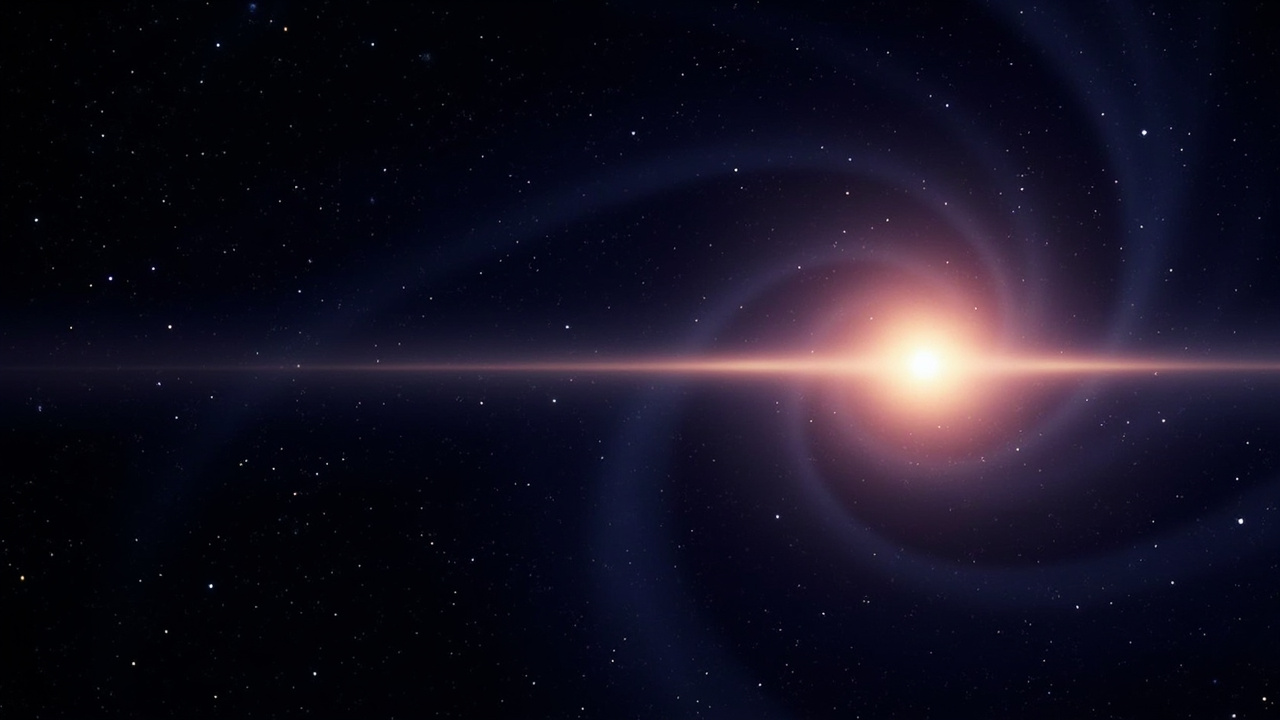
Okay, I need you to sit down for this one. Scientists might have just figured out something absolutely nuts about what happens when massive stars die. And honestly, my brain is still trying to process it.
Here's the deal: when really massive stars run out of fuel, they collapse under their own gravity. The traditional story goes that they squash everything down into an impossibly tiny point called a singularity, and boom — you've got a black hole. We've all heard of black holes, right? Those cosmic vacuum cleaners that swallow everything in their path?
But here's the problem. Physicists have been scratching their heads about black holes for decades. How can something with the mass of billions of Suns get squeezed into an infinitely small point? How does spacetime become infinitely curved? Here's the kicker: at those extreme conditions, our known laws of physics just... stop working. Scientists can't accurately describe what's happening. It's like trying to read a recipe when half the ingredients are invisible.
And black holes have another annoying feature — they hide everything. Anything that crosses into a black hole's event horizon (including light itself) is gone forever, beyond our ability to observe or study. Talk about frustrating!
So some researchers have been exploring an alternative idea. What if objects we think are black holes are actually something completely different? Enter the gravastar.
What's a Gravastar?
Imagine an object that's almost as dense and massive as a black hole — so it would have similar intense gravitational pull and be incredibly hard to detect. But here's the difference: gravastars wouldn't have that problematic singularity or event horizon hiding everything.
Instead, beneath their outer layers of normal matter, gravastars would be filled with dark energy. You know, that mysterious stuff that makes up about 68% of the universe and is causing it to expand faster and faster? Dark energy creates an outward pressure that fights against gravity, potentially preventing complete collapse.
Sounds pretty cool, right? But here's the question that's stumped scientists for about 25 years: how could these things actually form?
The New Solution: Mini Universes
Two theoretical physicists, Daniel Jampolski and Professor Luciano Rezzolla, just published what they're calling the first dynamic solution to Einstein's equations that explains how a collapsing star could produce a gravastar.
And their answer? When a massive star collapses, it might trigger the birth of a miniature universe within the collapsing matter itself. This tiny universe wouldn't be all that different from our own Big Bang. Just like in our cosmos, dark energy would drive its expansion.
As this mini universe expands, it pushes outward against gravity's inward pull. This creates a cosmic tug-of-war that can stop the collapse before a black hole forms. The result? A stable gravastar — a perfect balance between the star's material trying to collapse and the interior universe trying to expand.
As Jampolski explains, "The Big Bang of the emerging universe can unfold once the star has already collapsed almost to the point of becoming a black hole." Which is honestly one of the most poetic descriptions of cosmic physics I've ever heard.
Why This Matters
Look, I'm not going to pretend I fully understand the math here (neither can most of us mere mortals), but what I do understand is why this is exciting.
When matter gets compressed to these extreme densities, we're entering territory where our current physics just can't follow. There's room for entirely new phenomena that we haven't dreamed up yet. As Jampolski puts it, "It is easier to imagine that the Big Bang occurs only at a very late stage, when matter has already been compressed to an extreme degree, thereby giving rise to new effects."
Professor Rezzolla makes an important point too: exploring alternatives doesn't mean scientists are rejecting black holes. "Looking for alternatives to black holes should not suggest a skepticism towards black holes, which still represent the most natural and simplest solution to the fate of gravitational collapse." But he emphasizes that good science means staying open-minded about what we don't fully understand.
"History teaches us that it is not unusual for the latter to become the former." — meaning exotic ideas often eventually become the accepted standard. Remember when the idea of black holes themselves seemed ridiculous? Now we have actual photos of them.
The Bottom Line
So here's the wild possibility this research opens up: every time a massive star dies, it might not be ending. It might be beginning. A new universe could be unfolding right now, hidden inside what we thought was a black hole. Our universe might have even started this way — born from the collapse of something in a previous cosmos.
How cool is that?
We might be living in a baby universe, surrounded by countless others we can never see. The universe just got a whole lot more interesting.