
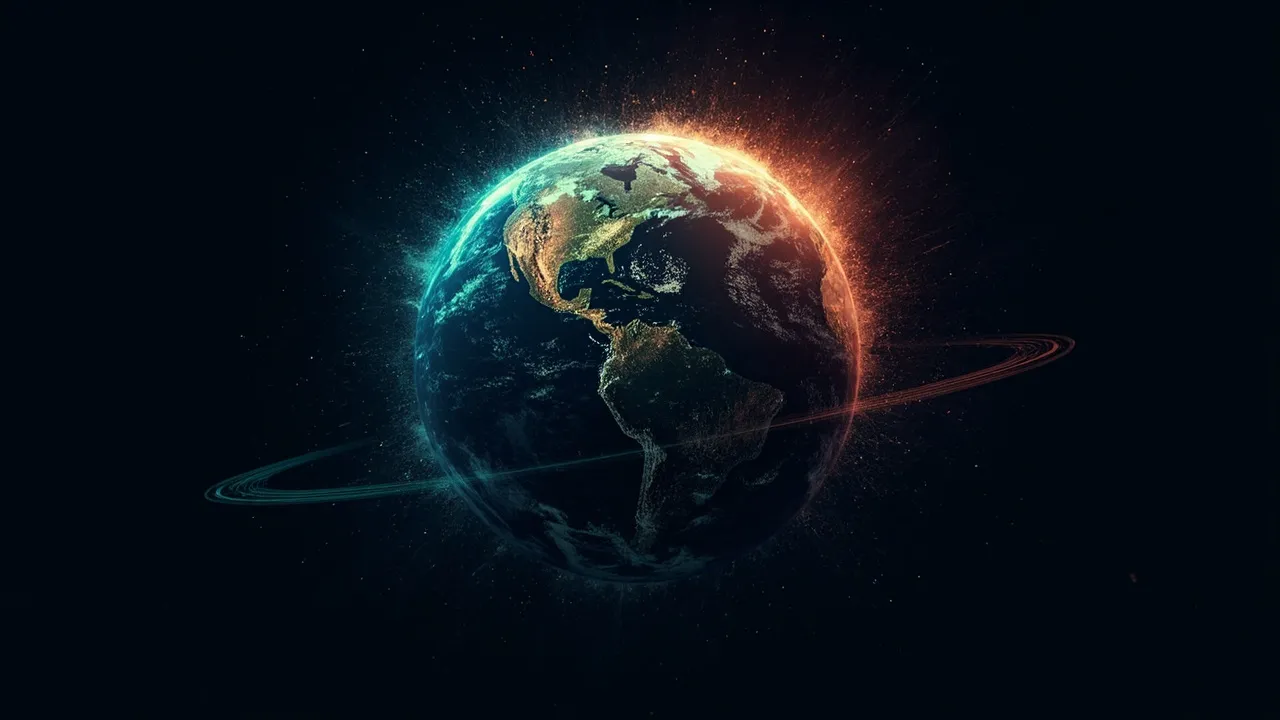
So here's something that's been bouncing around in my brain ever since I first heard about it: What if Earth isn't just a rock where life happens to exist, but is actually alive itself?
I know, I know—it sounds like something you'd hear at a late-night dorm room discussion fueled by questionable amounts of caffeine. But stick with me here, because the science behind this idea is actually pretty fascinating.
The Daisy That Changes Everything
Let me introduce you to something called Daisyworld, and no, that's not the name of a new startup or a particularly ambitious gardening project.
Imagine a planet where only two types of flowers exist: black daisies and white daisies. The black ones absorb heat from the sun (because dark colors do that), while the white ones reflect it. Now here's where it gets interesting: when the planet is cool, the black daisies thrive and multiply, which warms things up. When it gets too hot, the white daisies take over and cool things down.
The result? A perfect, self-regulating temperature that keeps both types of daisies happy. Nobody planned this. There's no flower government making decisions. It just... happens.
This thought experiment comes from James Lovelock, a scientist who spent much of his career studying how our actual Earth manages to stay so perfectly hospitable for life. And once you start looking, the coincidences start to pile up.
Why Is Earth So... Convenient?
Think about this for a second: our sun has been getting hotter over billions of years—about 25-30% more energetic since life first appeared. But surface temperatures on Earth have stayed within the range where life can exist. That's like your apartment somehow staying at a perfect 72 degrees while the outside weather swings from Arctic to desert.
Lovelock pointed out something else that's genuinely strange. Earth's atmosphere is chemically unstable—in a "this shouldn't exist" kind of way. We have all this oxygen floating around, which is actually a very reactive gas that wants to bond with almost anything. The only reason our atmosphere stays the way it does is because living things keep producing more oxygen to replace what's constantly being used up.
Meanwhile, Mars and Venus have these atmospheres that look like the exhaust from a combustion engine. Our atmosphere looks like the stuff going into one. The difference? Life.
So Is This... Consciousness?
Here's where people get understandably skeptical. Lovelock called his idea the Gaia hypothesis, after the Greek goddess of Earth. But he wasn't claiming the planet has feelings or is literally conscious in the way you or I are.
His point was more subtle: life doesn't just adapt to Earth's conditions—it actively helps create those conditions. We're not passengers on a stable spaceship; we're crew members actively maintaining the systems that keep everything running.
And here's the part that makes some scientists uncomfortable: if that's true, then maybe we're not the ultimate goal of this planetary system. Maybe we're just one experiment that's running its course, and life will find a way to continue without us.
That's a lot to process on a Tuesday, honestly.
What I Find Most Compelling
Here's my take as someone who's spent way too much time thinking about this:
The Gaia hypothesis might be wrong. Scientists have valid criticisms—evolution doesn't work with foresight, so how could organisms coordinate to regulate the entire planet?
But the alternative—that Earth just happens to be perfectly calibrated for life through pure random chance—is somehow even harder to believe, right?
What I love about this theory is that it makes us ask bigger questions. We're so used to thinking of "nature" as something separate from us, this backdrop against which human history unfolds. But what if we're not separate from it at all? What if we're as essential to Earth's functioning as, say, our own cells are to our bodies?
That doesn't mean Earth "needs" us or that we're special in some cosmic sense. If anything, it should make us humbler. We're part of something much bigger than ourselves, and we have the ability to either support or disrupt the systems that keep everything alive.
The Takeaway
Whether or not you buy the full Gaia hypothesis, there's wisdom in its core message: we're not isolated observers on a dead rock. We're participants in a planetary system that's been keeping itself alive for nearly four billion years.
The question isn't whether Earth can survive without us—it absolutely can. The question is whether we can figure out how to keep being part of this beautiful, strange, self-regulating ecosystem instead of disrupting it beyond repair.
No pressure, right?