
When Destruction Becomes Creation
Here's a wild thought: what if the worst thing that ever happened to Earth was also the best? We typically think of asteroid impacts as catastrophic events—dinosaur extinction, global winter, all that doom and gloom. But what if some of those cosmic collisions actually set the stage for life itself?
That's the fascinating direction some scientists are now exploring, and honestly, it's kind of blowing my mind.
The Great Mystery of "How Did We Get Here?"
Before we dive deeper, let's acknowledge the elephant in the room: we still don't really know how life started. This isn't some fringe debate—it's one of the biggest open questions in science. You can have all the right chemicals, all the right conditions, but getting from lifeless molecules to something that actually lives is incredibly complex. It's the ultimate "something from nothing" puzzle.
So scientists do what scientists do when faced with a mystery—they look for clues. And it turns out those clues might be hidden in the scars left behind by ancient asteroids.
Deep-Sea Vents: The Original Life Laboratory
For decades, researchers have pointed to deep-sea hydrothermal vents as the most likely birthplace of life. These are basically underwater hot springs—places where superheated, mineral-rich water shoots up through cracks in Earth's crust.
What's wild about these vents is that they support entire ecosystems without a single ray of sunlight. Instead of photosynthesis, organisms there use a process called chemosynthesis, essentially eating chemicals instead of sunlight. In the cold, dark depths of the ocean, these vents became little oases of energy and activity.
But here's where the new research comes in: maybe vents powered by asteroid impacts were even more common on early Earth than the volcanic ones we've been studying.
Asteroids as Thermal Engineers
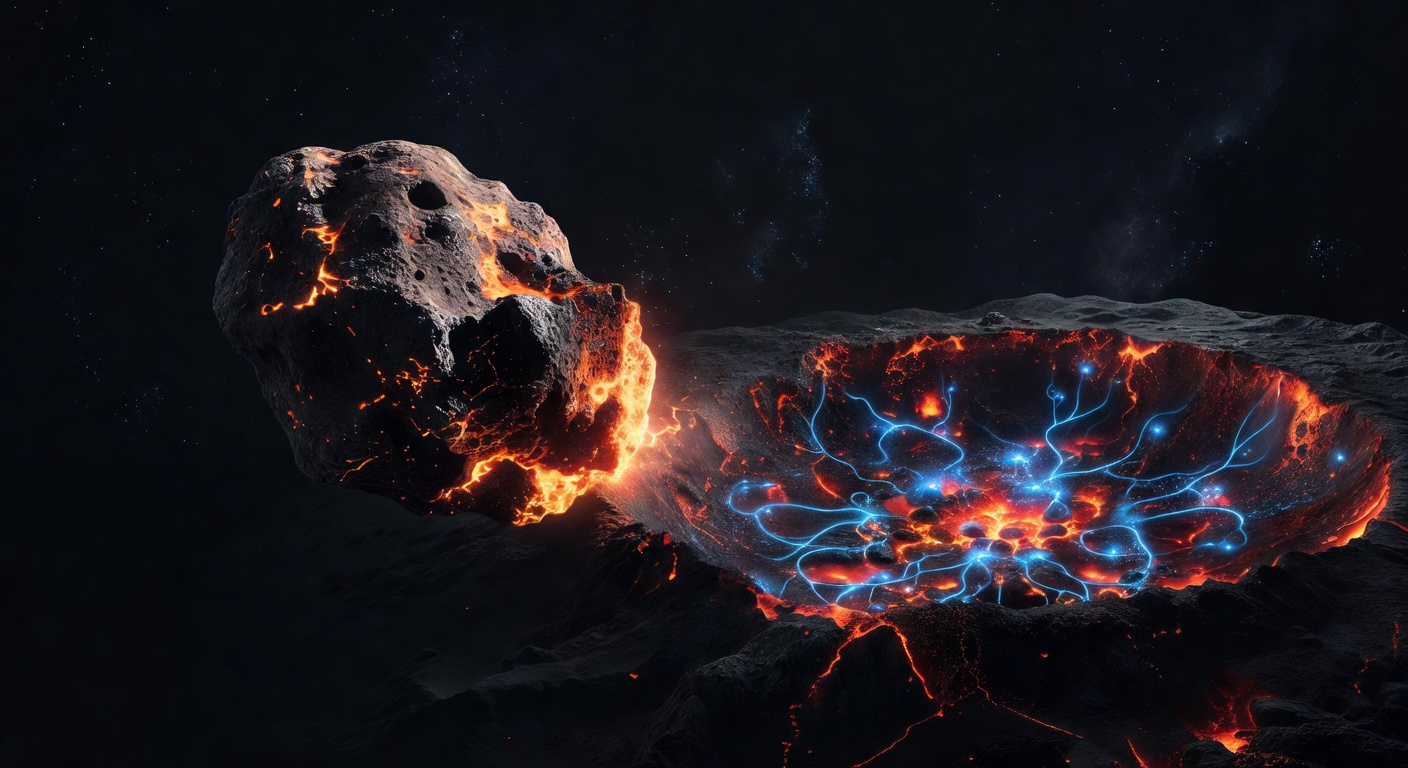
Imagine this: a massive asteroid slams into Earth. The impact creates intense heat—so intense it melts the surrounding rock. As the crater fills with water and gradually cools, something remarkable happens. You get a system that's basically identical to deep-sea vents: hot, chemical-rich water circulating through rock and creating the perfect environment for complex chemistry to occur.
The difference? These impact-created systems could have been everywhere on early Earth. We're talking about a planet getting regularly pummeled by space rocks, creating hundreds or thousands of these temporary chemical factories all over the place.
A young researcher named Shea Cinquemani decided to dig into this idea. She started the work as an undergraduate assignment (I love that!), but it evolved into something much bigger. Her research looked at three famous impact craters to understand how they might have functioned as life-incubators:
The Chicxulub Crater in Mexico (the asteroid that killed the dinosaurs 65 million years ago) actually had a hydrothermal system that lasted for thousands of years. Haughton Crater in Canada formed about 31 million years ago. And Lonar Lake in India, created just 50,000 years ago, still exists today and shows us how these systems actually work.
Why This Actually Makes Sense
Here's what gets me excited about this idea: early Earth was basically being carpet-bombed with asteroids. Unlike today, when major impacts are rare cosmic flukes, the early planet experienced constant bombardment.
So rather than looking for life beginning in a couple of deep-sea vent locations, we should maybe be thinking about life potentially sparking into existence in numerous impact craters scattered across the young planet. It's like the difference between having a few ovens versus having thousands of them all baking simultaneously. Your chances of success go way up.
These systems also stick around long enough—thousands to tens of thousands of years—for simple molecules to gradually combine into more complex ones. That's important because building life-like structures isn't a quick process. It requires time for chemistry to do its thing.
The Bigger Picture
What I really appreciate about this research is that it doesn't contradict the deep-sea vent theory. It expands it. Scientists aren't saying, "Forget about vents, asteroids are the real answer!" They're saying, "Hey, we might have been overlooking this other major source of the exact same conditions."
That's how science should work—building on previous discoveries rather than constantly tearing them down. Cinquemani's work shows how a curious undergraduate asking good questions can help shift how we think about some of life's deepest mysteries.
Plus, there's something poetic about the idea that life emerged not despite our planet's violent cosmic bombardment, but because of it. The very forces that seem most destructive may have actually been creative. Asteroids didn't just reshape Earth's surface—they may have kickstarted the entire biological revolution.