
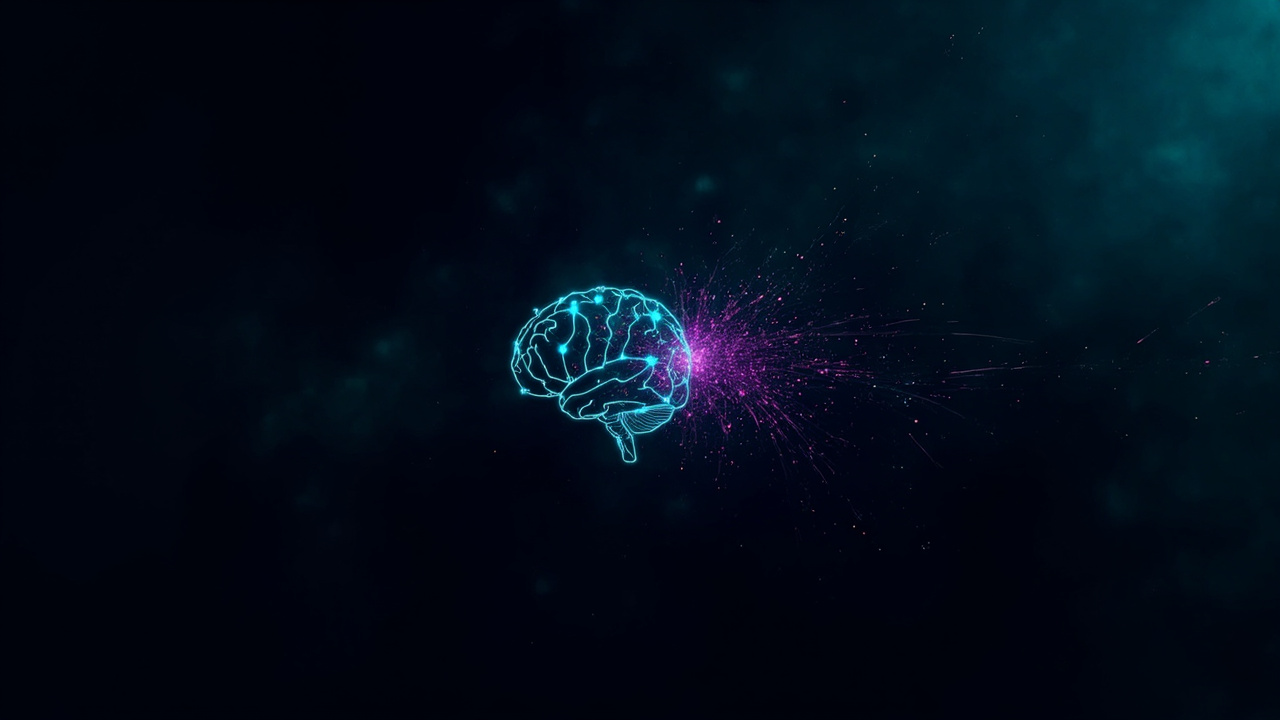
The Uncomfortable Question That Won't Go Away
Imagine waking up tomorrow and discovering that everything you remember—your childhood, yesterday's breakfast, that embarrassing thing you said last week—might be a complete illusion. Not because you have memory problems, but because the laws of physics might actually prefer illusions to reality.
Sound bonkers? Yeah, I get it. But this is the essence of something called the "Boltzmann brain hypothesis," and physicists keep circling back to it because it raises genuinely unsettling questions about the nature of reality itself.
How Physics Accidentally Created a Monster Problem
Here's where it gets interesting. One of the foundational principles of physics is the second law of thermodynamics, which basically says the universe tends to get messier over time. Think of it like your bedroom—it naturally drifts toward chaos unless you actively clean it. This law explains why we experience time flowing in one direction: from an ordered past to a more chaotic future.
The physicist Ludwig Boltzmann figured out the mathematical reason why this happens, and it all comes down to probability and statistics. The more disordered something is, the more ways it can arrange itself. So disorder is just... more likely.
But here's the plot twist that'll keep you up at night: if you look at the equations carefully—really carefully—they don't actually care about which direction time goes. The math is perfectly happy working backward or forward. This opens a philosophical trap door.
The Cosmic Probability Trap
If randomness can create complexity through pure chance, and if the universe has had an insanely long time to bounce around and arrange itself in every possible way, then statistically speaking, wouldn't it be more likely for your exact memories and thoughts to simply pop into existence randomly rather than being the product of actual events that unfolded over time?
Think of it this way: imagine a monkey with a typewriter. Given enough time, it could randomly type out a Shakespeare play. In the same way, the universe could theoretically randomly generate the exact pattern of atoms that makes up your brain with all your memories intact—without any of those events actually having happened.
This is the "Boltzmann brain" idea. It's creepy because it suggests that observers (like us) should statistically be the product of random fluctuations, not actual history. And if that's true, maybe we're all living in some kind of cosmic hallucination.
The Hidden Assumptions Game
Recently, three physicists—David Wolpert, Carlo Rovelli, and Jordan Scharnhorst—decided to dig into this problem from a different angle. Instead of trying to solve it head-on, they wanted to understand why physicists keep disagreeing about it.
What they found is surprisingly interesting: most of the debates about memory, entropy, and time rely on assumptions that scientists sneak in without explicitly stating them. Different scientists make different assumptions about where to start their analysis or which points in time to treat as fixed, and these choices dramatically change what conclusions you reach.
It's a bit like asking whether your house is clean: the answer depends entirely on when you started observing it and what "clean" means to you.
The Circular Reasoning Problem
Here's where their work gets actually important. The researchers identified something they call the "entropy conjecture"—a pattern where scientists use assumptions about the past to prove something about memory, then turn around and use that same conclusion to justify the original assumptions. It's circular reasoning hiding under fancy mathematics.
By pulling back the curtain and showing how these hidden assumptions work, they're not necessarily solving the Boltzmann brain problem. Instead, they're creating a clearer framework for thinking about it. They're saying: "Here are the assumptions you have to make. Here's where physicists disagree. Here's why."
So... Are My Memories Real or Not?
The honest answer? We don't know yet. And according to this research, the reason we don't know is partly because we haven't been clear enough about what we're assuming when we ask the question.
This is the kind of problem that sits at the intersection of physics, philosophy, and mathematics—where the "laws of nature" run up against the deeper question of what we mean when we try to interpret those laws. The researchers aren't claiming to have solved it. They're making it possible to have a smarter conversation about it.
And honestly? That might be exactly what we need.
What This Really Means
For most of us, this probably won't change how we live our lives tomorrow. You'll still trust your memories, you'll still plan for tomorrow, and the universe will keep doing its thing. But these kinds of foundational questions matter because they help us understand the bridge between pure mathematics and physical reality—and that's where all the deepest mysteries hide.
The Boltzmann brain hypothesis reminds us that even our most intuitive assumptions about reality need careful examination. It's weird, it's unsettling, and it's exactly the kind of question that makes physics endlessly fascinating.