
I want you to picture something for a moment.
You're living in Manaus, Brazil—a city of over 2 million people tucked deep in the heart of the Amazon. One morning, you step outside and notice the sky has turned an eerie, yellowish-gray. The air feels thick, almost painful to breathe. You check the air quality index and discover it's in the second-worst category possible. Schools are closing. Outdoor events are canceled. Kids can't play outside.
This isn't a dystopian movie scene. This was reality in October 2026, when thick smoke from wildfires engulfed the city, with particulate matter exceeding 135 micrograms per cubic meter. And here's what's really unsettling: the fires causing this aren't even fully visible yet.
The Amazon Is Basically on Fire—and We Can't See Most of It
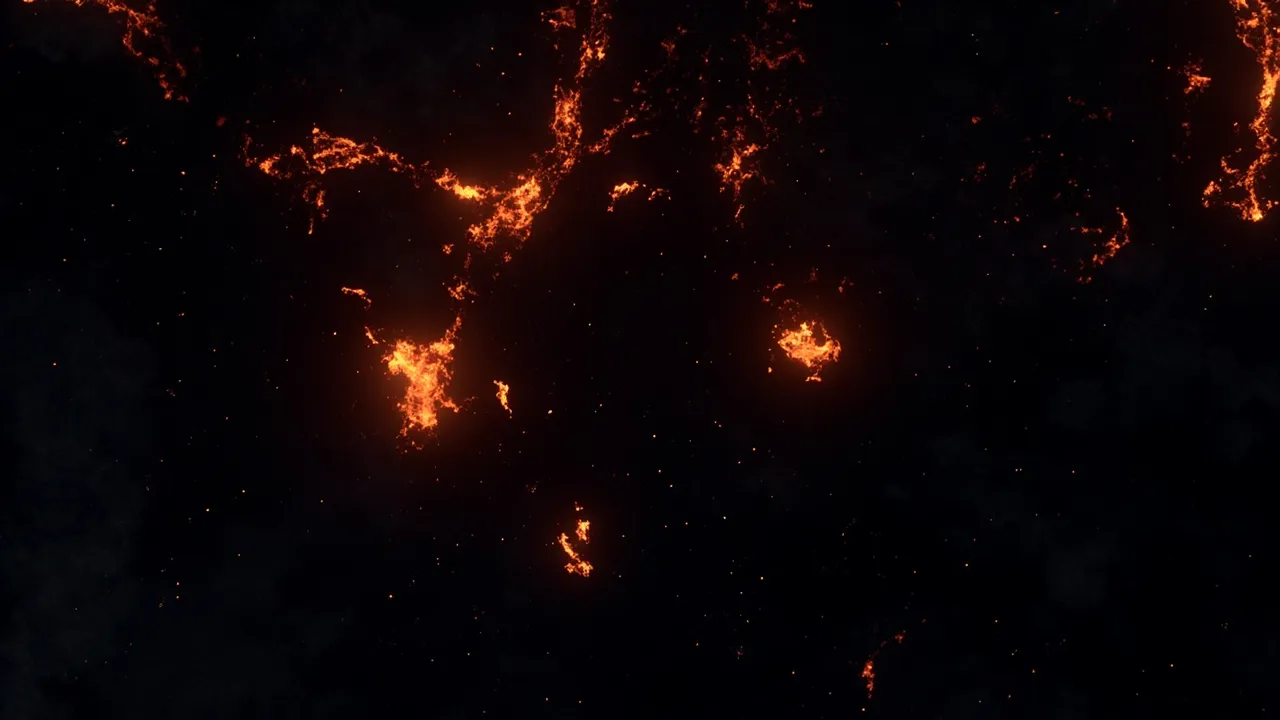
NASA's satellites caught something remarkable (and terrifying) on October 12, 2026. Enormous plumes of smoke were billowing from fires burning on both sides of the Amazon River. The images showed massive columns of smoke rising from what used to be pristine rainforest.
The areas affected stretch from forests near Manaus and Santarém—major commercial and transportation hubs—all the way east toward where the Amazon empties into the Atlantic. We're talking about hundreds of miles of forestland going up in smoke.
What makes this even more concerning is that NASA scientists say this is just the second "domino" falling in a much larger pattern.
Meet the Wildfire Cascade
Dr. Douglas Morton, an Earth system scientist at NASA's Goddard Space Flight Center, has a way of describing this phenomenon that really stuck with me: he calls it a "cascade."
Think of it like a row of dominoes set up across thousands of miles:
First domino: Indonesia experiences severe drought, which ignites peat fires burning through carbon-rich soil. This happens near the equator, where El Niño disrupts normal rainfall patterns.
Second domino: As those fires burn and dry conditions spread, fire activity intensifies in the central and eastern Amazon—including the areas now threatening Manaus.
This isn't some new, never-before-seen pattern. Dr. Morton and his colleagues documented the exact same sequence during the devastating 2015-2016 El Niño. They saw it again in 2023. And now, here we are in 2026, watching history repeat itself.
Why This Time Feels Different
Here's what keeps me up at night about this story: many of the forests now burning have already burned before.
"It's so striking—and frustrating—that this is happening all over again," Morton said. The forests damaged during the 2015 and 2023 El Niño events are catching fire once more. Trees that were partially burned in previous seasons are weakened, making them more vulnerable. It's like watching someone get injured in the same spot over and over.
And the scientists aren't predicting relief anytime soon. Morton and his team expect fire activity to expand northward during November and December 2026, threatening the Brazilian states of Roraima and Amapá, plus parts of Venezuela, Guyana, and Suriname. Then the pattern shifts southward, with the worst conditions potentially hitting southern Amazon regions and Paraguay around August and September 2027.
We're looking at nearly two years of elevated wildfire danger across the tropics.
Why Rainforests and Fire Are a Particularly Bad Mix
You might be thinking, "Don't forests burn all the time? Don't some ecosystems actually need fire?"
Yes, but here's the crucial distinction: the Amazon rainforest is not a fire-adapted ecosystem. Most of the plants and animals living there have never evolved to handle frequent burning. Unlike grasslands or certain pine forests where fire is a natural part of the cycle, tropical rainforests are fundamentally different.
When flames move through the Amazon, the damage is severe and long-lasting. These forests rely on consistent moisture and humidity. They're not built to recover quickly from the kind of stress that fires create. And once you add previous fire damage into the mix—weakened trees, altered soil conditions, disrupted ecosystems—the vulnerability becomes even greater.
What Does This Mean for Regular People?
I know what you're thinking: "I'm not in Brazil. Why should I care?"
Here's why this matters to all of us, wherever we live:
The Amazon rainforest is often called the "lungs of the Earth." It absorbs enormous amounts of carbon dioxide and produces oxygen. When it burns, all that stored carbon gets released into the atmosphere, contributing to climate change. It's a vicious cycle—climate change (partly fueled by those emissions) disrupts weather patterns, which leads to more drought, which leads to more fires.
Additionally, these fires produce smoke that travels thousands of miles, affecting air quality far beyond the immediate region. Those PM2.5 particles NASA mentioned? They're microscopic enough to penetrate deep into lungs and cause serious health problems.
The Bigger Picture
What strikes me most about this story isn't just the scale of the disaster—it's the sense of inevitability. Scientists have documented this exact pattern. They know what's coming. They've warned us.
And yet, here we are, watching domino after domino fall.
I'm not telling you this to make you feel helpless. Instead, I want you to understand that these climate events are interconnected in ways we sometimes don't appreciate. The drought in Indonesia can influence fires in Brazil. El Niño conditions half a world away can affect your local weather. We're all sharing one planet, and what's happening in the Amazon should matter to all of us.
Stay informed. Support organizations working on forest conservation. Push for policies that address climate change. And maybe next time you hear about El Niño in the news, you'll remember that its effects stretch much further than you might have imagined.
The Amazon is burning. The question is whether we're paying attention—and what we'll do about it.
Source: https://www.sciencedaily.com/releases/2026/10/261016070633.htm