
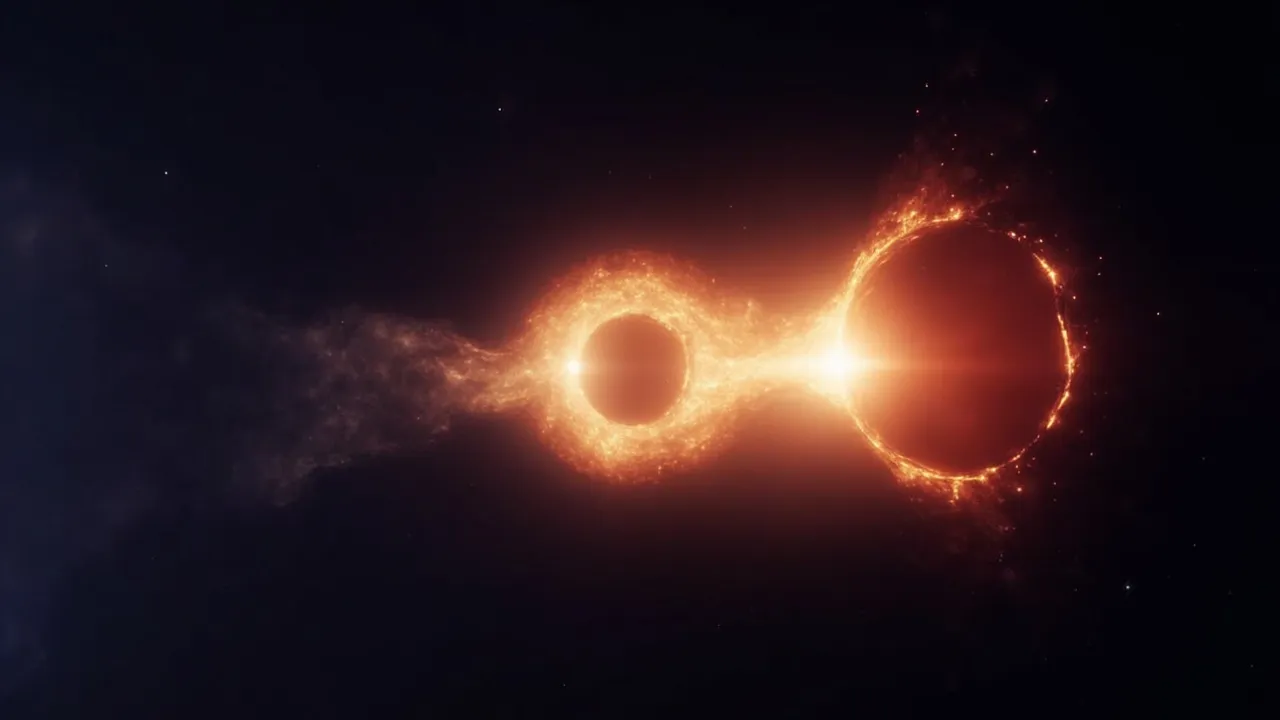
Okay, space fans, gather 'round. I've got a story that sounds like it was ripped from a science fiction novel, but trust me — this actually happened.
Astronomers recently watched a black hole literally tear apart a humongous star. I'm not talking about a gentle nibble here. This was the cosmic equivalent of someone inhaling an entire pizza in one gulp while simultaneously shredding the box it came in.
The Snack That Shook the Universe
So picture this: a black hole, sitting quietly in space, when along comes a star — not just any star, but one with serious mass. The black hole's immense gravity reached out and basically stretched this poor star until it broke apart. Scientists compared it to "preparing a snack for lunch," which, honestly, feels like an understatement when you're dealing with one of the most powerful events in the known universe.
During this destruction, the energy being released hit roughly 400 billion times the output of our Sun. Let me put that in perspective. Our Sun is a massive nuclear furnace that could power... well, everything on Earth for a very long time. Now multiply that by 400 billion. Even the most powerful supernova explosions we've ever seen? This thing blew past them like a sports car zooming past a bicycle.
Meet "The Whippet"
The event was officially designated AT2024wpp, but researchers nicknamed it "the Whippet" — which I find delightful. (Scientists have such fun naming things, don't they?)
Using the Zwicky Transient Facility at Palomar Observatory in California, astronomer Anna Ho spotted this cosmic monster almost immediately after its light reached Earth. Within days, observations from the Liverpool Telescope in the Canary Islands and NASA's Swift satellite confirmed what they were seeing: a Luminous Fast Blue Optical Transient (or LFBOT for short). These are rare, poorly understood events, and this one was doing everything at maximum volume.
Lead researcher Daniel Perley from Liverpool John Moores University described it beautifully: "We discovered what we think is a black hole merging with a massive companion star, shredding it into a disk that feeds the black hole. It's a rare and awe-inspiring phenomenon."
The Plot Twist
Here's where things get really interesting.
As the chaos unfolded, material from the shredded star formed a disk around the black hole and spiraled inward, getting incredibly hot and spitting out X-rays. This created a powerful shock wave that raced through surrounding gas at one-fifth the speed of light — which is absolutely bonkers when you think about it.
After about six months, scientists expected the show to be winding down. But then came the strange part. Using powerful telescopes, researchers spotted something unexpected: weak chemical signatures of hydrogen and helium appearing as the event faded.
Hold on. The star was supposed to be completely destroyed, right?
The helium signal was especially puzzling. It was moving toward us at over 6,000 kilometers per second — incredibly fast. The researchers have two theories. Either this is material from the star's core that got flung out during the black hole's shredding process, or — and this is the more "wait, what?" option — it could be coming from a third star in the system that's getting blasted by all that radiation and particle wind from the feeding black hole.
Why Should You Care?
You might be wondering, "Cool cosmic drama, but why does this matter?"
Perley explains it perfectly: "Not only do these events help us identify black holes, they provide a new way to identify where black holes occur and how they form and grow, and the physics of how this happens."
In other words, we're not just watching a cool light show. We're learning how black holes actually work, how they eat, and what happens to the material they consume. That's crucial stuff if we want to understand the universe better.
And honestly? There's something deeply humbling about watching this unfold. We're seeing physics in action at its most extreme — the kind of thing that reminds us how vast and weird and wonderful space really is.
The next time you look up at the night sky, remember: out there, right now, black holes are doing things that would make any horror movie director jealous. And scientists like these are watching every single moment, taking notes, and slowly figuring out the universe's darkest secrets.
Pretty amazing, right?
Source: https://www.sciencedaily.com/releases/2026/08/260814235849.htm