
The Perfect Timing (Or Perfect Accident?)
You know that feeling when you're about to start a big project and then something completely unexpected happens? Well, that's basically what went down at a wind turbine construction site in Germany's Lower Saxony region. Construction workers were ready to break ground on what would become a massive wind farm—23 acres with 19 turbines planned—when archaeologists showed up to do their usual pre-construction survey. Standard stuff, right? Nobody expected it to matter much.
Then the excavator made its very first scoop into the earth.
And that's when everything changed.
From Dirt to Treasure
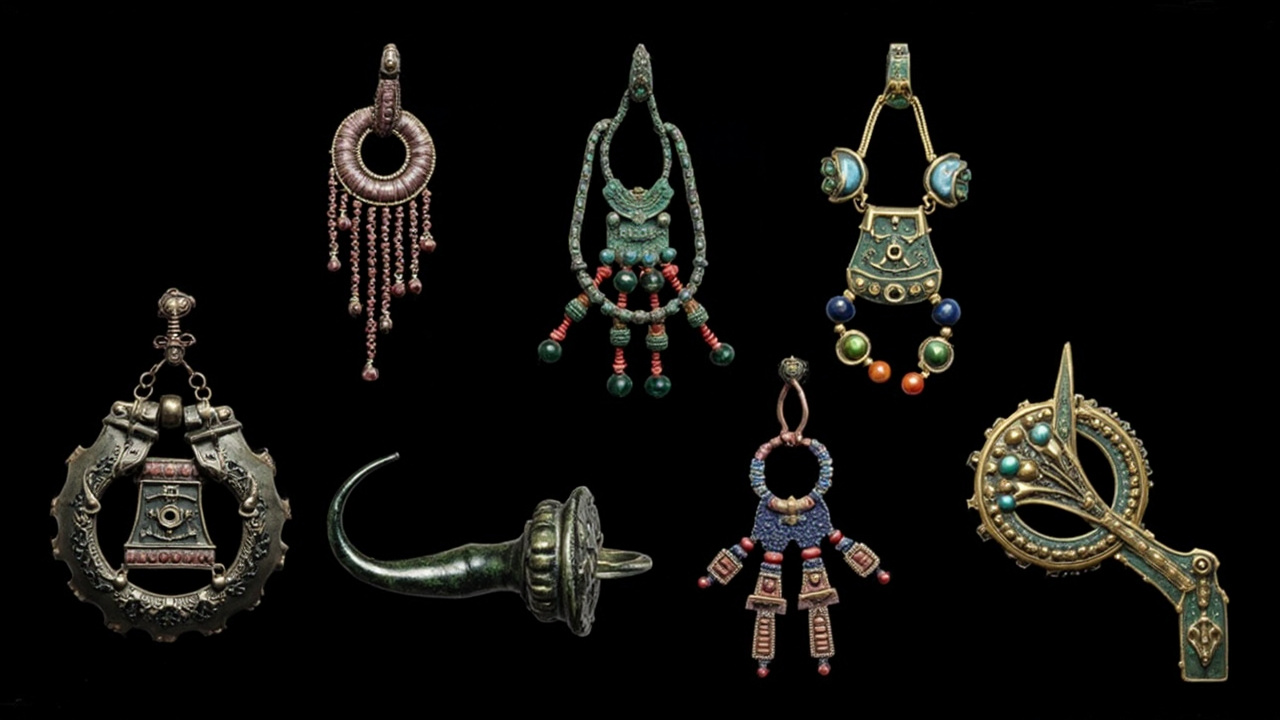
Tangled up in the first bucket of soil the excavator pulled up were pieces of bronze and amber. Not just any pieces—we're talking about an absolutely extraordinary hoard of Bronze Age jewelry that hasn't been seen in that region since 1967. We're talking decorated necklaces, arm spirals, bronze pins, and collar rings. The kind of stuff that makes archaeologists literally stop what they're doing and pull everyone back to the site.
The most stunning piece? A single necklace strung with 156 amber beads.
Let me pause and explain why that's so impressive: During the Bronze Age (we're talking around 1500-1300 B.C.E. for this find), amber was like the iPhone of precious materials. It was traded across enormous distances—from the Baltic coastlines all the way to the Mediterranean. Because of how difficult and expensive it was to obtain, only the wealthiest, most powerful people in society could afford it. Finding a necklace with 156 individual amber beads? That's basically archaeologist Christmas.
These Weren't Just Fashion Accessories
Here's where it gets really interesting: experts believe this jewelry didn't belong to just one person. They think it belonged to at least three different high-status women—think ancient queens or the wives of powerful tribal leaders. And get this—they think the jewelry was intentionally buried together as some kind of religious offering or ritual.
Imagine the scene: these precious items, collected and treasured over lifetimes, carefully placed in the ground for spiritual reasons. And then, thousands of years later, a construction vehicle almost unknowingly scatters them across a dirt bucket.
A Site Full of Stories
Here's what makes this even cooler: the wind farm site wasn't a random location. Archaeologists already knew this area was historically significant. The pre-construction survey had already turned up evidence of settlements dating back to the Neolithic period (we're talking 5000 B.C.E. or earlier) all the way through late antiquity. They'd found ancient houses, dog burial pits, Roman pottery, and even a surprisingly well-preserved three-layered comb from around the 4th or 5th century C.E.
But nothing compared to that Bronze Age jewelry hoard.
The researchers were able to carefully extract the remaining pieces by lifting them out of the ground in one solid block, keeping all the surrounding soil intact. It's like they turned the entire jewelry collection into an archaeological time capsule. Now the items are in a laboratory undergoing detailed analysis, and scientists have all sorts of high-tech tests planned to learn more about them.
Why This Matters
This discovery is honestly a perfect example of why archaeology matters. Modern construction projects can destroy ancient history in minutes if we're not careful. But when we take the time to do proper surveys and coordinate with experts, we can preserve incredible windows into human history.
Also, there's something genuinely moving about the idea that these Bronze Age women's treasures survived for 3,500 years, buried and forgotten, just waiting for the right moment to be discovered and appreciated again. The ancient "Amber Road" that connected distant civilizations? We're literally holding evidence of it in our hands.
Plus, you've got to admit—it's kind of awesome that a routine wind farm project turned into an archaeological jackpot. Talk about an unexpected plot twist.