
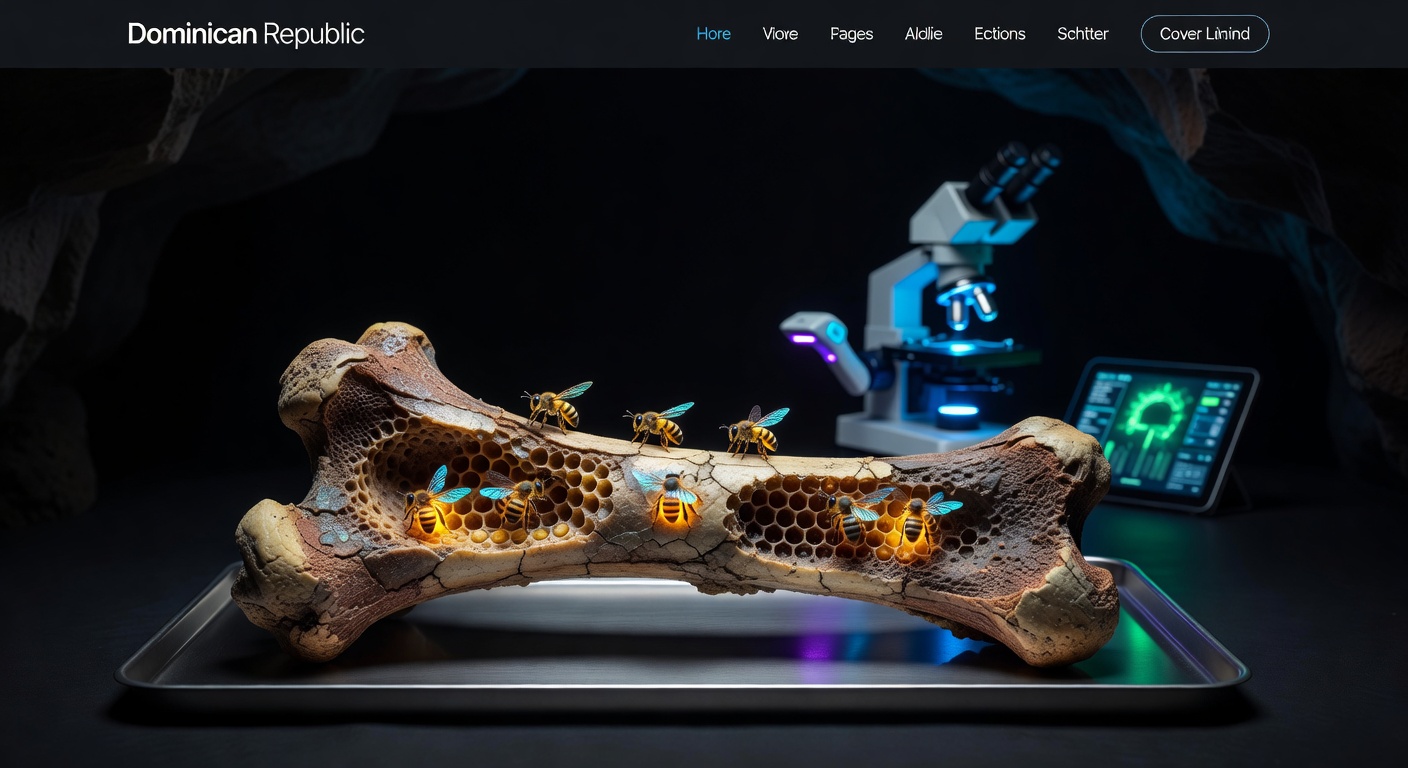
When Dead Bones Became Prime Real Estate for Ancient Bees
Imagine you're a tiny bee living thousands of years ago, searching for the perfect spot to build your home. You're scavenging through a dark cave, looking for shelter, when you spot something perfect: hollow cavities in old bones scattered across the floor. Why dig when someone else has already done the work for you?
This is exactly what happened inside a cave on the island of Hispaniola, and it's one of the most unusual stories I've come across in a while.
How Nature's Recycling Program Actually Works
Here's the wild chain of events: A giant barn owl hunted a small rodent called a hutia and brought it back to its cave to feed its babies. The owl had essentially set up a feeding station—a place it would return to again and again over generations, leaving prey remains scattered everywhere. Fast forward thousands of years, and a bee arrives, looking for a place to build a nest.
The bee's real genius move? Those ancient rodent jaws had small sockets where teeth used to sit. The spaces were empty, smooth from erosion, and exactly the right size for a bee nursery. So instead of laboriously chewing into solid clay and stone, the bee simply moved into these ready-made apartments. Other bees figured out the same trick, and suddenly fossilized bones became an entire bee housing complex.
It's basically the ancient equivalent of finding a furnished apartment and deciding to just keep the furniture.
The Guy Who Actually Looked Closely at Stuff
None of this would've been discovered if Lazaro Viñola Lopez hadn't been the type of scientist who actually pays attention. Most fossil hunters immediately clean off all the sediment when they dig up bones. Viñola Lopez decided to examine the fossils more carefully first, and that's when he noticed something weird: the inside of one cavity was smooth instead of rough like typical bone would be.
This tiny observation—that one detail that could've easily been missed—became the entire foundation of the discovery.
Plot Twist: They Thought They Found Wasps
Here's where it gets funny. Viñola Lopez remembered finding wasp cocoons mixed in with dinosaur fossils in Montana years earlier, so his first instinct was "Oh, these are wasp nests!" He mentioned this idea to his colleague Mitchell Riegler, who basically said, "Cool idea, but I'm busy, dude."
But then something magical happened: Riegler had a challenge from an old advisor to write a scientific paper in just one week. The two of them turned it into a game—who could write a paper faster—and suddenly the bee discovery became the perfect project. They dug in, reviewed what's known about fossils and ancient nesting behaviors, and realized they had it all wrong.
These weren't wasp nests. They were bee nests.
The clue? Bee nests have smooth, waxy interiors because bees coat them with a special secretion that waterproofs and polishes the walls. Wasps, on the other hand, build rougher structures from chewed-up plant material and saliva. These fossils were definitely smooth. Game, set, match—these were bees.
Why This Actually Matters (Beyond Being Cool)
Discovering bees nesting in fossils might sound like a fun party trick, but it's genuinely rare. There's only one other known case of burrowing bees living in caves, and this is the only documented case of bees using pre-existing fossil structures without modifying them. Previous discoveries involved bees drilling into human bones, but actual bees just... moving into ancient animal remains? That's unprecedented.
Once the team realized how significant their finding was, they slowed down and got serious about it. They brought in bee experts, dug through scientific literature, returned to the cave to study its geological history, and even launched a rescue mission when the cave faced threats from potential development.
Bones Are Fancier Than You Think
The story gets even better. The bees weren't just nesting in hutia jaws. Researchers found bee nests in sloth teeth too—specifically in the pulp cavities, which are the hollow centers where the nerve used to be. It's like discovering that ancient bees had discovered multiple apartment buildings throughout the cave, each one suited to different needs.
What This Actually Tells Us
What I love most about this discovery is how it reveals something fundamental about nature: organisms are incredibly adaptable. When resources are scarce and opportunity presents itself, even tiny bees can figure out creative solutions. They didn't need a realtor. They just needed to recognize an opportunity and move in.
It also reminds us that the smallest details matter. One scientist's careful observation—noticing that one cavity was smooth instead of rough—led to an entirely new understanding of ancient bee behavior. That's how science actually works: curiosity, careful observation, and willingness to follow strange leads.
Plus, it's just a genuinely charming story. Thousands of years ago, bees found abandoned bones in a cave and thought, "Yeah, this'll do nicely." And they were right.