
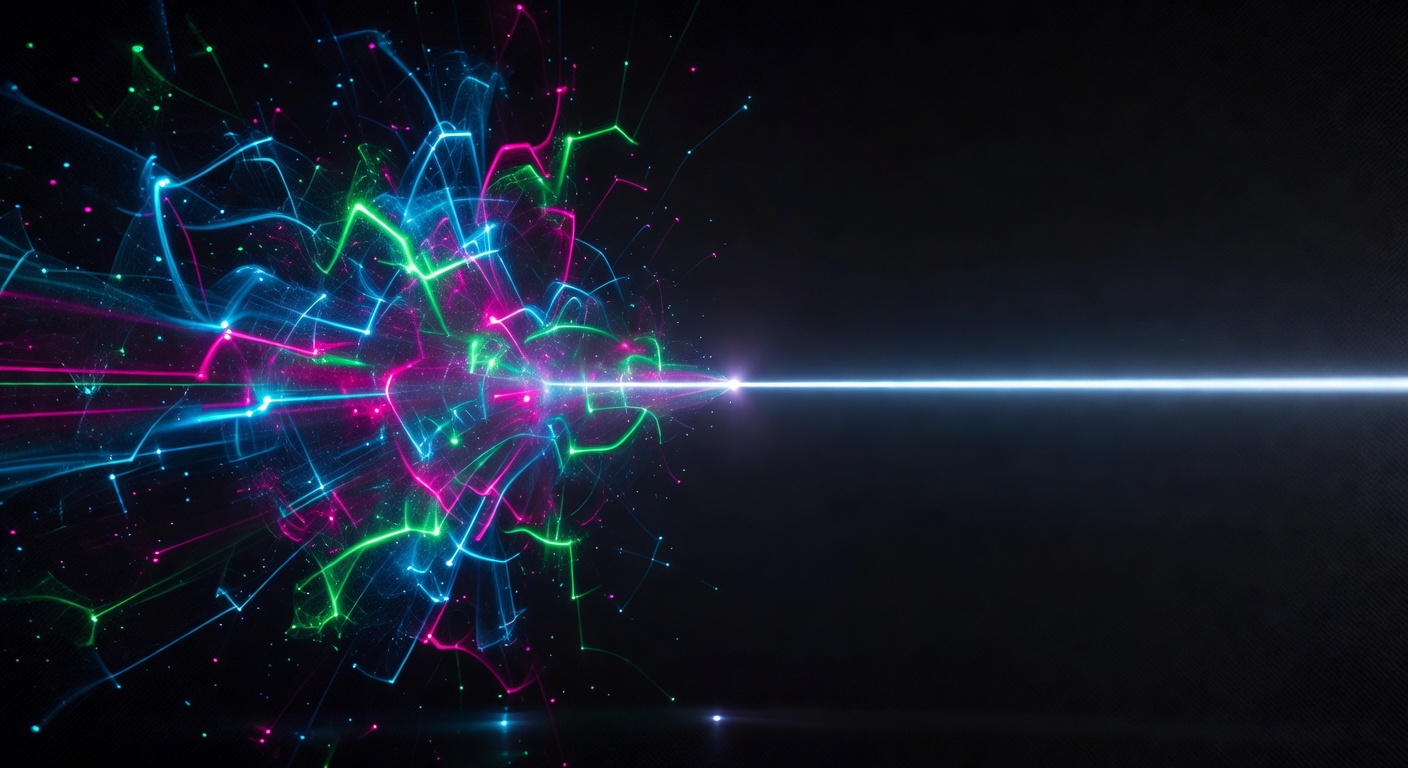
When Messy Laser Light Decides to Be Useful
Here's something that probably seems counterintuitive: sometimes the best solutions come from conditions that physicists have been actively avoiding for years.
MIT researchers just stumbled onto one of those delightful surprises. They were experimenting with laser light traveling through fiber optic cables—the kind of setup that's supposed to get messier and more chaotic as you pump more power through it. But something unexpected happened instead. The light basically said "nah, I'm going to organize myself," and spontaneously formed an incredibly sharp, focused beam.
It's the kind of thing that makes scientists do a double-take. One team member, Sixian You, put it perfectly: everyone in the field just assumed that cranking up the power would turn the light into chaos. Turns out that assumption was incomplete.
The Accident That Almost Didn't Happen
The discovery came when researchers gradually increased the laser power in a device designed to shape and control light in fiber optic cables. They were testing the limits, and something surprising occurred right at the edge of where the fiber might get damaged.
Instead of scattering into a confused mess, the light suddenly concentrated into what physicists call a "pencil beam"—super thin, incredibly sharp, and surprisingly stable.
The really interesting part? This happened in a totally ordinary fiber optic cable. There wasn't any fancy custom engineering involved. Just the right combination of precise alignment and sufficient power created conditions where the light's natural nonlinear properties balanced out all the inherent disorder in the fiber.
"You could actually do this without being an expert," You noted. That's code for: this isn't some finicky lab trick that only works once per year under a full moon. It's reproducible, and that matters.
Why This Actually Matters for Your Brain
So we've got cleaner laser beams. Cool. But here's where it gets genuinely exciting.
Researchers used this self-organized pencil beam to image the blood-brain barrier—basically the bouncer at the brain's front door. This barrier keeps out harmful substances but also blocks most drugs from reaching brain tissue. It's a huge problem in treating diseases like Alzheimer's and ALS.
Normally, studying how drugs cross this barrier requires taking a bunch of 2D slices one at a time. It's slow and gives you incomplete information. With this new method? They created detailed 3D images about 25 times faster while maintaining the same image quality.
Even cooler: they can now watch individual cells actually absorbing drug molecules in real time. Instead of guessing whether a treatment reaches the brain, scientists can literally watch it happen.
The Hidden Lesson Here
What I find most interesting about this discovery isn't just the technical achievement—it's the attitude behind it.
The researchers didn't dismiss an anomalous result because it contradicted expectations. Instead, they investigated it. They figured out the conditions that made it work. They didn't need to invent something entirely new; they just needed to understand what was already possible when you looked at the problem differently.
In a world where we're often told that "best practices" are fixed, this is a refreshing reminder that sometimes the best breakthroughs come from asking "wait, what if we did it the way everyone said not to?"
And in this case, letting light organize itself might just help unlock new treatments for some of our most challenging brain diseases.
Source: https://www.sciencedaily.com/releases/2026/04/260428045542.htm