
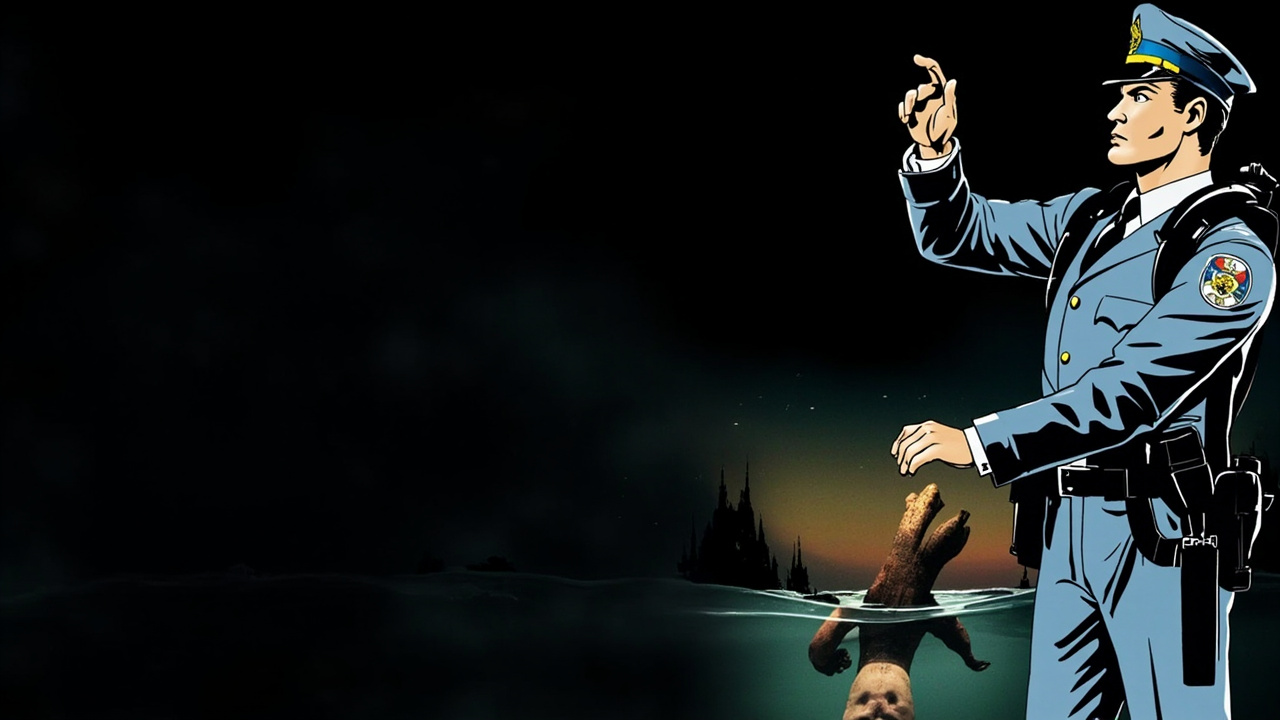
When Police Officers Went Full Frogman: A 1950s Crime-Fighting Adventure
I stumbled across this absolutely bonkers story from 1956 about Seattle cops who literally became underwater detectives, and I had to share it because it's such a wild slice of police history that nobody talks about anymore.
The Accidental Birth of an Underwater Police Unit
Picture this: It's the mid-1950s. A car loaded with stolen Army rifles gets ditched in Hicks Lake by panicking thieves. Problem is, it's sitting 30 feet underwater. So what does the Seattle Police Department do? They send Officer Ron Faires down there in a rubber diving suit to literally look inside the sunken car and confirm the stolen goods are actually there.
This wasn't some specialized, well-funded police division with fancy equipment. It started because Faires just... liked diving. It was his hobby. Then a couple of other officers got interested, and suddenly you've got three cops who wanted to wear diving gear as part of their job. And somehow, this actually caught the attention of the police chief, who thought, "You know what? This is actually useful."
Crime Gets Wet
Here's what blew my mind about this story: the police chief was 100% right. In a city surrounded by water—Seattle sits on all sides near lakes and the Sound—criminals were literally just throwing evidence into the water and assuming it was gone forever.
A murder weapon? Into the lake. A looted safe? Into the water. It's the perfect crime scene coverup... except when you've got guys in diving suits who can actually go down there and find stuff.
The captain running this unit explained it perfectly. People can hide things underwater just like you'd hide chewing gum under a movie theater seat. But once you know roughly where to look, a trained diver with a flashlight becomes basically a superpowered crime solver.
The Darker Side of the Job
Now here's where this story gets genuinely sobering. A huge part of what these frogmen did was recover drowning victims. And Faires talks about this in a way that's surprisingly candid for a 1950s news article.
Families would be waiting—grieving, desperate, unable to move forward—until they actually had the body. They needed closure. And these divers had to go down into pitch-black water and find their relatives.
Faires had developed his own coping mechanism: he'd turn off his light before surfacing so he wouldn't have to see what he'd found. That's heavy. That's the kind of emotional toll that doesn't make headlines but should make you respect these people.
A Night on the Job
The article follows Faires through one shift that perfectly captures the chaos of the job. He starts his night writing a speeding ticket, dealing with drunk people in bars, the usual patrol stuff. Then suddenly: "Drowning at Lake Union Dock. Man fell into water stepping from boat to dock. Frogman job... Faires..."
Siren blaring, he races home to grab his diving gear from his car trunk (which he always kept loaded and ready), then heads to the dock. The Harbor Patrol's grappling hooks are stuck in old cable—the kind of thing that could literally strangle a diver.
Faires goes down into the black water at 28 feet, navigating around cables and barbed wire with nothing but a flashlight. And get this—he actually invented his own safety innovation: a pouch full of Ping-Pong balls. If he got trapped, he'd release them and they'd float to the surface as an emergency signal.
Why This Matters (Even in 2024)
Reading this story now is kind of surreal because we're used to police having all kinds of specialized units. But in the 1950s, the idea of having trained divers as part of a police department was radical. It was born out of necessity, enabled by a few passionate people, and formalized because someone in charge actually paid attention.
It's also a reminder that sometimes the most effective solutions come from the simplest observations: "We live near water. Criminals hide stuff in water. What if we trained people to dive?"
The frogman unit eventually became standard in major departments across the country. But it started in Seattle with one guy who just really liked diving and figured out how to make it his job.
Pretty cool origin story if you ask me.