
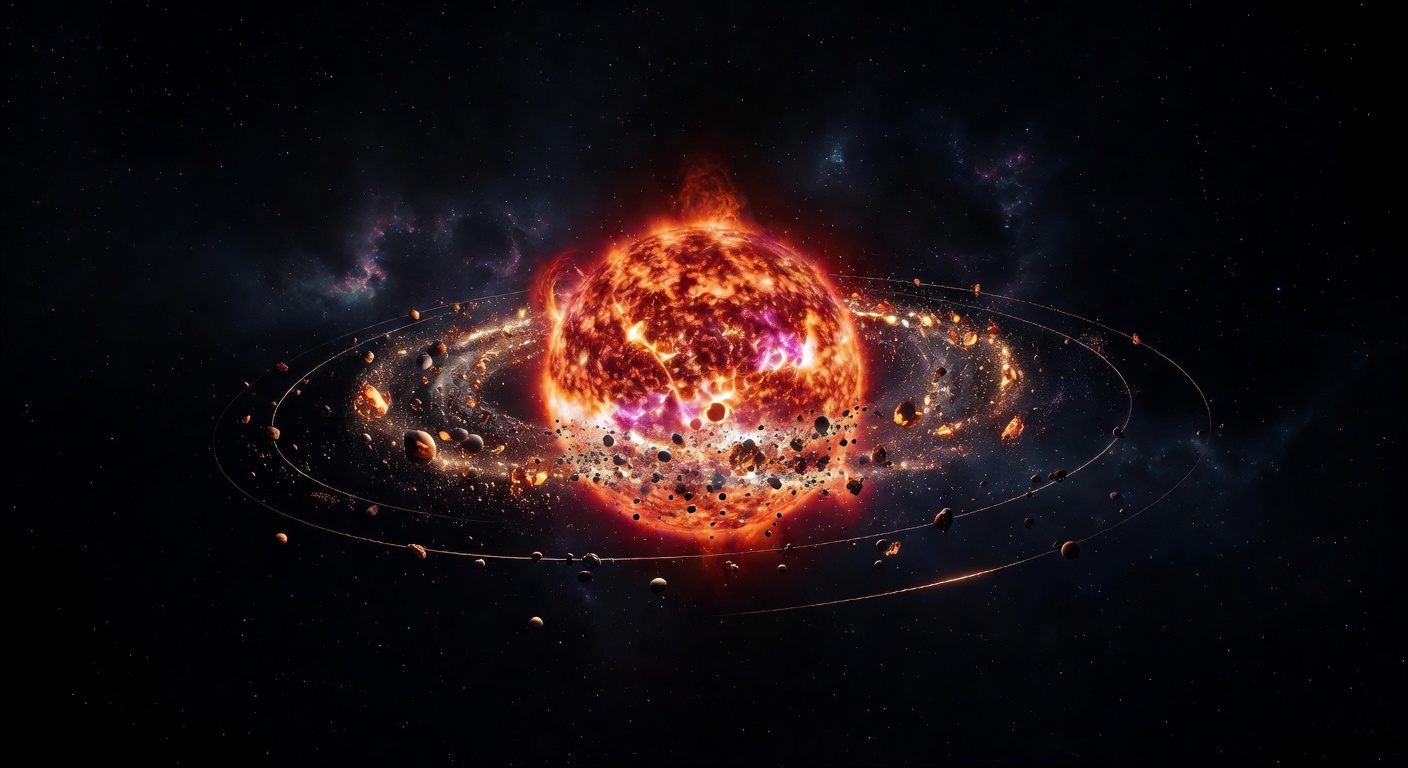
When Stars Eat Their Planets: The Cosmic Version of a Bad Breakup
Have you ever wondered what happens to planets when their host star starts dying? For a long time, this was mostly theoretical—something astronomers debated over coffee and published papers about. But now we have actual evidence, and honestly, it's kind of wild.
The Universe's Most Brutal Demolition Process
Think about it this way: our Sun has been happily hosting its planets for about 4.6 billion years. But the Sun isn't going to last forever. In roughly five billion years, it's going to run out of fuel and transform into what's called a red giant—basically, a bloated, cooling version of itself that will expand dramatically outward.
When that happens, anything orbiting too close? Goodbye.
A new study from researchers at University College London and the University of Warwick has finally given us concrete proof that this cosmic demolition is real, and it's happening all around us right now.
The Detective Work
Here's where it gets interesting. Astronomers looked at data from NASA's TESS satellite—basically a space telescope designed to hunt for planets around distant stars. They sifted through observations of nearly half a million stars that are already in this red giant phase or transitioning into it.
What they found was striking: when they looked for giant planets orbiting close to these aging stars, they found... way fewer than expected. The numbers told a clear story.
- Younger red giants? About 0.35% had close-in giant planets
- Older, more evolved red giants? Only 0.11% had them
That's a huge drop. All those missing planets? They didn't just move elsewhere in the solar system. They got pulled in and destroyed.
It's Not Magic—It's Tidal Interaction
The culprit behind this cosmic destruction is something called tidal interaction, and it's the same phenomenon that keeps our Moon pulling at Earth's oceans to create tides.
Here's what happens: As a star expands and grows larger, it exerts an increasingly powerful gravitational pull on nearby planets. This isn't a sudden snap—it's more like a slow, inexorable drag. The gravitational tug-of-war gradually slows the planet down, shrinking its orbit bit by bit, until eventually it spirals into the star's atmosphere and gets obliterated.
The researchers were actually surprised by how efficient this process is. These dying stars are essentially cosmic vacuum cleaners, systematically erasing their inner planetary systems.
What Does This Mean for Us?
Okay, here's the part that made me sit back in my chair: Earth isn't necessarily safe from what will happen to our Sun.
In a few billion years, when our Sun becomes a red giant, it will expand outward significantly. The giant planets in our solar system—Jupiter, Saturn, Uranus, and Neptune—will be at serious risk. They orbit relatively close to the Sun (in cosmic terms), which means they could easily get pulled in.
Earth, on the other hand, orbits much farther away than those gas giants. Based on current evidence, it might actually survive the Sun's red giant phase. But here's the catch: life as we know it almost certainly won't. You don't need to obliterate a planet to make it uninhabitable—just expanding and heating up is plenty.
As one of the researchers put it, Earth might survive, but us? Not so much.
Why This Matters
This discovery does more than just give us a sobering reminder about our place in the universe (though it definitely does that). It fundamentally changes how we think about planetary systems and their lifespans.
For decades, scientists wondered: do these close-in planets really get destroyed as stars age, or do they somehow survive? Now we have our answer, and it's definitive. We're not just looking at one or two examples—we're seeing the pattern across hundreds of thousands of stars. That's powerful evidence.
It also raises interesting questions about exoplanets we've discovered elsewhere. Many of the giant planets we've found orbit unusually close to their host stars. Does that mean we're predominantly finding younger planetary systems? Are the older ones already past the point where those planets exist? These are the kinds of follow-up questions that'll keep astronomers busy for years.
The Silver Lining
If there's anything remotely positive about all this cosmic destruction, it's that Earth has time. We're not talking about something happening next century or even in the next million years. We've got roughly five billion years before the Sun becomes a red giant at all.
That's incomprehensibly long—far longer than modern humans have even existed. Whatever civilization inherits the solar system at that point will have plenty of warning and hopefully the technology to deal with it.
For now, we can just appreciate the fact that someone finally cracked what's been one of astronomy's longest-running mysteries. Sometimes the universe is dramatic in the most unsettling ways.