
Okay, I have to admit—this story made me gasp out loud when I first read about it.
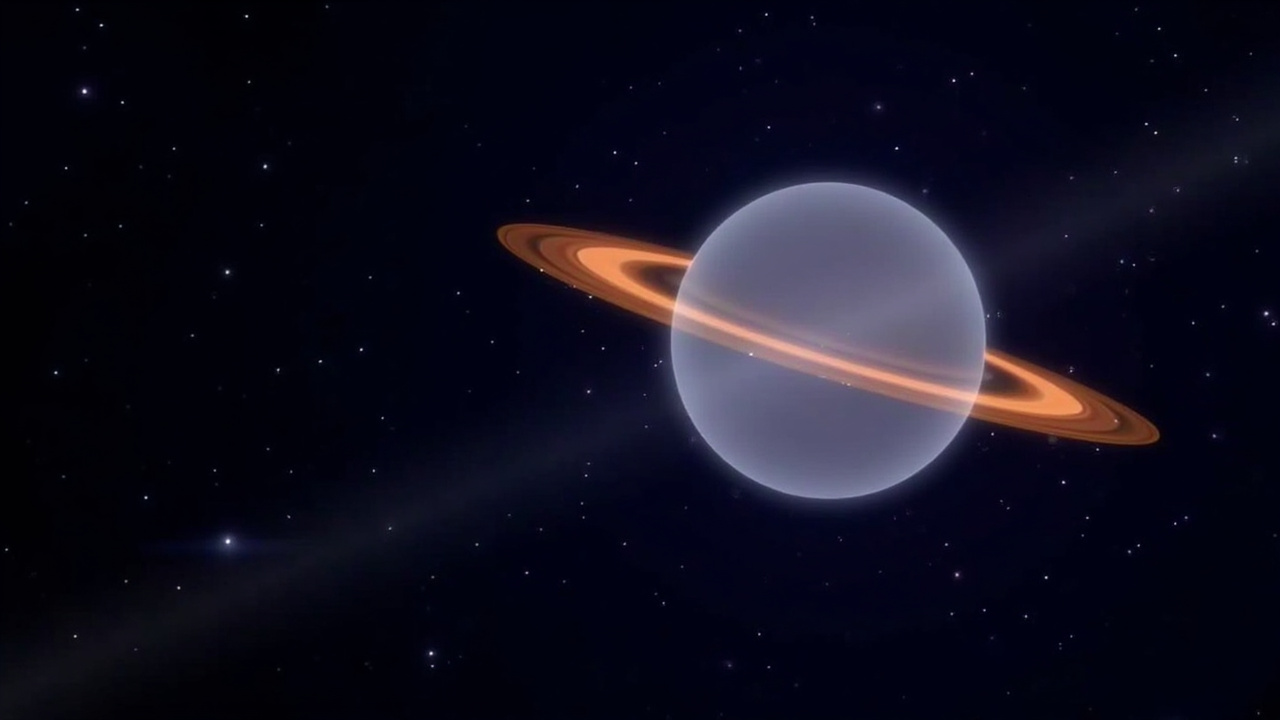
For decades, astronomers have been scratching their heads over Saturn. The planet seemed to be doing something that should be physically impossible: its rotation rate appeared to be changing over time. Not gradually over millions of years like Earth does, but noticeably shifting during human observation periods. That's like watching a spinning top suddenly decide to spin faster or slower while you're looking at it.
The Impossible Observation
Here's the thing: planets just don't do that. Their angular momentum is essentially locked in unless something dramatic happens (like a massive asteroid collision). So when NASA's Cassini spacecraft started measuring Saturn's rotation in 2004 and detected changes, scientists were baffled.
The measurements weren't wrong. But something was definitely making Saturn look like it was changing its spin. And nobody could figure out why.
The First Clue
Jump ahead to 2021, and a team led by Professor Tom Stallard from Northumbria University offered a partial explanation. Their research suggested that Saturn's rotation wasn't actually changing at all—what was changing was how we were measuring it. Specifically, atmospheric winds high above Saturn's visible clouds were affecting electrical signals tied to the planet's aurora, which scientists were using to estimate the rotation rate.
So, case closed, right? Not quite. While this explained the misleading readings, it opened up an even bigger question: what was causing those atmospheric winds in the first place?
That's the mystery that kept scientists up at night.
James Webb to the Rescue
Enter the James Webb Space Telescope—humanity's most powerful eye in the sky. Stallard and his team pointed JWST at Saturn's northern aurora and did something no previous telescope could manage: they watched continuously for an entire Saturnian day.
That's roughly 10.7 Earth hours of unbroken observation, which sounds almost meditative when you think about it.
What were they looking for? A molecule called trihydrogen cation (try saying that three times fast). This little character forms in Saturn's upper atmosphere and acts like a natural thermometer—where it glows brighter, things are hotter. By mapping its infrared emissions, the team created the most detailed temperature maps ever made of Saturn's auroral region.
The improvement in precision was honestly staggering. Previous measurements had uncertainties around 50 degrees Celsius. JWST? It was about ten times more precise. We're talking the difference between "it's hot out" and "it's exactly 87 degrees out."
The Planetary Heat Engine
Here's where it gets really cool (or should I say, really hot?).
The data matched computer models from over a decade ago—but only if the atmospheric heating was coming from exactly where auroral particles were slamming into Saturn's atmosphere. That detail turned out to be crucial.
What the researchers discovered was essentially a self-perpetuating heat engine:
- Saturn's aurora deposits energy into specific regions of the atmosphere
- That heating generates powerful winds
- Those winds create electrical currents
- Those currents help power the aurora
- The aurora heats the atmosphere again
It's a beautiful, self-sustaining loop. Professor Stallard called it "a planetary heat pump," and honestly, that's a perfect description.
Why Should We Care?
Beyond the sheer "wow" factor of understanding Saturn better, this discovery has bigger implications. The team found that Saturn's atmosphere and magnetosphere (the region of space shaped by its magnetic field) are far more interconnected than we realized. The atmosphere influences the space around the planet, which then feeds energy back into the atmosphere. This back-and-forth likely explains why the whole system remains stable over long periods.
And here's the really exciting part: Saturn probably isn't unique. If similar interactions are happening there, they could be happening on other planets too—including ones we're just beginning to study.
As Stallard put it, this changes how we think about planetary atmospheres in general. If atmospheric conditions can drive currents out into space, then understanding what's happening in the atmospheres of distant worlds might reveal connections we haven't even imagined yet.
The Takeaway
We've been watching Saturn for centuries, and it turns out the ringed giant still has secrets to share. The lesson here? Sometimes the strangest observations lead us to the most profound discoveries. Saturn wasn't secretly changing its spin—it was revealing a hidden connection between its atmosphere, its aurora, and the space around it.
And thanks to JWST, we finally got to see the whole picture.