
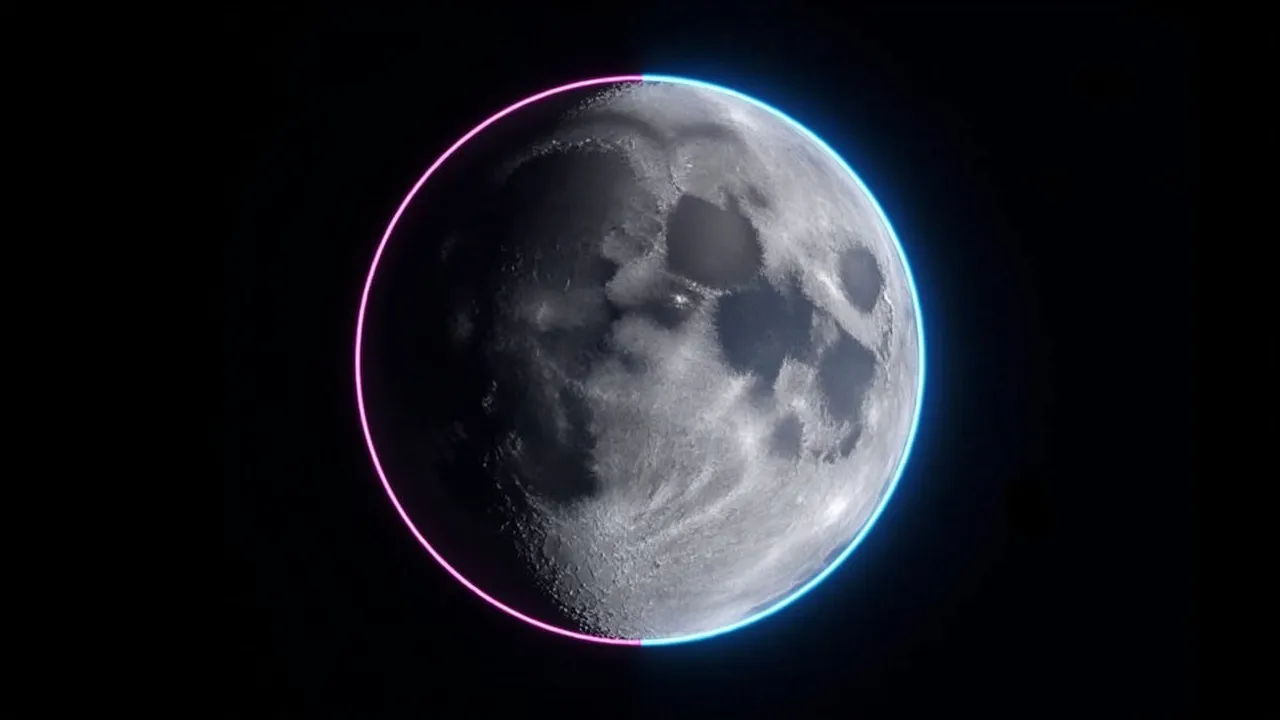
Have you ever noticed that the Moon always shows us the same face? It's true – thanks to something called tidal locking, one hemisphere permanently faces Earth while the other always points away. But here's what's really fascinating: these two sides look completely different.
The side facing us is covered in vast dark plains (those "man in the moon" markings we all recognize), while the far side is rugged, heavily cratered, and largely featureless in comparison. For generations, scientists have wondered what caused this dramatic difference.
Well, folks, we might finally be getting some answers – and they're pretty mind-blowing.
The Moon's Two Faces: A Cosmic Mystery
Let me paint you a picture of just how different these two hemispheres are.
The near side (the one we've stared at for millennia) features those iconic dark volcanic plains we call "maria." These are essentially ancient lava flows that filled in giant impact craters billions of years ago. Scientists also find relatively high concentrations of something called KREEP – potassium, rare earth elements, and phosphorus – which sounds like a space drink but is actually an important chemical signature.
Flip the Moon over, though, and you encounter a completely different world. The far side is dominated by ancient, heavily cratered highlands. The crust there is noticeably thicker, and those dark volcanic plains? They're few and far between.
It's genuinely strange when you think about it. Why would one hemisphere develop so differently from the other? We've been debating this for decades, and honestly, the scientific community has been kind of stuck.
A Game-Changer: Chang'e-6 Lands on the Far Side
Here's where things get exciting. In 2024, China's Chang'e-6 mission accomplished something never done before – it returned rock samples from the Moon's far side. This was a huge deal! Every previous sample return mission (including Apollo) had only collected material from the near side.
For the first time, scientists could directly compare rocks from both hemispheres under controlled conditions. And that's exactly what a research team led by Professor Hejiu Hui from Nanjing University did.
They analyzed three types of lunar rock: anorthosites (the light-colored stuff that makes up much of the lunar crust), Mg-suite rocks (which form when crust and mantle materials interact), and mare basalts (those dark volcanic rocks).
What they found was both surprising and illuminating.
The Deep Mystery: What's Happening Underneath?
You know what the researchers discovered? The Moon's interior might be more similar than we thought.
The basalt samples from Chang'e-6 showed chemical signatures suggesting they came from depleted mantle material – remarkably similar to samples collected from the near side. This is significant because it tells us the mantle cumulates (essentially, the minerals that settled out as the Moon's original magma ocean cooled and crystallized) don't appear to differ substantially between the two hemispheres.
They found supporting evidence in the Mg-suite rocks too. These rocks form through interactions between the crust and mantle, and their magnesium content provides clues about their origins. Both the Chang'e-6 and Apollo samples showed similar values, leading the team to conclude that the mantle beneath both sides shares broadly similar chemical characteristics.
In other words, the Moon's "heart" might be pretty much the same on both sides. The differences are concentrated closer to the surface.
The Crust Tells a Different Story
And that surface? That's where things get really interesting.
The anorthosite samples from Chang'e-6 showed higher magnesium content than comparable Apollo samples from the near side. This suggests the far side's crust contains more magnesium-rich material – something that earlier remote observations had hinted at but couldn't confirm.
The differences in Mg-suite rocks were even more striking. The far side samples contained extremely low concentrations of rare earth elements and had different chemical ratios than their near-side counterparts.
This suggests two possibilities: either the Mg-suite magmas on the far side formed without much involvement from KREEP-rich materials, or that layer of elements developed unevenly across the Moon, leaving the two hemispheres with different chemical fingerprints.
Earth's Surprising Influence
Now here's where it gets really cool – and where the research team developed their explanatory model.
The scientists propose that early in the Moon's history, when it was still a ball of molten magma, the cooling and crystallization process was relatively uniform. The first mantle cumulates and anorthositic crust formed before the Moon became tidally locked to Earth.
But once the Moon settled into its current orbit, with the same face always pointing toward us, everything changed. Earth and the Moon were much closer together back then (the Moon is slowly drifting away, about an inch and a half per year). With Earth looming large in the sky, gravitational tidal forces created heat within the Moon.
This heat-driven circulation within the ancient lunar magma ocean likely shaped the dramatic differences we see today. The near side, more influenced by Earth's gravity, may have developed differently than the protected far side.
Think of it like this: imagine you're cooking something in two different pots, but one pot is being gently stirred by an invisible hand while the other sits still. Even if you started with the same ingredients, you'd end up with different results.
Why This Matters
I find this whole story genuinely exciting because it touches on something deeply human – our need to understand our place in the cosmos.
The Moon has been our constant companion for 4.5 billion years. We've gazed at it, named its features, and even walked on it. And yet, it still holds mysteries waiting to be solved.
What's particularly fascinating to me is that this new research came from actual rock samples. We can theorize and model all we want, but having physical material to analyze – from both sides of the Moon, no less – brings us closer to understanding the truth.
The Chang'e-6 mission represents something remarkable: it's allowing scientists to finally test hypotheses that have existed for decades. Each new mission and sample return brings us closer to solving these cosmic puzzles.
What's Next?
Of course, science rarely provides neat, final answers. This research raises new questions even as it answers old ones. How exactly did the tidal forces influence crystallization? What other secrets might the far side be hiding?
But that's the beauty of science – it's an ongoing journey of discovery. And personally, I can't wait to see what we learn next about our mysterious lunar neighbor.
Next time you look up at the night sky and see that familiar face of the Moon, remember: you're looking at a world shaped by heat, gravity, and billions of years of cosmic evolution. And thanks to missions like Chang'e-6, we're finally beginning to understand how it all came to be.