
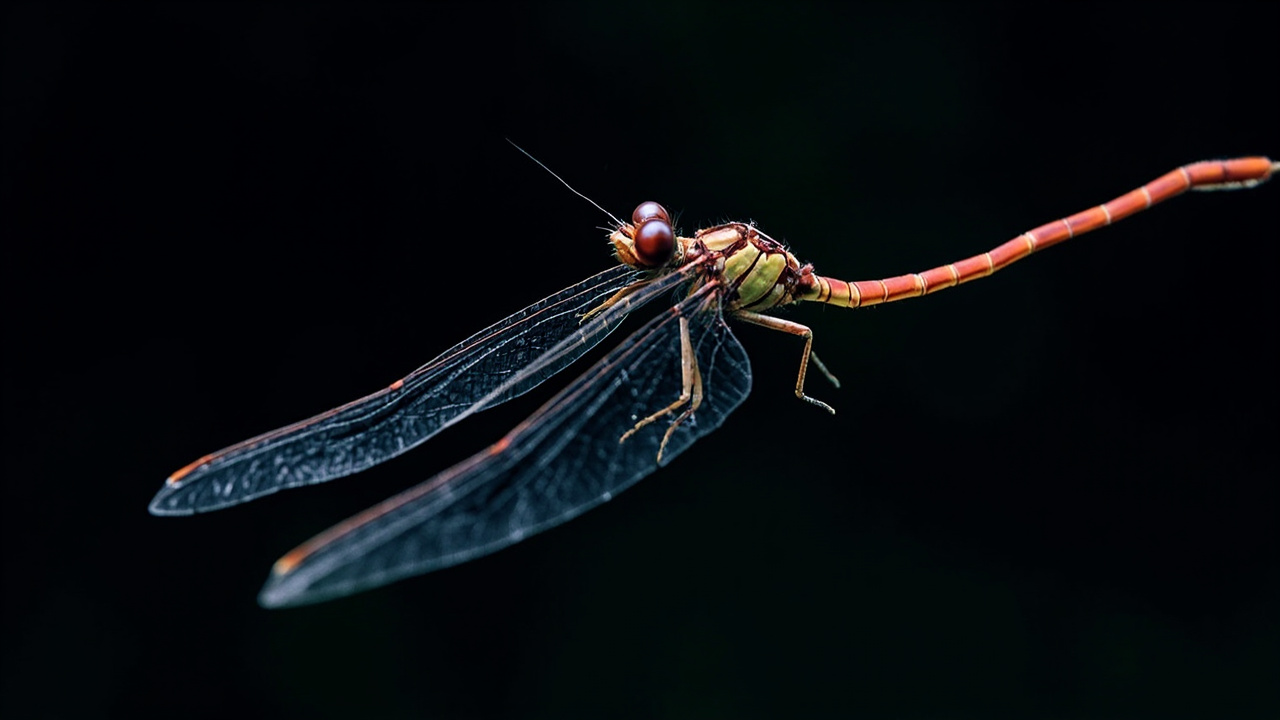
The Giant Bug Mystery That Won't Go Away
Picture this: it's 300 million years ago, and you're walking through a swampy forest. Suddenly, a dragonfly the size of a hawk buzzes past your head. Not a metaphor—an actual insect with a wingspan of 27 inches. Terrifying, right?
These creatures actually existed, and for the longest time, we thought we had the answer to why. But here's the thing about science: sometimes the answers we're most confident about turn out to be totally wrong.
The Story Everyone Believed
Back in the 1990s, scientists had what seemed like a brilliant explanation for these mega-insects. The logic went like this:
Back then, Earth's atmosphere had way more oxygen than it does now—roughly 45% more. Insects don't have lungs like we do. Instead, they have these tiny tubes called tracheoles that branch throughout their bodies and deliver oxygen directly to their muscles. The bigger the insect, the harder it is to move oxygen around through diffusion alone.
So the theory was: more oxygen in the air = bigger insects possible. Simple, elegant, case closed.
This idea stuck around for decades. It became textbook knowledge. Ask a scientist why those ancient dragonflies were so huge, and they'd tell you it was all about the oxygen.
Plot Twist: The Oxygen Might Not Be the Culprit
Fast forward to now. A team led by researcher Ned Snelling at the University of Pretoria decided to actually look closely at how much space these oxygen-delivery tubes take up in insect flight muscles.
Here's what they found: those tracheoles only occupy about 1% or less of the flight muscle space. Even in the giant griffinflies from 300 million years ago, the proportion stays tiny.
Think about that for a second. If oxygen delivery was really the limiting factor for how big insects could get, you'd expect to see insects filling up massive amounts of their muscle space with these tubes. But they're barely using any space at all. It's like having a water pipe that could be twice as thick but choosing to keep it skinny—there's clearly room to expand if you needed to.
The Comparison That Changes Everything
Here's where it gets really interesting. When researchers compared insects to birds and mammals, they found something shocking.
In a bird or mammal's heart, the tiny blood vessels (called capillaries) take up about ten times more space than insect tracheoles do. That's a huge difference. If mammals and birds can pump oxygen to their muscles using vessels that occupy so much more space, why would insects be limited by tubes that barely take up any room at all?
It's a fair point. It suggests that insects could theoretically evolve way bigger tracheoles if they needed to. The fact that they don't hints that oxygen availability probably isn't what's holding them back from growing bigger.
So What's the Real Answer?
And here's where the mystery deepens instead of getting solved.
If it's not oxygen, then what made ancient insects grow so enormous? And more importantly, what made them stop growing that huge? Because these giant insects completely vanished. They didn't gradually get smaller—they just went extinct.
There are other possibilities on the table now. Maybe it was predation from vertebrates that got better at hunting. Maybe the exoskeleton itself has physical limits we don't fully understand yet. Maybe it was a combination of factors we haven't even considered.
Some scientists are being cautious too, pointing out that oxygen might still play a role in other parts of the body or in different ways we haven't tested yet. The jury isn't completely back in.
Why This Matters Beyond Just Bug Facts
What I love about this story is that it shows how science actually works. We come up with our best guess based on evidence, we teach it as fact for a while, and then new tools and new thinking come along and shake everything up.
This isn't a failure of science—it's science doing exactly what it's supposed to do. The oxygen theory made sense at the time. It was testable and seemed to explain the evidence. But better technology and more careful observation revealed it was only part of the story, if it was part of the story at all.
Now researchers have to get creative and figure out what really limited insect size back then. And that's actually way more interesting than having an answer already wrapped up.
The ancient world just got a little more mysterious again.