
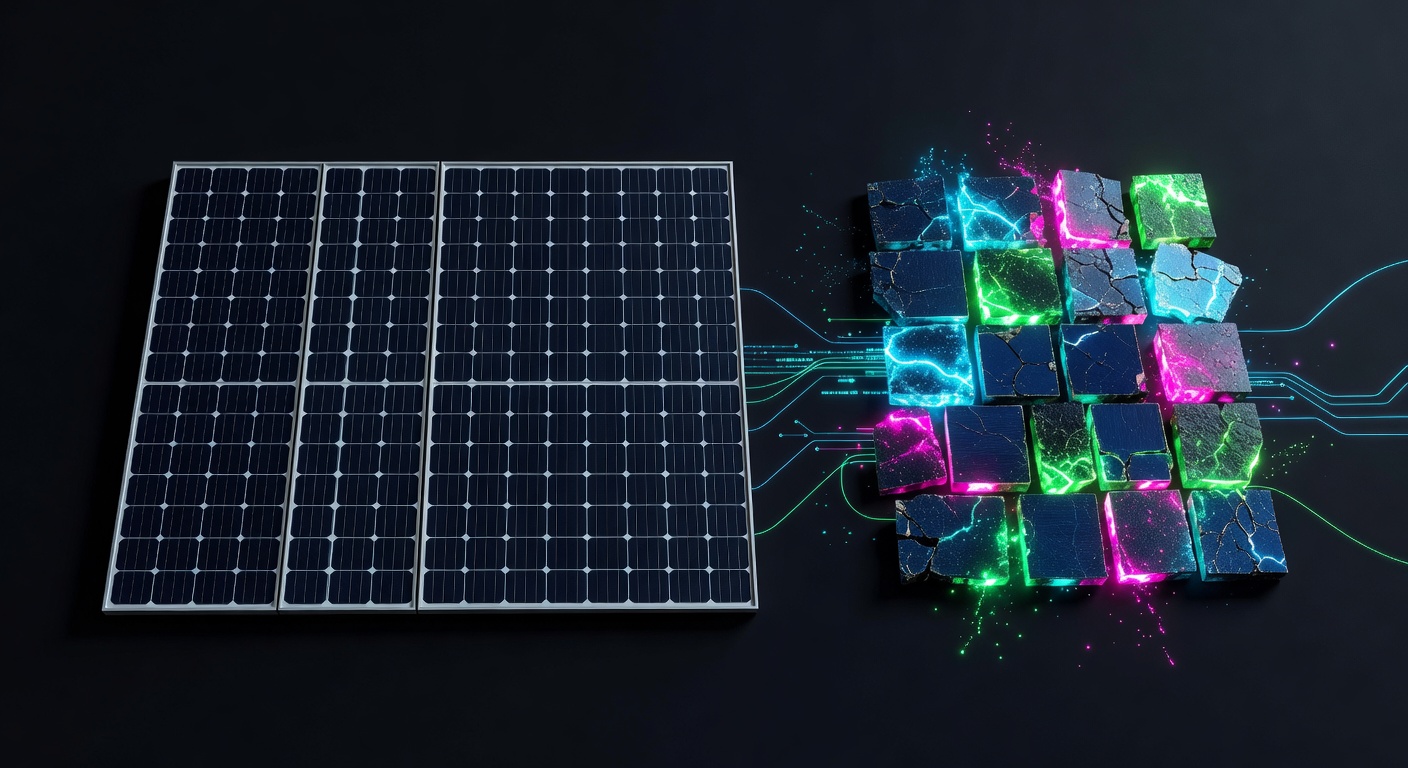
The Weird Truth About "Defective" Solar Panels
Here's something that would make any quality control manager tear their hair out: the best new solar technology works because it's imperfect.
I know that sounds backwards. We're used to thinking that better = more refined, purer, more expensive. But nature doesn't always follow our expectations, and neither do solar cells made from lead-halide perovskites.
Why This Matters (And Why You Should Care)
For decades, silicon solar panels have been the gold standard. They're efficient, they work, and they've gotten cheaper over time. But here's the catch: silicon demands perfection. You need ultra-pure materials, carefully controlled manufacturing, and decades of engineering know-how. It's expensive and complex.
Perovskites, on the other hand, are the scrappy underdogs of the solar world. You can make them in a solution, kind of like you'd make a batch of cookies. They're cheap. They're easier to produce. And yet, they're already approaching silicon's efficiency levels. For years, this had scientists genuinely confused. How is this even working?
The Mystery Gets Solved
Researchers at the Institute of Science and Technology Austria finally cracked the code, and the answer is delightfully counterintuitive.
Unlike silicon, which needs to be basically flawless to function, perovskites thrive with imperfections. The defects and structural flaws in the material actually form networks that act like microscopic highways for electrical charges. Think of it like this: instead of charges getting stuck at random obstacles (like they would in silicon), they have built-in pathways that help them zip through the material efficiently.
It's genuinely wild. The very thing that would tank a silicon panel's performance—having tons of defects—is what makes perovskites so good at converting sunlight into electricity.
How Do These "Highways" Actually Work?
When sunlight hits a solar cell, it knocks electrons loose, creating pairs of negatively charged electrons and positively charged "holes." These particles need to reach the electrodes to generate electricity. On a human scale, this is like having to travel hundreds of kilometers without getting lost or trapped.
In silicon, the solution is brute force: eliminate every possible defect so charges can travel freely. In perovskites, nature took a different approach.
The researchers discovered something fascinating: internal forces within the material actively push electrons and holes apart, preventing them from recombining too quickly. These forces aren't random—they're concentrated at specific regions called "domain walls" where the crystal structure is slightly different. These domain walls create an interconnected network throughout the material, essentially creating charge-separation zones.
When the team tested this by injecting charges deep into the material, they found a consistent electrical current flowing in the same direction—without even applying any external voltage. That's the hidden force at work.
What Does This Mean for Your Future Energy Bill?
This isn't just cool physics trivia. This discovery could legitimately transform the solar industry.
If perovskites can match silicon's efficiency while being cheaper and easier to manufacture, they could make solar panels even more affordable. Imagine solar becoming so cheap that more rooftops have panels, more communities go solar, and renewable energy becomes the obvious choice instead of the aspirational one.
The research also opens doors to other applications. Perovskites are already showing promise in LEDs, X-ray detection, and imaging technology. If we understand what makes them tick, we can optimize them even further.
The Bigger Picture
What I love about this discovery is that it reminds us that perfection isn't always the goal. Sometimes nature has figured out a better solution—one that's not just more efficient, but also simpler and cheaper. We just needed to look at it the right way.
Silicon solar cells taught us about precision and refinement. Perovskites are teaching us about working with nature's imperfections rather than against them. And in a world desperate for clean energy solutions, that's exactly the kind of creative thinking we need.
The next generation of solar panels might not be the most pristine. But they'll be efficient, affordable, and accessible—and honestly? That's way more beautiful than perfection.