
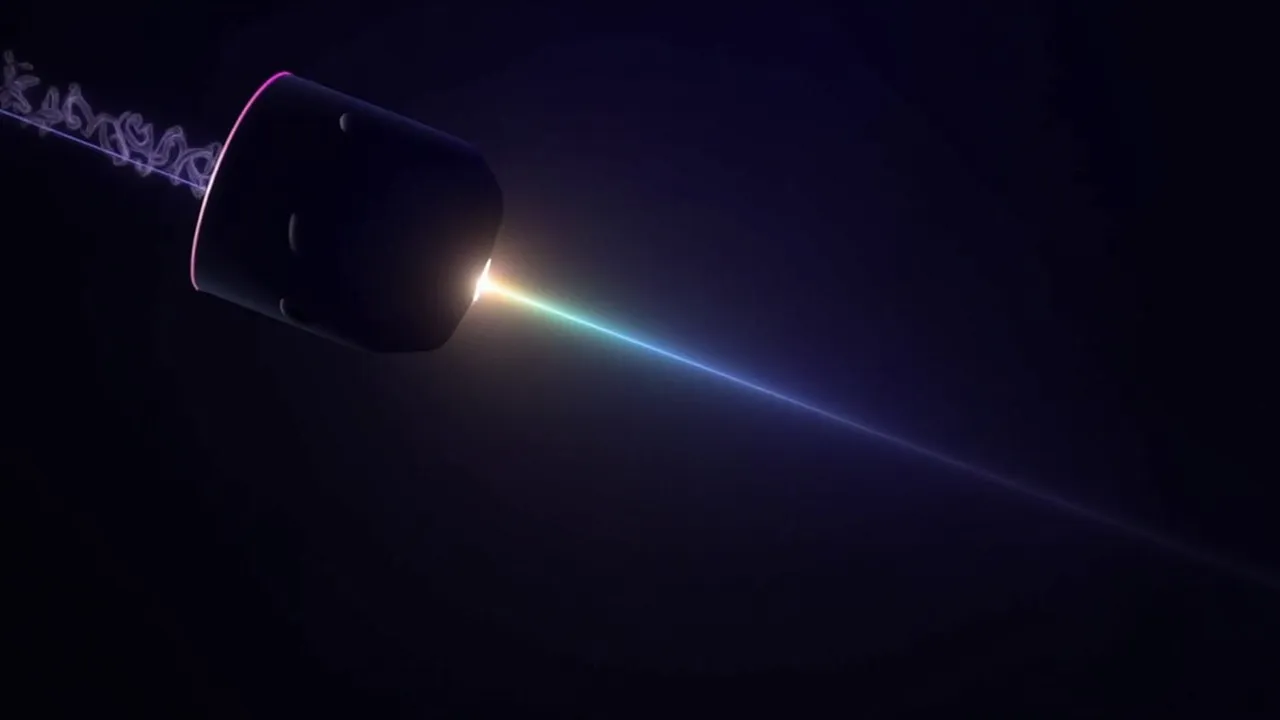
Have you ever looked up at the night sky and wondered what's actually raining down on us from all those distant, violent events out there? Spoiler alert: a lot more than you'd think.
Here's something that genuinely amazes me. Right now, as you read this, thousands of tiny particles from space are passing through your body. You can't see them, can't feel them, can't hear them. They're just... there, silently zooming through everything.
These particles are called muons, and they're created when cosmic rays — incredibly energetic particles blasted out from supernovae and other cosmic cataclysms — slam into atoms high up in Earth's atmosphere. The resulting particle shower includes muons that can travel through the atmosphere, through walls, through rock, and yes, through you, without causing any damage.
Pretty wild, right?
The Problem With Detecting the Undetectable
Here's the thing: scientists have known about muons for decades. They've even used them for some seriously cool applications — like in 2016 when researchers used muon detection technology to discover a hidden corridor inside the Great Pyramid of Giza. That's right, we found a secret room in one of the ancient wonders of the world using particles from space.
But here's the rub. Traditional muon detectors are... well, let's just say they're not exactly user-friendly. We're talking about racks of electronics the size of a small bookshelf, costing serious money, and requiring serious expertise to operate.
This means two big problems:
- Researchers are limited in the kinds of experiments they can run
- Students rarely get hands-on experience with this fascinating physics
It's hard to get excited about particle physics when the equipment looks like it belongs in a 1980s computer room.
Meet CosmicWatch: The Little Detector That Could
Enter Spencer Axani, a physics professor at the University of Delaware who decided to flip the script.
Axani and his team developed CosmicWatch — a muon detector roughly the size of a box of animal crackers. And here's the kicker: it costs around $100 to build.
The device is beautifully simple. It flashes and counts whenever a muon passes through it. You can store the data and analyze it later. It's portable, it's affordable, and it's been a total game-changer.
"CosmicWatch detectors allow us to do far more physics at a dramatically lower cost, in a compact and portable form, opening the door to many new kinds of experiments and outreach opportunities." — Spencer Axani
From Antarctica to the Classroom
The story gets even better. Axani first created CosmicWatch back in 2017 when he was a graduate student at MIT. His original goal? Build a compact detector for the IceCube observatory in Antarctica — you know, that massive underground neutrino detector buried under a mile of ice.
The technology evolved from there. Axani realized the same principles could make particle physics accessible to everyone, from high school students to citizen scientists.
Now, students at UD assemble these detectors themselves. They learn about high-speed electronics, design their own experiments, and actually get to "see" cosmic particles in real time. How cool is that?
Why This Matters More Than You Might Think
Okay, I know what you might be thinking. "That's neat, but why should I care?"
Here's why this actually matters: muons can tell us about some of the most powerful events in the universe — supernovae, gamma-ray bursts, blazars. By measuring muons, scientists can figure out properties of the original cosmic ray, including its energy, mass, and where it came from.
And get this — muons actually helped confirm Einstein's theory of special relativity! Back in the 1940s, measurements of these particles provided one of the first experimental proofs of relativity. Not bad for something you can't even see.
What's Next for CosmicWatch?
The latest version (CosmicWatch 3.0) recently dropped, and it's more capable than ever. The new detector can monitor its surroundings, handle high radiation levels, and gather data faster.
Researchers are now using CosmicWatch in serious experiments too. It's being used to calibrate large-scale dark matter detectors and even in experiments searching for the mysterious particles that might make up dark matter.
And here's where it gets really exciting: scientists are working on a version that could measure cosmic rays aboard rockets and spacecraft. Imagine what we might discover with an affordable, portable particle detector floating through space!
What's the Point?
Here's what gets me about this story. For decades, studying cosmic particles was locked behind expensive equipment and specialized knowledge. Now, a $100 device smaller than a cereal box is democratizing physics in a way we've never seen before.
The next great discovery about our universe might come from a high school student with a CosmicWatch in their garage. And honestly? I wouldn't bet against it.